

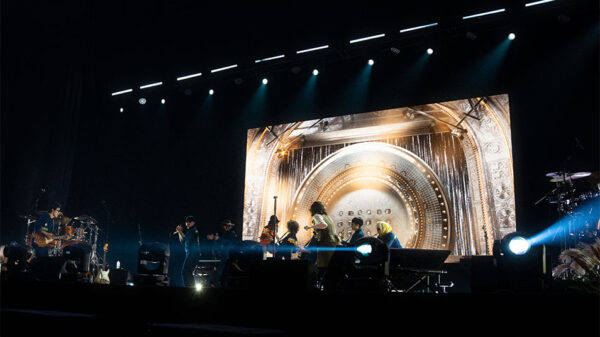






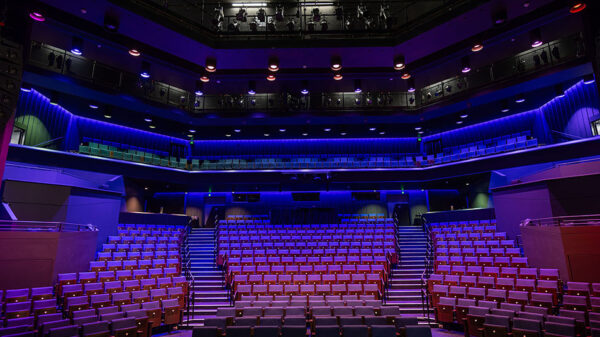
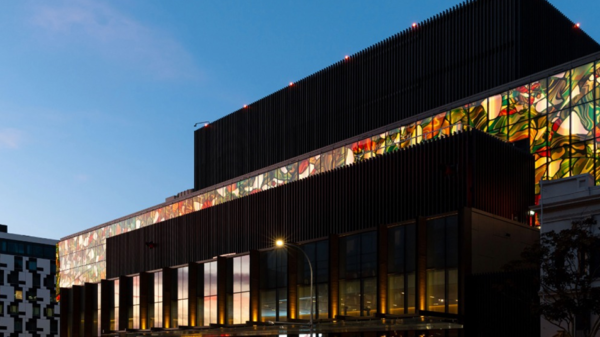
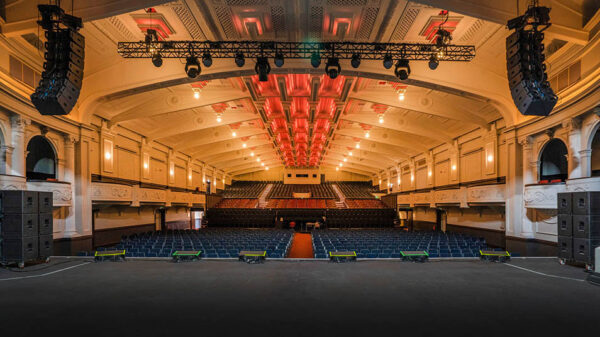


As attendees entered Sydney’s TikTok Entertainment Centre, gentle birdsong played from the stage, setting a tranquil mood—an intriguing prelude to the vibrant spectacle that awaited them.
It would be difficult to find a current production more ambitious than David Byrne’s ‘Who Is The Sky?’ tour. Byrne is recognised as an innovator and an insightful commentator on contemporary life. His artistic expertise has been comprehensively integrated into this new show.
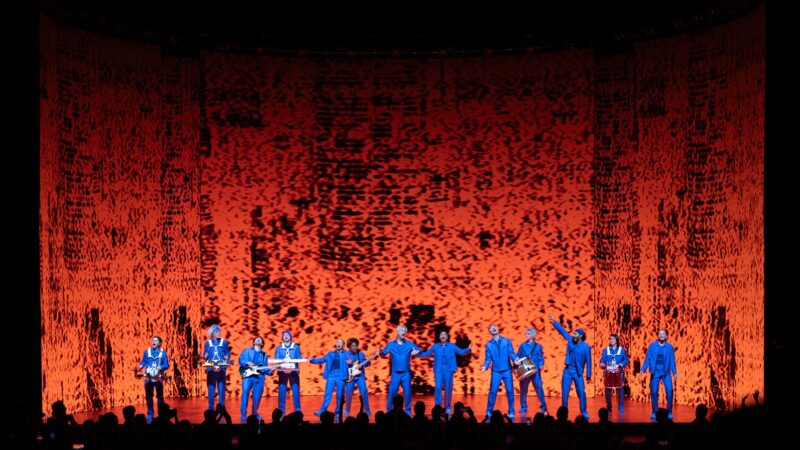
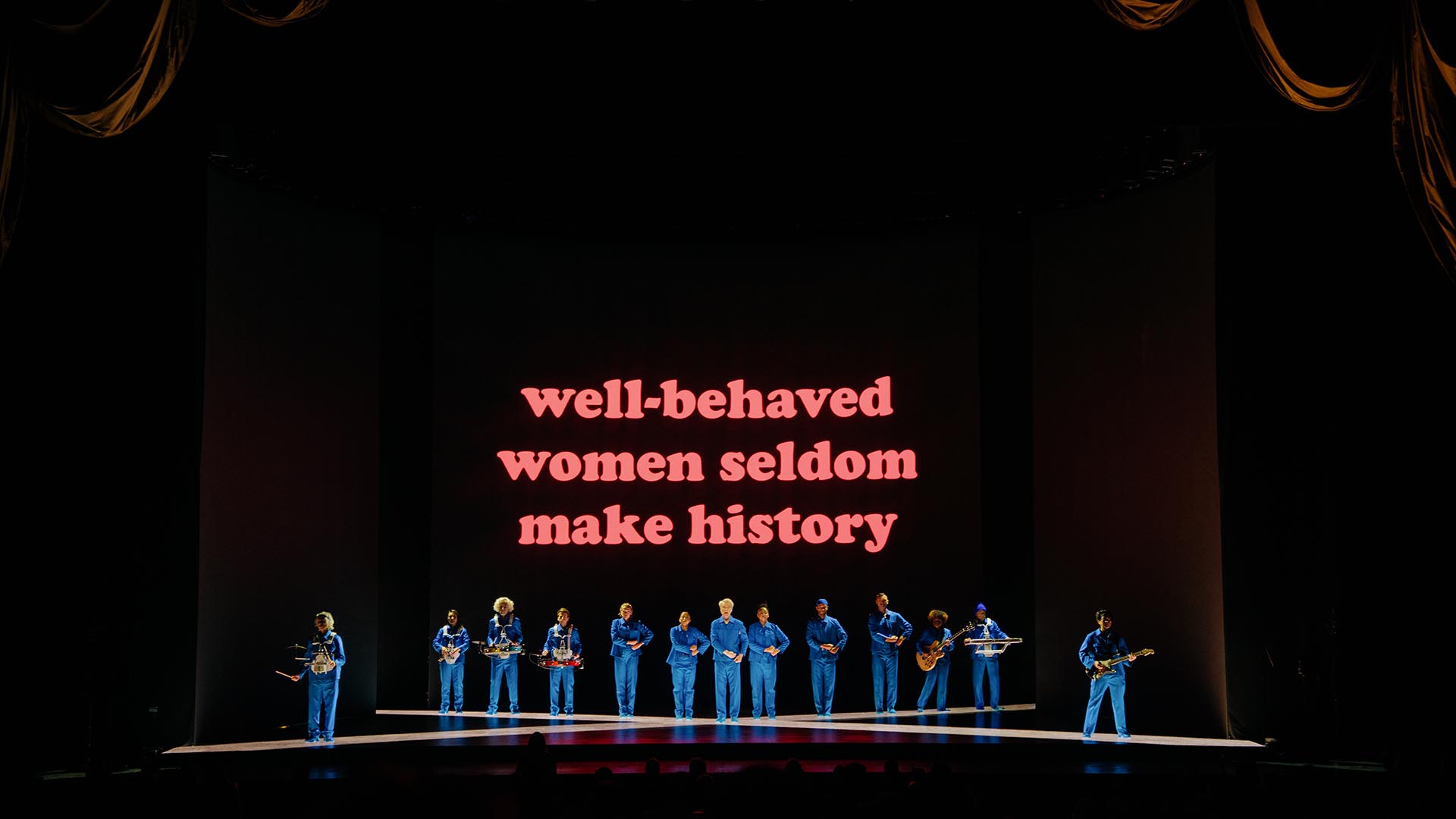
The stage is wide open, with no amplifiers, microphones, or typical live performance equipment to fill the space. This allows all 14 people on stage to perform more like a marching band. With nothing tied down, everyone is in perpetual motion.
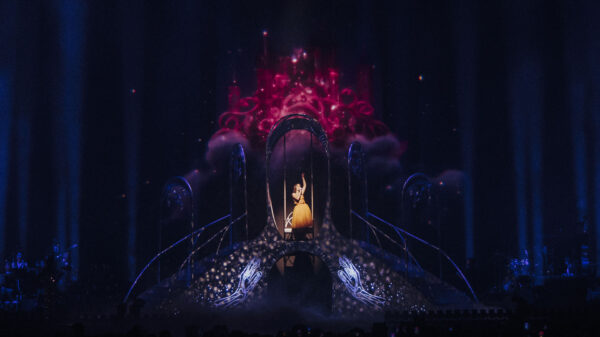
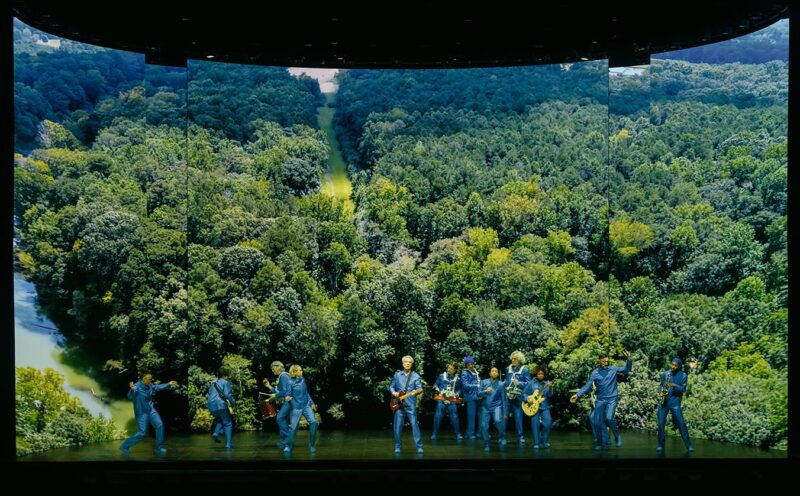
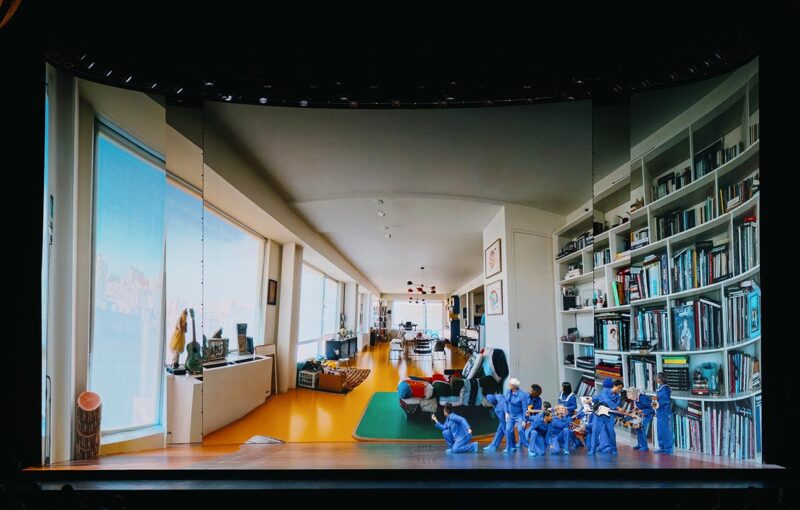
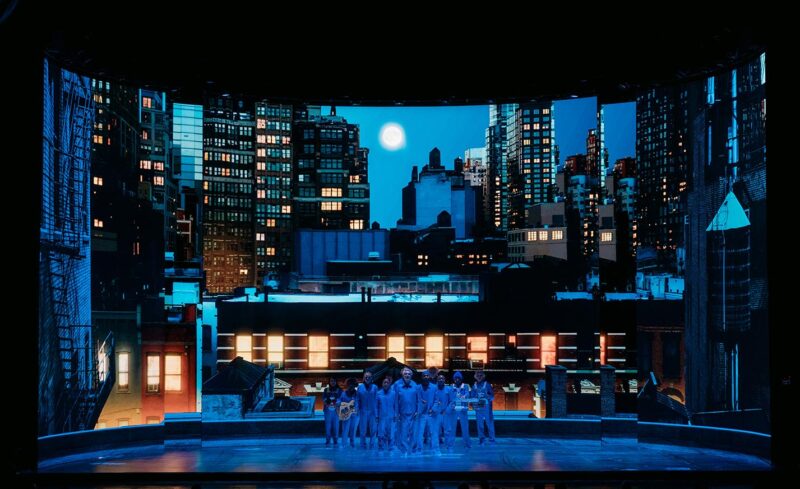
It is a concept first explored by Byrne on his American Utopia tour, but this time, an LED floor was added, making the environment even more immersive. One minute, everyone is in an empty department store, then a lush forest, in Byrne’s apartment, in the ocean or contemporary America.
“David didn’t want to go backwards but wanted to explore what would happen if each song in the show had a sense of place,” explained Rob Sinclair, Show/Lighting Designer. “We talked a little about what had and hadn’t worked, but we were also aware that we were creating something new. David always wanted the space to be a curved volume, and he is very involved from the first sketch to the last cue. David is so aware of production and is also a great collaborator. He’s always willing to hear your point of view.”
Sinclair says that the initial concept for the show was pretty much as you see it now, with the only challenges being the usual: money, space, and time.
Key to Sinclair’s design is the use of BlackTrax; with up to 14 people on stage, all moving and wearing identical suits, you can’t possibly even consider lighting the show with regular spotlights. BlackTrax was the only choice, and Sinclair notes that it’s been a real joy to integrate it with video on this show.
“I think one of the things about light is that you can never master it,” says Sinclair. “I learn new things from light every day. A video wall is just a light. It sheds into the scene and affects how you see things. It would be foolish to look at it any other way.”
The contrast between the minimalistic stage and the impressive visual presentation creates a powerful sensory impact. Additionally, the audio quality is exceptionally clear.
There is significant technology integration in the show, much of which goes unnoticed by the audience. This subtlety demonstrates that the technology is functioning effectively without causing distraction.
Each show requires tremendous effort from the crew to ensure everything runs smoothly, and their commitment is outstanding.
LIGHTING
Thorough preparation was key to this tour, and with a history in theatre lighting, Lighting Director Aaron Veness is particularly suited for a concert that leans heavily towards theatre.
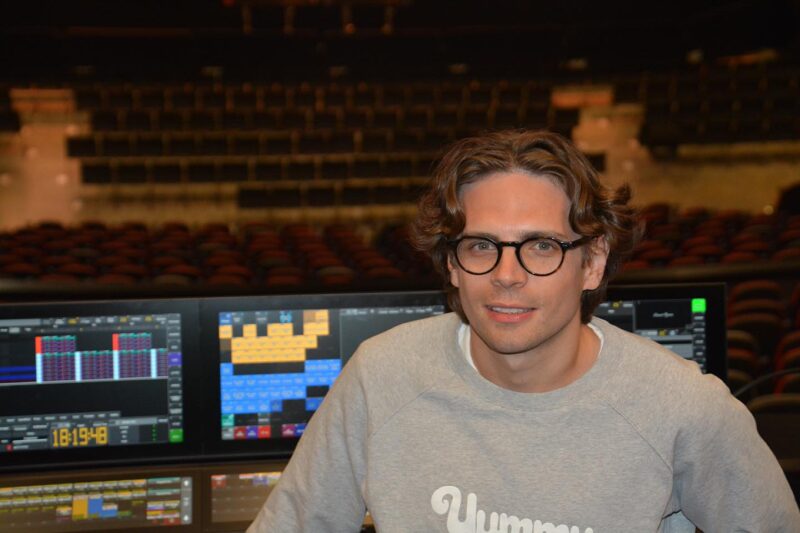
Pre-viz was done in New York early in the process and, according to Veness, was much more detailed and precise than a typical rock-and-roll performance.
“We’re very much looking at the choreography and video content with lighting there to support it and highlight certain elements,” he added. “Almost every day, David would come into pre-viz, and we’d review in what direction we thought songs would be going.”
Joe Watrach programmed the bulk of the lighting, whilst Veness kept track of choreography notes and which BlackTrax fixtures to consider throughout the process. They then moved to Rock Lititz for full rehearsals.
“This show has been more preparation and a lot more fine-tuning of key light levels and colours,” he elaborated. “Deciding that actually in this song we’re going to have three cues rather than doing all the hits and the stabs because it doesn’t need it.”
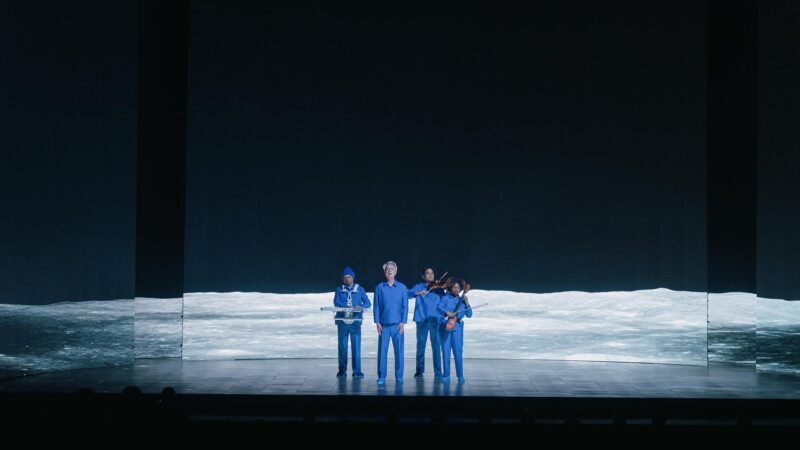
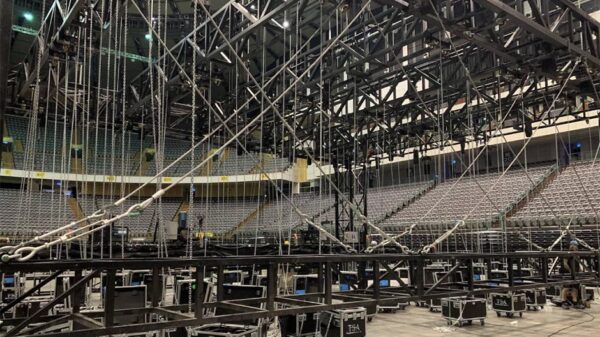
At first glance, the lighting appears quite minimal for such a large space. Four straight trusses housed 15x Martin MAC Viper XIP, 13x Prolight ECLPanel TWC, and 18x Chauvet Strike M, whilst 34x Ayrton Rivale Profiles were located around the top of the video screen, and two more sat on the floor for cross-light. However, many of the show’s intricacies come from balancing the lighting to support the show rather than make it an element of it.
The Rivales were used for back and top light, the MAC Viper XIP keylight, and the Strike Ms were used mainly in the latter part of the show to provide a few rock and roll stabs and flashes.
It is fair to say that the lighting is often about what’s not lit as much as what is. The show Rob has created is split into four sections, and the first two focus on negative space, with light or shapes of light on top of the video, allowing people to enter and exit to add texture to what would otherwise be a flat video wall.
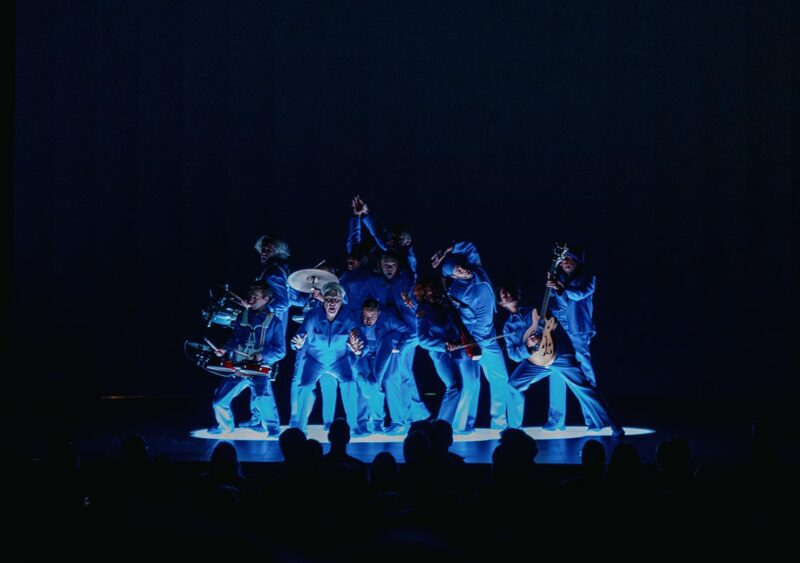
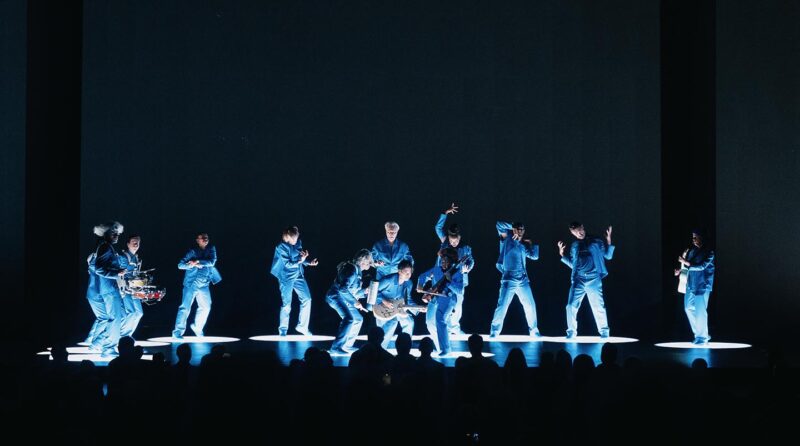
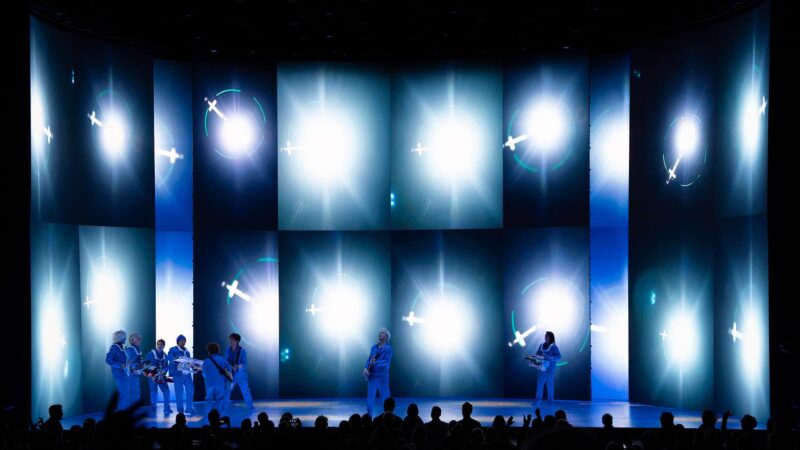
The performance of Psycho Killer has everyone talking. It’s also Veness’ favourite number, which is amusing, as it has the fewest lights in it. With the assistance of BlackTrax, the 14 people on stage are almost entirely lit from beneath by circles of ‘light’ from the video floor, mimicking spotlights. That doesn’t mean Veness sits back and has a cup of tea; he also triggers all the videos from the grandMA3 console.
No time code is used by Veness; all video and lighting cues are triggered from the lighting desk to keep everything in sync.
“It’s a bit weird because I have cues that don’t do any lighting, just video,” remarked Veness. “It took a little bit of getting used to, but I think I’m on the right track. Having BlackTrax has opened up a whole new world of possibilities. It gives me the ability to light anyone at any time, which, again, opens a world of options when you’ve got 14 people on stage. We can also track them with video.”
BLACKTRAX
Sam Augustus has built a solid reputation as a freelance BlackTrax engineer and is sought after for his talent, having worked on tours by Muse, Drake, Queen + Adam Lambert, and Peter Gabriel. On this tour, the BlackTrax system is supplied by Dark Art Creative. The previous American Utopia tour utilised BlackTrax, so Byrne and Sinclair were familiar with it and keen to use it again.
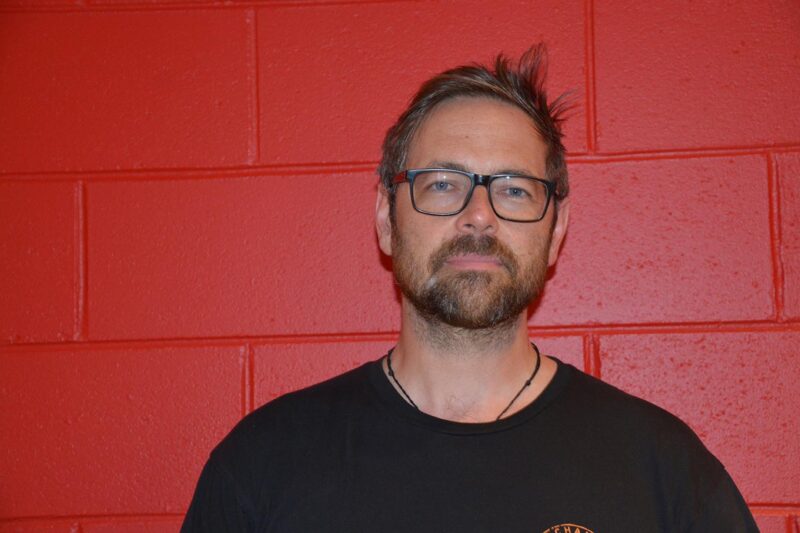
Augustus attended a four-day tech meeting at Rock Lititz to demonstrate what other technologies, such as Disguise and Stage Precision, can integrate with BlackTrax.
“It was basically to explore what we were able to do, which allowed us to formulate the platform for David and the creatives to work from,” he commented. “Primarily, BlackTrax is being used for followspots, ensuring that David is lit and tracked consistently for the show. This functionality extends to every band member on the stage, of which we can light as and when we need, such as picking a band member up during a solo or directing the audience’s attention to a key moment in the show.”
Whilst the main weight of the technology application would be the followspots, the manipulation of video content comes very closely behind. Most notably, there’s the aforementioned Psycho Killer, where the LED floor displays white circles that track the performers, lighting them exclusively from beneath for the duration of the song. It’s a marvellous highlight in the show that can take the audience a moment to comprehend.
“I occasionally joke to people that if the audience doesn’t quite catch on to what’s happening, then I think the effect and the technology are working well,” said Augustus. “Conversely, if it’s jarring, distracting and begins to make people really question what is going on, then it rather breaks the spell of what we’re trying to achieve.”
The show utilises an array of 12 infrared cameras, mounted on the front truss and on the headers of the curved video walls, all looking into the stage with overlapping fields of view to provide a reliable tracking volume. Each band member wears a small tracking pack (no larger than an IEM receiver pack) on their belt. By way of cables integrated into the jacket (one night all blue, then the next night all orange), the tracking pack connects to an infrared LED mounted on each shoulder. These LEDs emit light in a very narrow band of the infrared spectrum, just barely visible to the naked eye but detectable by cameras.
This integration of cables into the jackets was a critical task that called for precise garment modifications and has been carried out fantastically by the wardrobe department, Jin-Joo Maddy and Keith Haberstroh.
“The camera system works to triangulate and calculate the XYZ position of each of these LEDs or ‘tracked points’ within the tracking volume,” continued Augustus. “In total, we have 26 individual tracked points, two per band member. “After the positional data is calculated, this stream of tracking data feeds into the next part of my system, which handles the assignments and control of lighting fixtures for the show.
“For this show file, I have preprogrammed scenes (or ‘Chapters’, to use the product terminology) which contain information about what fixtures are assigned to which band members, and include more detailed data such as per-fixture beam size, velocity prediction, beam intensity, XYZ offsets, etc. For much of the show, we have one chapter per song, which gives me great scope to program the detailed variations needed to accommodate the technical and choreographic demands of each song.”
When the show is running, changes from one chapter to the next are triggered by the lighting console, ensuring they remain consistent with the show cues for every show.
For the BlackTrax control stream to reach the lighting rig, Luminex hardware plays the essential final role in the process. Luminode 12s (Provided by Neg Earth lights) receive both the BlackTrax control stream and the lighting control stream from Veness’ grandMA3, and ‘merge’ the streams before sending them out as DMX data to the lighting rig.
“In addition to the Luminode 12s, all of the other networking duties within my BlackTrax system are performed by products from the Luminex range,” added Augustus. “Now entering into my tenth year of running, programming and touring BlackTrax systems around the world, Luminex products have proven to be a consistently reliable aspect of my job.”
Augustus points out that during the show is his least busy part of the day, as the majority of his work is in the setup, calibration, and configuration leading up to it. “Once the show is running, I’m essentially monitoring the system and making the occasional adjustment to ensure the performer tracking stays as high quality as possible.”
VIDEO
The Video Designers for the show are Simon Roberts, JT Rooney (Silent Partners Studio) and, of course, David Byrne.
Roberts has collaborated with Sinclair on several past projects and described this show’s design as a very organic process, driven by the space that Byrne and Sinclair created: a 180-degree LED volume, plus a floor, with entrances and exits. The LED walls wrap the stage, placing the performers in an environment rather than in front of an LED backdrop.
In March, a month-long rehearsal solely for the video elements was held at Rock Lititz, with much of the content created as they went. The rehearsal and programming phase is crucial to achieving the best results, as the opportunity to design and execute simultaneously sparks greater creativity. The video team then joined the music and dance rehearsals in August.
“The whole thing was very collaborative,” said Roberts. “A lot of the material in the show came directly from David, including photos and videos, but the ideas were very collective. With implementation and styling, we had a lot of back-and-forth and close collaboration on pretty much every aspect.”
Employing BlackTrax in the video workflow enabled them to create content that was completely organic to the dancers and musicians on stage.
“It’s been implemented in video systems before, but it’s rarely been done quite so fully, especially on this scale,” Roberts commented. “It’s a volume that they’re in, surrounded by LED, which we can use both as a lighting tool and a video tool.”
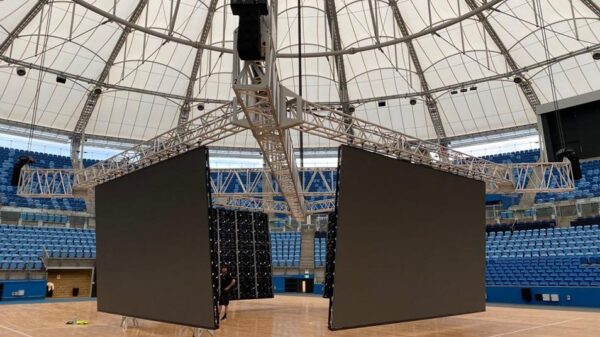
The LED setup comprises five ROE Visual Graphite GP2 LED walls and a YES TECH LED floor.
“YES TECH have a great fabrication and engineering department, and it’s a rock-solid product,” added Roberts.
Control is four Disguise GX 3 media servers and one EX 3+, plus two Barco E2 for backup switching. It’s all timeline-driven, but it’s a very organic show; they don’t use tracks or timecode. It’s all triggered manually by the lighting director.
On the tour, Donnie O’Brien is Roberts’ main Disguise operator, and Ben Rotella handles more of the technical implementation.
“They are fantastic at adapting and being able to make changes as venue size changes, or if the artist wants to add some more things or experiment,” added Roberts. “I’ve been using Disguise for nine years, and I’ve developed a workflow with Rob. It’s our preferred tool for video because we know what it can do and its reliability.”
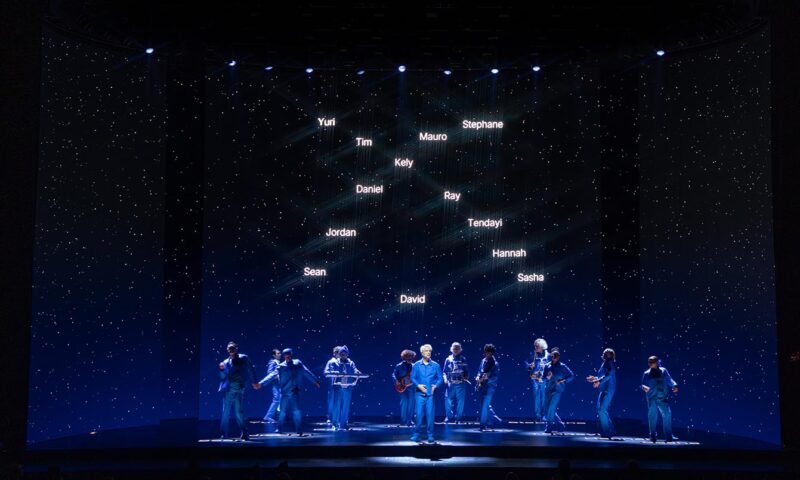
The performance of Independence Day is a highlight for Roberts and is based on the idea of seeing the names of each performer up on the back wall and below their feet as they come on stage.
“It gives us an interesting perspective where we are seeing the performers’ names tracked in real-time on the back wall as if we were looking at them overhead.”
This article first appeared in the March issue of Lighting & Sound International
Show Photos: Rob Sinclair