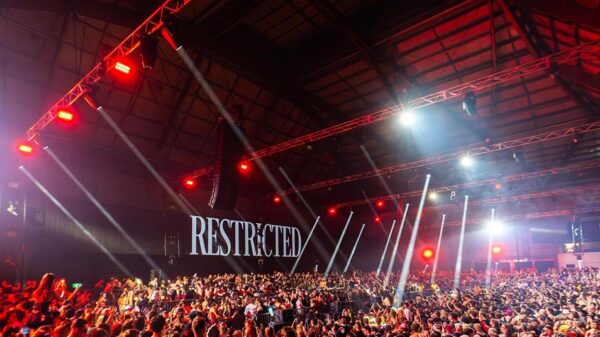
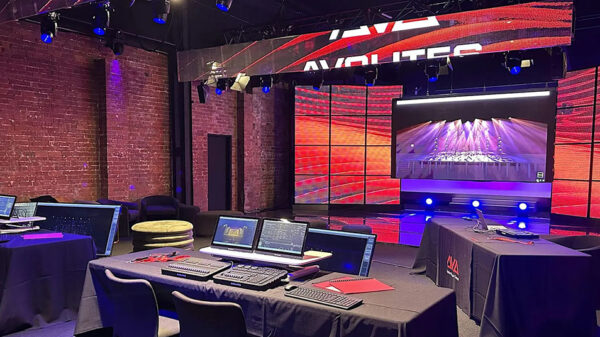
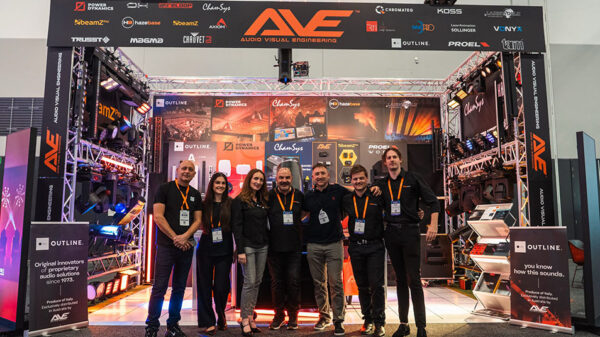
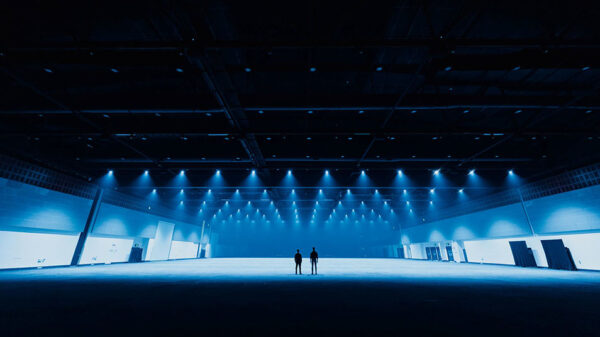
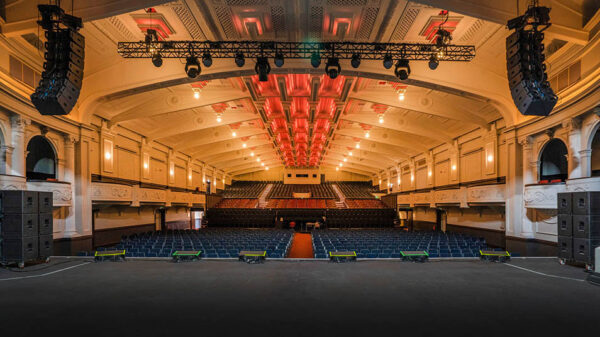
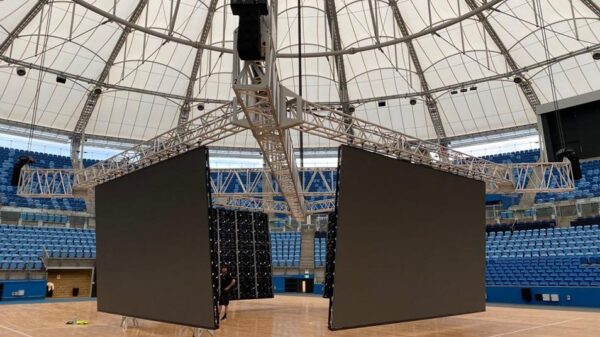

A record crowd swarmed Sydney’s Hordern Pavilion yesterday (Tuesday 19 May) to evaluate the latest, brightest, lightest and most powerful new entertainment tech — and to voice growing concerns around impediments such as inductions and electrical regulations.
While the 61 stands were the powerhouse of the touring tradeshow, the NW Group’s EnTalks Theatre was the engine room for industry collaboration, offering an accessible forum — following a trend long associated with ENTECH. The Electrical Compliance keynote featured a masked technician revealing his truth: he performs illegal work, terminating cables, tightening neutral connections in three-phase cables, and maintaining PowerLock systems.
Speaking anonymously as ‘The Guy’, he said the risks within the current system are such that should a fatal accident occur, he would face industrial manslaughter charges and twenty years’ jail — despite the entertainment industry having no known recorded electrocutions, unlike building or domestic settings.
“The entertainment sector faces a structural barrier in the current electrical licensing framework. Entertainment technicians work safely to AS/NZS 3002 — the Australian Standard for temporary electrical installations — every day, but the licensing system only recognises AS/NZS 3000 work signed off by licensed electricians. This creates a regulatory gap where compliant, safety-critical work gets no recognition.
“The core issue is that current licensing requires supervised experience signed off by a licensed electrician, while entertainment companies routinely install temporary power without licensed electricians on staff.
“No supervisor exists to provide sign-off, creating an unbreakable cycle. This affects touring crews, venue technicians, and equipment service technicians across Australia.”
He pointed to an opportunity for change, detailing how he attempted to obtain a National Restricted Electrical Licence but was unable to find a training organisation willing to conduct Recognition of Prior Learning or Recognition of Current Competency — both mandated within the training system.
“With the federal government now designing a national electrical licensing scheme (2025–26 Budget, $900M National Productivity Fund), there is a critical window to address this gap. The precedent exists: National Restricted Electrical Licences already allow plumbers, fitters, and mechanics to perform trade-specific electrical work. Similar to Victoria’s REL Class 1/Class 2 structure, the live events industry could have its own tiered approach.”
The Guy’s proposed solution: an entertainment-specific NREL with two classes.
Entertainment NREL Class 1 (Power Distribution) would cover the building and modification of portable power distribution equipment; maintenance and repair of touring power systems; and system testing and certification.
Entertainment NREL Class 2 (Flexible Cable) — a simpler qualification — would cover terminating flexible cables and connectors, equipment disconnect/reconnect for touring, simple repairs to touring leads, and temporary power distribution installation and removal. He noted that in Sydney, ENTECH crew connected the touring PowerLock board, while in Victoria the same task required a licensed electrician.
“We all want to work in compliance with Australian electrical standards, but we need a realistic pathway for both show technicians and service technicians to reduce industry liability and insurance costs.”
The Guy was logical and passionate, and session attendees raised concerns around Test and Tag — a regime unique to Australia and New Zealand that imposes significant costs with negligible benefits. As several reported, every show cable is physically rolled by experienced technicians on every show day, which is a considerably more robust inspection than plugging it into a PAT machine every three months.
ENTECH’s Julius Grafton detailed the ‘electronic Certificate of Compliance’ impediment the show faces in Adelaide, where an electrician certifies the touring setup with the cost charged back to the show. He drew gasps from the crowd with a scenario of this state-based regime spreading to affect every show of any size nationally — should other states follow suit.
The session resolved to form a working group, engage with state-based technical performing arts organisations and with Live Performance Australia — the peak industry body — to pursue regulatory changes and a possible solution around show power for the creative industries.
Anyone interested is invited to join a Discourse discussion at https://leecwg.discourse.group/
A second keynote followed by Susan Twartz drew an even larger crowd and detailed experiences and irregularities around inconsistent and often irrelevant Venue Inductions. She gave examples of sensible revisions that would save venues and hirers from inefficient and time-consuming procedures.
Both topics deserve wider industry engagement around economics – cost to the industry and thus on to the community through ticket prices, along with the broader scope of industry turnover. ENTECH plan to issue a survey around these shortly.
The Electrical keynote runs at midday in each city, followed by the Induction session: next scheduled for ENTECH Brisbane on Thursday, May 21, Tuesday 26 May at Melbourne Showgrounds, Thursday 28 May in Adelaide Showgrounds and concluding Tuesday 2 June at HPC Stadium, Perth.