





















L-Acoustics has announced the launch of Source Intelligence, a proprietary voice-separation technology designed to deliver clearer, more intelligible vocals as well as higher gain before feedback for live performances.
Running as an exclusive licensed application on the L-ISA Processor II andintegrated in the L-Acoustics system workflow, Source Intelligence gives front of house engineers mixing on an L-Acoustics PA a tool to clean up vocals from noisy stages and allow performers to move freely across any stage configuration, including in front of the PA, without risking feedback or sacrificing vocal clarity.
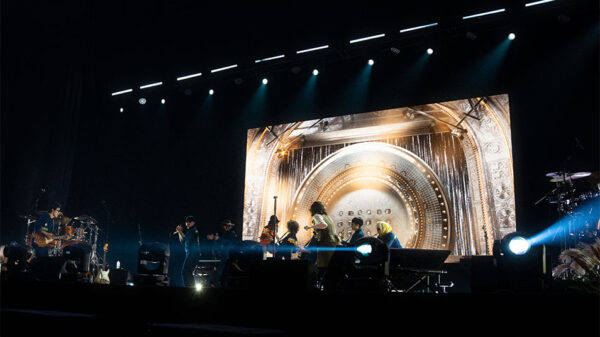
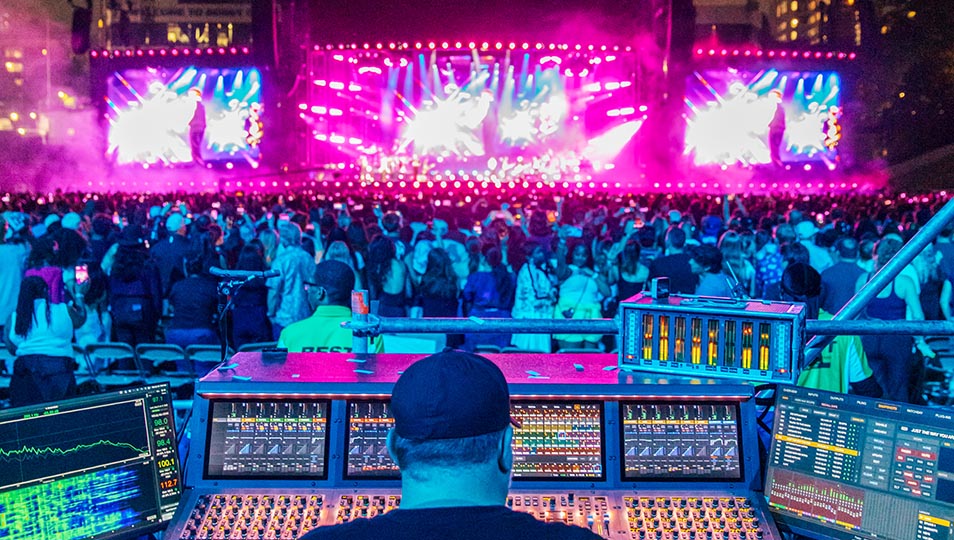
The technology launched at the L-Acoustics Keynote 2026 alongside the L1 large-format line array system and CS1 subwoofer. The event featured a performance by The War on Drugs.
Source Intelligence uses machine learning to continuously identify the voice in a microphone signal and remove everything else. PA bleed, crowd noise, stage instruments, room reverb are stripped away in real time, leaving a cleaner, more natural-sounding vocal. The result is a vocal that preserves the natural tone, character, and intelligibility of the source, a quality difference that has consistently been audible to engineers and listeners in blind tests.
“For decades, engineers have been solving the PA bleed and feedback problem with compromises like notch filters that color the sound, expanders that can be unpredictable, or staging layouts that pull performers away from the audience,” explains Ryan John, director of Product Management, Software at L-Acoustics. “Source Intelligence removes that trade-off entirely. The machine is continuously listening and continuously working, so the engineer can focus on the mix instead of fighting feedback, and the performer can own the whole stage.”
In blind listening tests with both internal and external participants, Source Intelligence consistently ranked highest for voice quality, removing up to 40 dB of non-voice signal, a difference that is consistently audible to professional engineers and casual listeners. The technology also significantly reduces feedback risk by eliminating the PA bleed and ambient noise that cause it, rather than reacting after it starts.
Source Intelligence has been used in the field since Spring 2025 across major touring productions, Broadway shows, and house of worship campuses. Current beta partners include Solotech on the Harry Styles tour, Clair Global on Benson Boone and Rosalia tours, and PRG on the Broadway production Dog Day Afternoon.
“Source Intelligence gives me a vocal sound like no other. It’s basically studio quality vocals now, which changes the game completely,” says Joey Diehl, FOH engineer for Benson Boone.
The technology is designed for any application where a voice is being amplified: touring, house of worship, corporate events, and theatrical productions. It works with handheld, headset, lapel, and distant-pickup microphones, and processes up to four channels simultaneously. Each instance can handle one vocal at a time and can even be placed in the path of a group of channels so that a single instance may, for example, serve all handheld microphones in a corporate workflow.
“I’m very impressed with how much headroom it gives me. I was able to get crisp, clean vocals in any scenario—including very loud stage environments and actors in front of the PA,” says Cody Spencer, Tony Award-winning sound designer who used it on the Broadway production Dog Day Afternoon.
Source Intelligence is part of a growing portfolio of licensed technologies that run on the L-ISA Processor II as part of the L-Acoustics ecosystem, the same platform that powers L-ISA Immersive Hyperreal Sound, L-Acoustics DJ, Ambiance, and HYRISS. Each of these software applications are separately available for purchase, allowing engineers and production companies to expand the capabilities and flexibility of a processor they already own.
Once installed, Source Intelligence requires no threshold setting, no ongoing adjustment, and no changes to the existing console workflow or signal routing. End-to-end latency is stated as less than 8.5 ms over MADI, fixed whether processing is active or bypassed, so that automation and snapshot changes never affect system timing. PSU, network audio, and DSP redundancy are standard through the L-ISA Processor II platform.
Source Intelligence is available now as a software subscription via L-Acoustics All Access for the L-ISA Processor II, exclusively for L-Acoustics system deployments. Go here for more information.