


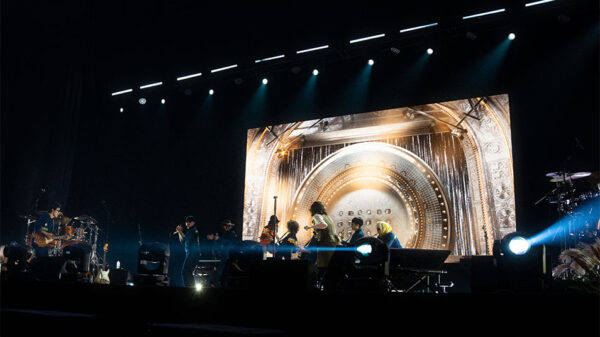





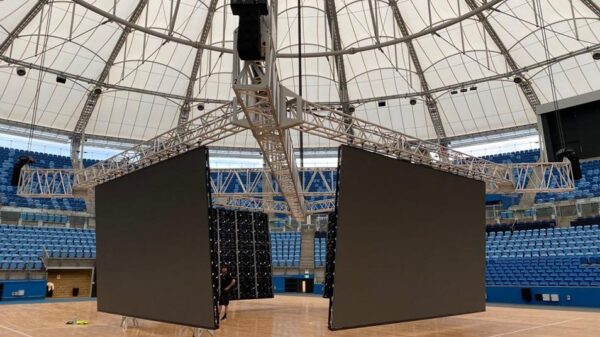


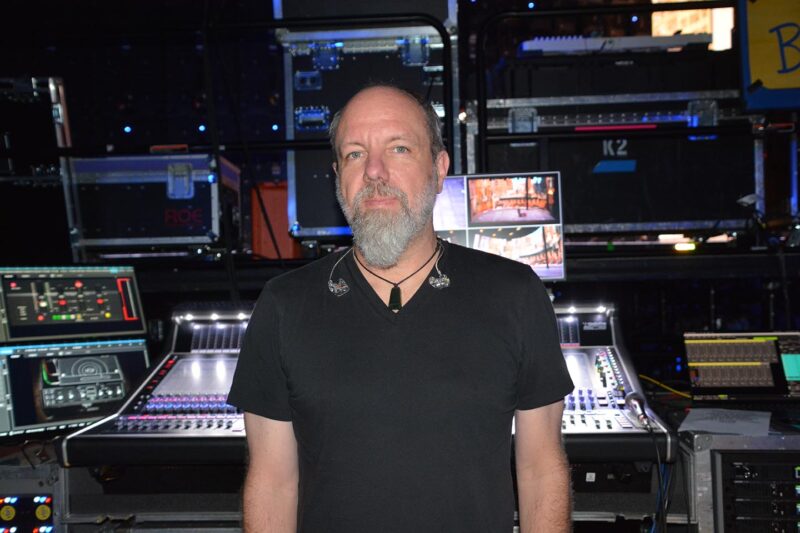
The Sydney show was only the fourth show that FOH Engineer Danny Bernini mixed for David Byrne.
Bernini had been mixing Ben Harper full-time for the past ten years, and he also owns SpiritHouse Music, a recording studio in Massachusetts, which he calls his other main gig. He was brought onto this gig by his long-time friend and associate Pete Keppler, who has worked with Byrne on several occasions over many years.
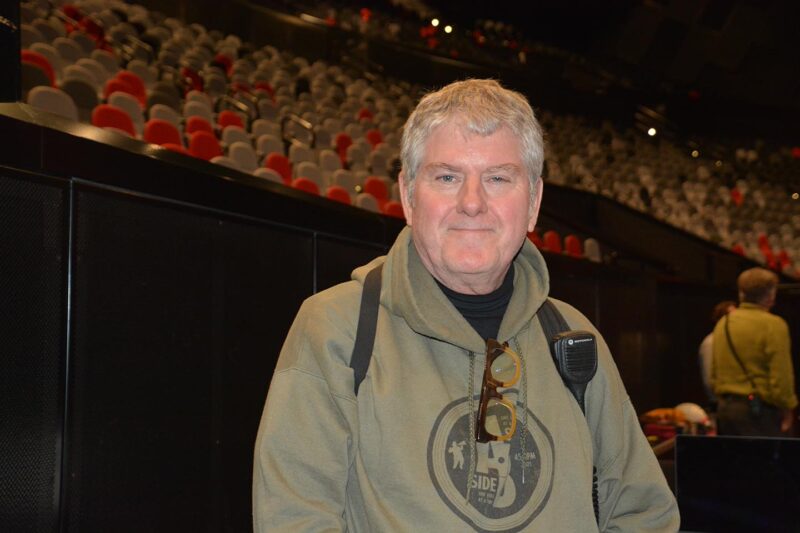
“Pete and I worked on many projects together over the years, and we also worked at The Hit Factory in New York City together, so he recommended me for this tour,” explained Bernini.
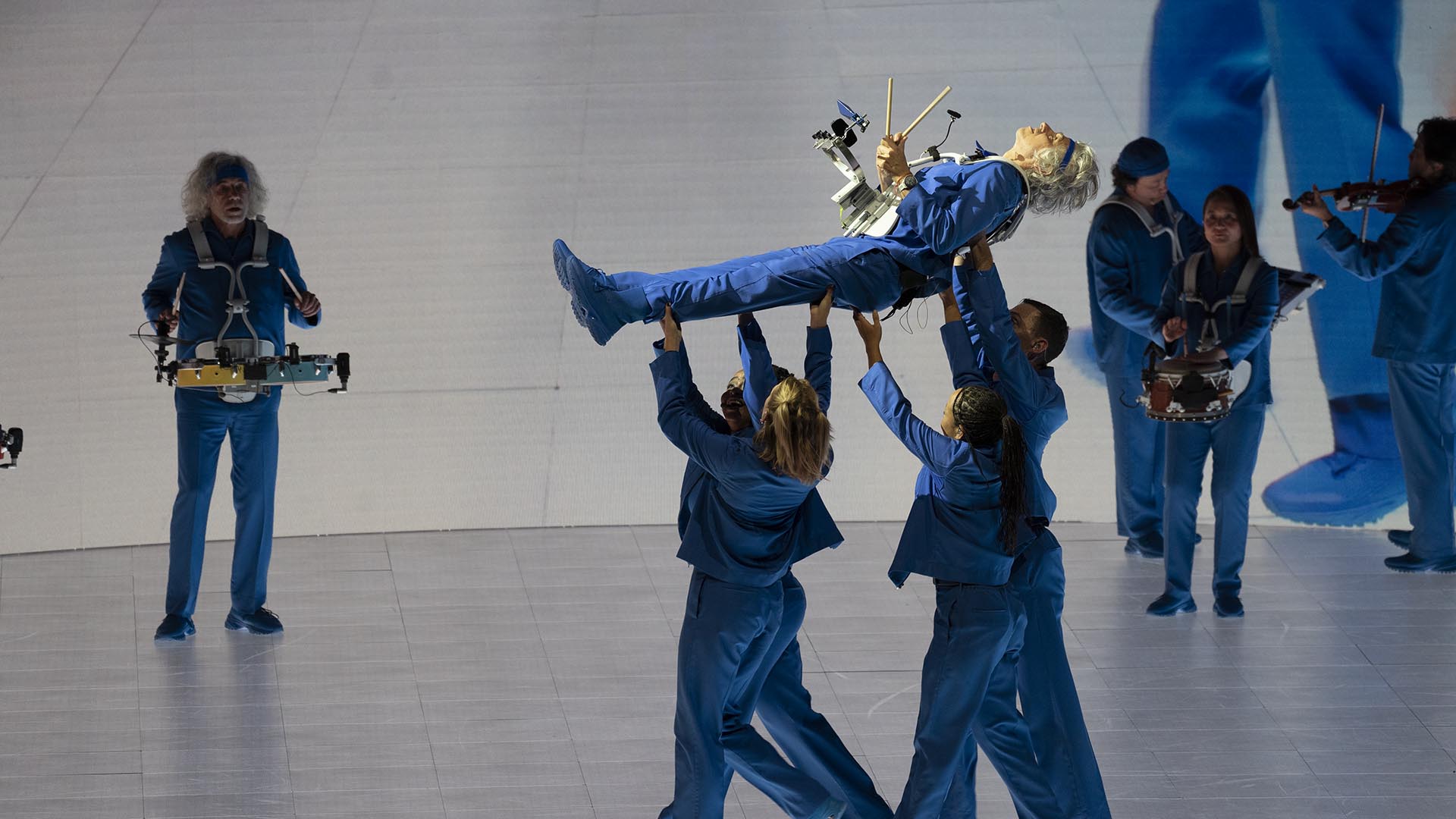
Bernini was not fazed by taking on such a daunting task, with all those people running around the stage, wireless mics, and an exceptional, exacting artist. He says the initial challenge was learning all the songs because the inputs coming from the stage change on every song, with the musicians constantly switching instruments.
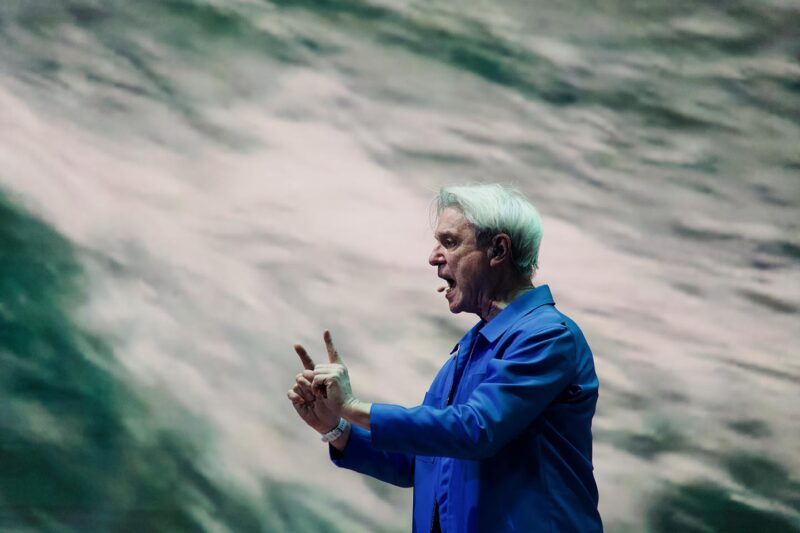
“Even in the middle of a song, musicians can change their instruments, and so learning where all of that is going to happen took time,” Bernini added. “And to be honest, I’ve just gotten my head around that in the last show or two. It’s a lot to keep an eye on, but Pete really left me in a good starting place in terms of organising and labelling everything properly. There are many people singing and open microphones on stage between the singers and the percussion players, plus they’re dancing. It’s a challenging project to make sure that tambourines, cymbals, and drums played by David don’t come into his microphone too much. Consequently, I never have my hand off David’s vocal channel.”
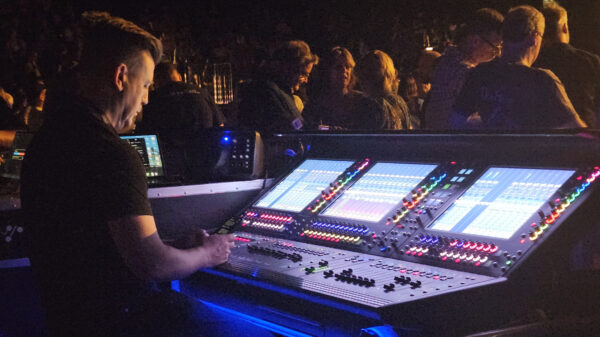
Bernini’s console of choice for the past few years has been a DiGiCo Quantum 338, and this tour was no different, with the show currently totalling around 60 stage inputs. He notes that he likes the 338 for its ergonomics and finds it easy to reach important things quickly.
“I really love the screens on this console more than any other; they’re awesome,” he noted. “They’re clear and easy to see, even outdoors in the sun.”
Bernini used virtual soundchecks extensively to learn the songs and isolate issues, such as a tambourine or cymbal that sounds too loud right when he’s trying to push the background vocals up for an important part.
“Sometimes the background vocals are a key part of the song; they’re not just backing up David,” remarked Bernini. “I must push them quite a lot to get them above the band, and that can bring up a lot of unwanted stuff along with it. So maybe I’ll put some multi-band compression on some of the background vocal mics, so if a tambourine hits right next to them while they’re singing, it’ll grab that frequency and pull it back. Our monitor engineer, John Chadwick, did an amazing job choosing the right microphones for everything, which is really where you want to get it right. If the source is great and the mic is the right choice, then my job becomes much easier.”
The only outboard gear Bernini is using is a pair of Wave servers, which he says he mainly uses for reverb, delay, a couple of special effects, and sometimes a little distortion. He adds that it’s just effects, and everything else is done on the console, including using some Chilli multi-band and Mustard compression.
“The Waves effects aren’t anything too fancy, basically a very old school approach with modern gear,” said Bernini. “I’m using four reverbs, one Abbey Road small chamber for drums, one Abbey Road large plate for drums, one Abbey Road medium chamber for vocals and one H-Verb for large vocals. I use one H-Delay for long stereo echo and one J37 for shorter slap. I use a couple of different spreaders/wideners: one H3000 with some slight pitch change left and right, and one ADT for a little doubler-type thing. These are all automated, changing from song to song.”
Bernini admits that his job is made easier by the fact that the sound coming from the band and Byrne is phenomenal to begin with.
“David’s singing is very present and clear, even though he’s dancing and running around the stage. It’s pretty impressive. I haven’t really had a hard time getting him to be nice and clear out front. Even when he speaks in between songs, it’s not as challenging as some other artists who tend to mumble when they talk. My goal is always to make sure that the people sitting in the toughest-to-reach seats feel like the vocalist is singing to them. If you can reach everyone at that level, the whole audience will be on your side and engaged throughout the show. It’s the difference between a great show and an okay one, in my opinion.”
Although Bernini has mixed on a Clair Cohesion PAs, this is the first time he has taken one on tour, having the same PA every night, and a great system engineer (Paul Jump from Clair) has been a treat. Bernini adds that Jump makes the system sound great from room to room, night after night. The setup comprised 16 CO10s for the main hang, 12 CO10s for the side hangs, six CP218 self-powered subwoofers, and four Clair CF28 front fills.
“Clair Cohesion is very different from every other PA that I’ve used,” remarked Bernini. “It’s very clean, transparent and clear sounding, almost more than I expected. I find myself thinking more about adding a little colour and saturation, and things like that, because it’s digital from the console all the way up to the speakers, and it’s very clean and pure. Between using a DiGiCo and Cohesion, it’s as clean and pristine as it gets. It’s a blank canvas to get creative with.”
JPJ Audio supplied the crew and equipment, and Bernini commented that they were awesome, nice people who totally took care of him.
MONITORS
Monitor Engineer John Chadwick worked on Byrne’s American Utopia tour, describing it as the best thing he has ever done, and so he was more than happy to do it all again! It also gave him the advantage of bringing over the knowledge he learnt on the first tour.
“There are things that we learned the hard way when we put RF on a load of drums and other percussion,” he commented. “We kind of made our own rules for best practice and brought that over from day one on this. Our main challenge is that the entire band is mobile; none of the instruments have a static location. They are all worn on the body of the musician, and those musicians are pretty much constantly in motion.”
Further to this, the percussion instrumentation changes rapidly from song to song. To aid changeovers with acoustic percussion, microphone transmitter packs are mounted directly onto the instrument. When someone takes one piece of percussion off and gets handed a different instrument, the RF and mic stay with that instrument.
“A more measured approach may be to have the musician wear a transmitter pack and plug and unplug as required, but there simply isn’t time for this,” clarified Chadwick. “Figuring out how to get packs on some of the more metal-themed Brazilian percussion was a bit of a challenge, but we figured that out.”
The musicians are not only skilled in onstage choreography – they also have some proficient moves backstage to achieve the swift changeovers; otherwise, they’d all just be crashing into each other constantly.
Five of the musicians were on the previous tour and knew what to expect, but it was a bit of a shock to some of the others! Rehearsals for the tour lasted six weeks, with the final four weeks concentrating mainly on choreography. In all of that, they included their instrument changes as they learned the dance moves.

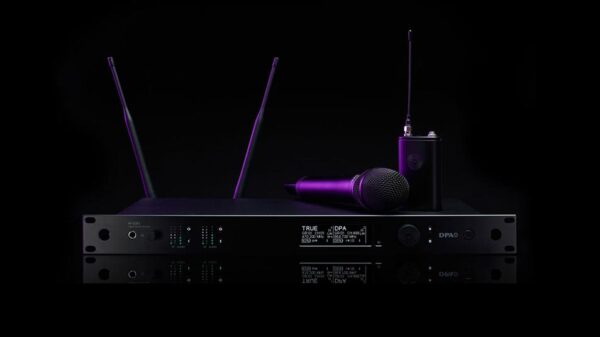
RF-wise, there are 48 channels of Shure Axient™ Digital wireless microphones.
“We’ve got ADX1 body packs, which do the majority of the heavy lifting, dealing with the vocals, the guitars, bass and all of the acoustic percussion,” he said. “And we’ve also got some ADX3s, which are used on the electronic drum percussion because we need those packs to provide phantom power for the drum sensors.
“We’ve also got a couple of handheld ADX2s, which we use for the choreographers and the occasional guest vocal.”
Everyone uses Ultimate Ears UE18+ Pro, and there are 20 channels of Shure Axient Digital PSM IEM systems, which, according to Chadwick, have made a huge difference to the tour and are, frankly, a game changer, especially as the stage is surrounded by video.
“We did some testing in pre-production, and every time we’d go through a video wall, we’d lose 9dB of RF and, in some locations, we might have been trying to pass through three layers,” explains Chadwick. “The PSM system lets you use two antennas painlessly. Previously, when you used two antennas passively split, some considerations and calculations were required. You had to use the exact same cable lengths and antennas to avoid problems and perform some gain jiggery pokery. With this system, you don’t have to do that; you can use different cable lengths, different antennas. It means we can get coverage behind the video wall, offstage, where all those changeovers are happening.”
It’s not that easy to find those antennas on the stage. They are some 28ft up in the air on dedicated trusses in an ideal location above the video screens.

Chadwick affirms that no matter where anyone is onstage or offstage, the reception is unbelievably good. He also favours the metrics he gets from the system, as everything is connected via ShowLink. He can monitor people’s belt packs, see their temperatures, see where their volume knob is, and, obviously, get battery information from them. There’s also the bonus of not having to sync packs on a daily basis, as it all happens through the magic of ShowLink.
“Before the show, the band will check exactly what their volume is with us, because we can see it on screen in Monitor World,” added Chadwick. “With most of the vocalists, the pack gets hidden away under layers of clothes, and in little neoprene packs, so they can’t adjust it once they’re strapped in. Before they fasten those final buttons up, they can come over and check and say, ‘ Are we at the right volume?’ so they’re always at exactly the same volume for every performance.”
DPA 4488 headset microphones are used for all vocals, with Sennheiser 904s and Shure Beta 98As for acoustic percussion. DPA 4088s are mounted in the percussion harnesses, like a chest mic, to capture any handheld percussion the guys might be playing.
For control, Chadwick ran a DiGiCo Quantum 5, revealing that his biggest challenge at each show is staying on top of the room sound, given 10 open vocal headset mics on stage.
“I’m using the recently added Mustard Source Expander on all of the vocal channels directly and again on my backing vocals bus to try and keep some element of control!
“But that’s it really. Now we’ve got it set up, it’s quite straightforward to run it daily. We do have MIDI control from my console over all the backline. When I fire the next snapshot, it also fires all the backline presets. The guitars and bass use Axe FX III processors, the keyboard system and MIDI marimba are on Ableton, and all the electronic drums use Sunhouse software via MOTU interfaces. This lets us keep the changeovers super tight as the entire backline changes together”
The only outboard gear used is three Universal Audio Live Racks, with Chadwick favouring the older version over the new one, saying it has lower latency. “The new versions only have Dante I/O, and because I’ve already got digital microphones going through a digital desk and digital in-ears, I’m already kind of up against it, latency-wise,” he explained.
This article first appeared in the March issue of Lighting & Sound International
Show Photos: Abigail Lester