










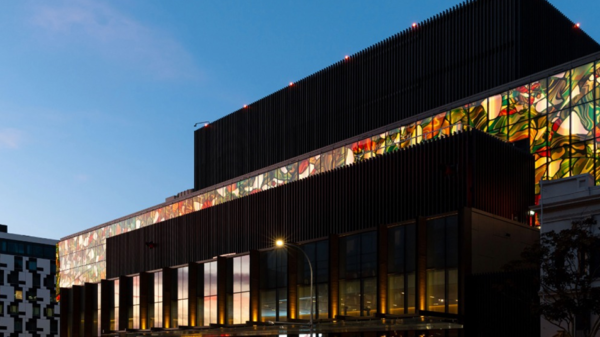







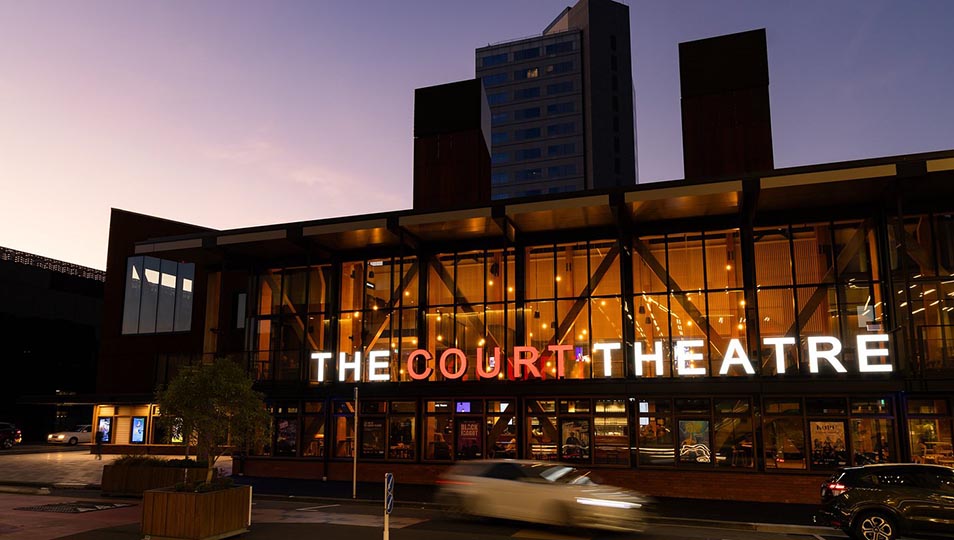
Years after the earthquake that devastated the city, Christchurch’s Court Theatre has reopened with modern home in the newly developed Performing Arts Precinct, complete with power management and data solutions from LSC Control Systems.
When Christchurch’s Arts Centre was damaged by the earthquake of 2011, the Court Theatre was forced to relocate to a temporary home – an old grain storehouse in the nearby suburb of Addington, called ‘The Shed’.
This ‘temporary’ measure was to be the theatre’s home for the next 14 years, while the city progressed ambitious plans for a new cultural hub in the city centre, to be known as the Performing Arts Precinct.
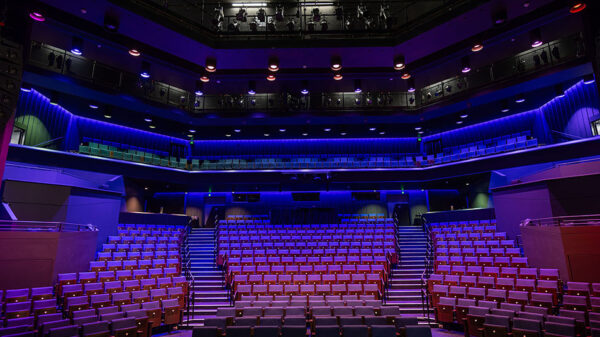
The new theatre, which eventually opened in May 2025, is a vastly improved, modern, producing facility. It includes an intimate, ‘courtyard’-style 377-seat main house called The Stewart Theatre, a flexible studio theatre space – the Wakefield Family Front Room, accommodating audience capacities from 120-150 – and two smaller multi-purpose event spaces, the R?t? Foundation Studio and the Ravenscar Lounge.
The technical production infrastructure throughout is designed to meet the highest standards. Following a technical specification drawn up by leading international theatre consultancy Charcoalblue, Auckland-based specialist LS Group was engaged by Hawkins Construction and Court Theatre to supply, install and commission the theatrical lighting and control systems.
They supplied four of LSC’s Unity switching/dimming racks (each 96-channel) – three serving the Stewart Theatre, and one for the Wakefield Family Front Room. “These dimmers provide the backbone of power dimming that allows Court Theatre to use a mixture of tungsten and LED lighting,” says LS Group’s Nick Abel.
The theatre’s head technician and principal lighting designer, Giles Tanner, adds: “In moving to a new facility, we were faced with a conundrum: would we transition to a LED only lighting rig, or have a mix of LED and incandescent fixtures? Because these two options require very different scenarios, this had significant implications in how lighting power would be implemented.”
Importantly, the UNITY racks are mounted on a floating, isolated metal framing system for seismic bracing, while vibration isolation was specified by Charcoalblue to prevent mechanical vibration being transferred to the building.
In addition, the flexible requirements of the R?t? Foundation Studio and the Ravenscar Lounge are served by six GEN-VI units – three for each space. With output channels configurable as 8-bit or 16-bit dimmers for lamps and LEDs, or as direct power relay channels (TruPower) for moving lights, video screens, and audio amplifiers, these versatile dimming and power distribution systems offer a wide range of options. Here again, they allow for the reliable, trouble-free operation of a mixture of tungsten and LED lighting.
The LSC product range also met various DMX routing requirements. Included were a number of MDR rack-mount DMX/RDM data splitters for the venue’s day-to-day DMX signal routing, and MDR DIN-rail splitters (“reliable products at a great price point” says Abel), as well as Nexus rack-mount Nodes for ethernet–DMX routing, plus a couple of Nexen DIN-Rail nodes providing power control for the house lighting system.
Tanner concludes: “Combining flexibility with great ease of configuration and use, Unity is proving to be a superb choice. The extensive reporting options and modularity of the system make it very easy to live with. We are looking forward to discovering all the benefits that the Unity system offers.”
lsccontrol.com.au