









In celebration of their 20th anniversary, shake & stir tackled Shakespeare’s most gripping tragedy, Macbeth, which premiered at QPAC’s The Playhouse.
Reborn into a ruthless world of rolling news, political theatre and weaponised ambition, this razor-sharp new production charts the course of a rising war hero who becomes the media’s latest obsession and, pushed by a partner as polished as she is dangerous, turns the 24-hour news cycle into his personal battleground.
This is Macbeth, as written by Shakespeare, reimagined at scale, for our age of clickbait and catastrophe: a dark, seductive, ratings-driven descent where perception is everything, loyalty is currency, and one couple’s hunger for the top spot threatens to bring their whole empire crashing down.
Such a momentous production required lighting designer Jason Glenwright to create something bold, ambitious and theatrical in scale.
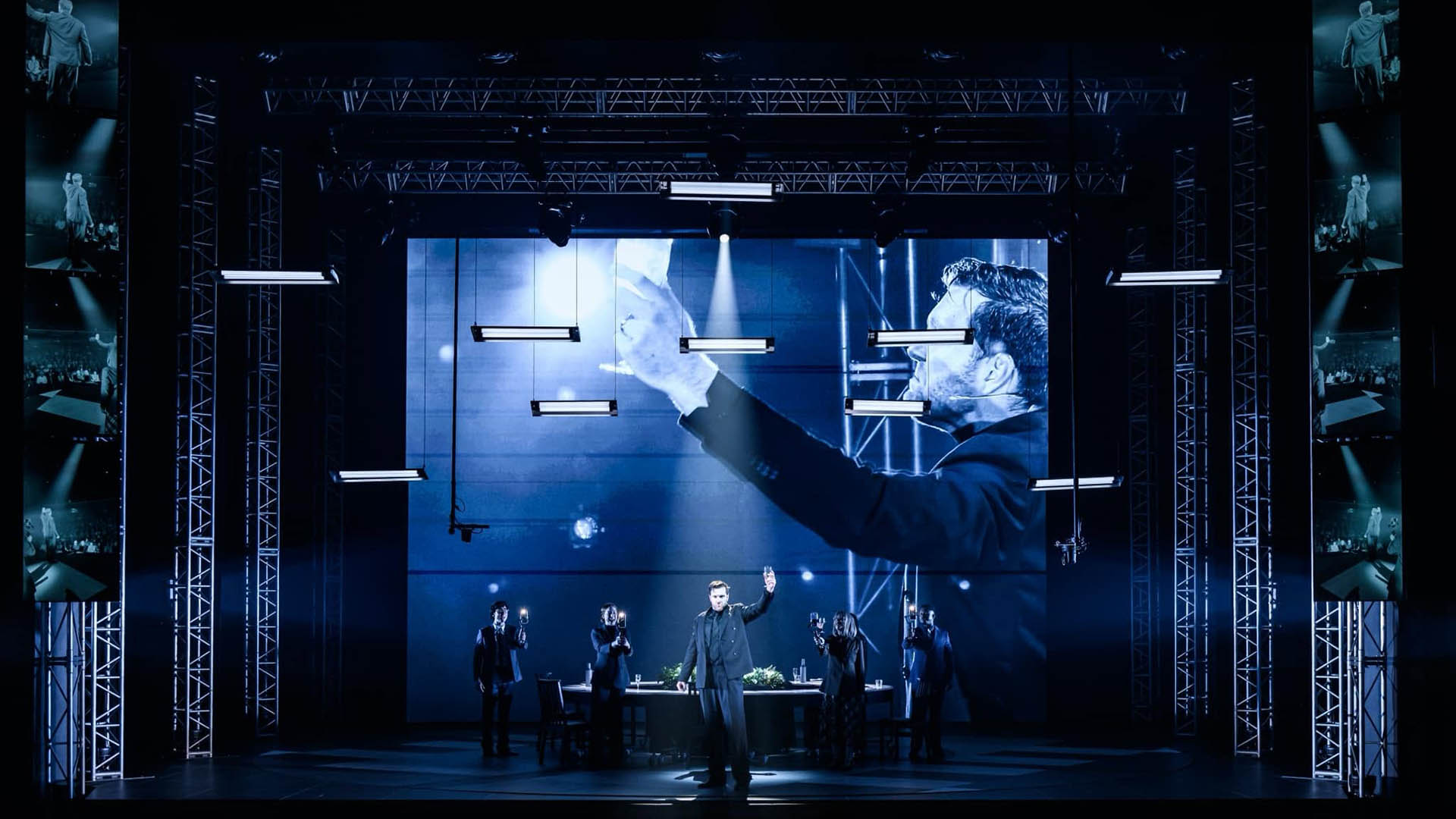
“The production comments on the populist politics we see playing out around the world, all while remaining faithful to the original language,” explained Jason. “With that in mind, we discussed creating a world that felt cold, monotonous and permanently illuminated by artificial light. This led to the creation of twenty suspended troffer-style fluorescent fixtures hanging over the stage, establishing a harsh, institutional environment.
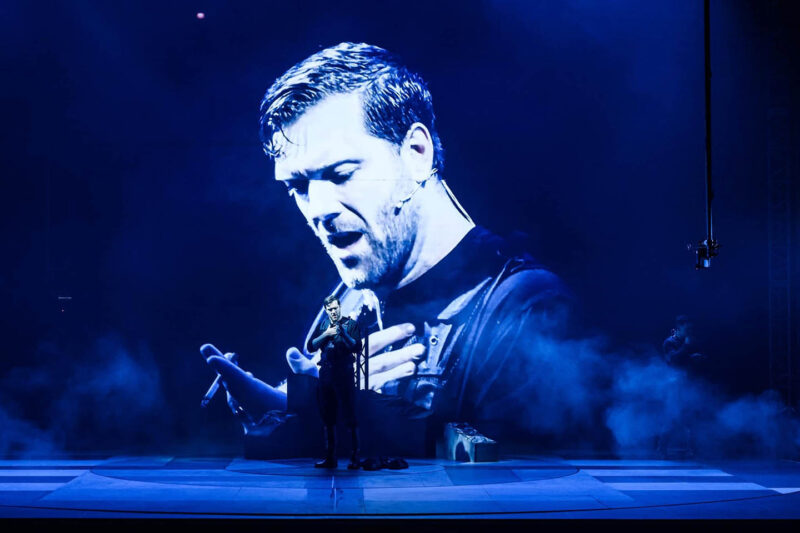
“We also spoke about the way modern political leaders increasingly turn politics into entertainment. The truss-filled world helped support this idea, allowing political announcements and public appearances to feel more like sporting events than traditional state occasions. At its peak, Macbeth’s coronation resembled a championship boxing match or arena spectacle, complete with the energy and anticipation of a major live event. It became less about ceremony and more about performance, reinforcing the production’s commentary on power, image and the theatre of modern politics.”
First and foremost, the lighting design needed to support the story, the world and the characters. It could never exist for its own sake. Every lighting choice was there to help tell the story and guide the audience through the production. Even during transitions, when the lighting stepped into the foreground, it was always working to shape atmosphere and prepare the audience for what was coming next.
“I recognise that many audiences can find Shakespeare’s language challenging,” added Jason. “What I loved about Director Nick Skubij’s retelling of Macbeth was that, despite retaining the original text, it felt immediate, accessible and engaging. The world, the performances and the atmosphere all helped audiences connect with the story and appreciate the play’s themes, even if they didn’t catch every line. I hoped the lighting could contribute to that experience.”
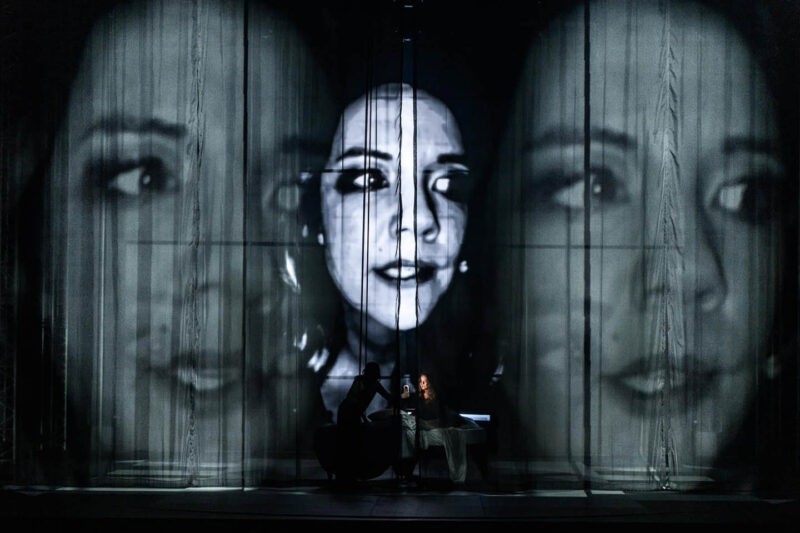
One of Jason’s goals was to create a world that felt real, dynamic and emotionally charged, allowing the audience to connect with the tension, ambition and relationships at the heart of the story. The lighting became another storytelling tool, helping communicate mood, power shifts and character journeys, and providing audiences with an emotional pathway into the work beyond the text alone.
Jason’s biggest challenge on projects like this is always time. He chose not to pre-visualise this show.
“For theatre productions, I’m not a huge fan of pre-vis because I enjoy lighting faces well, and I don’t believe current visualisation engines are yet accurate enough for this to be a particularly useful exercise for lighting faces,” he said. “This also wasn’t an effects-driven show, so pre-vis wasn’t going to save us a significant amount of time.
“I also strongly believe in collaboration across the team. A successful lighting design only works if it communicates with and works seamlessly with all the other departments on the show. To be able to plot a scene properly (and there are 26 scenes in total!), you need to understand how all the other elements are working together.”
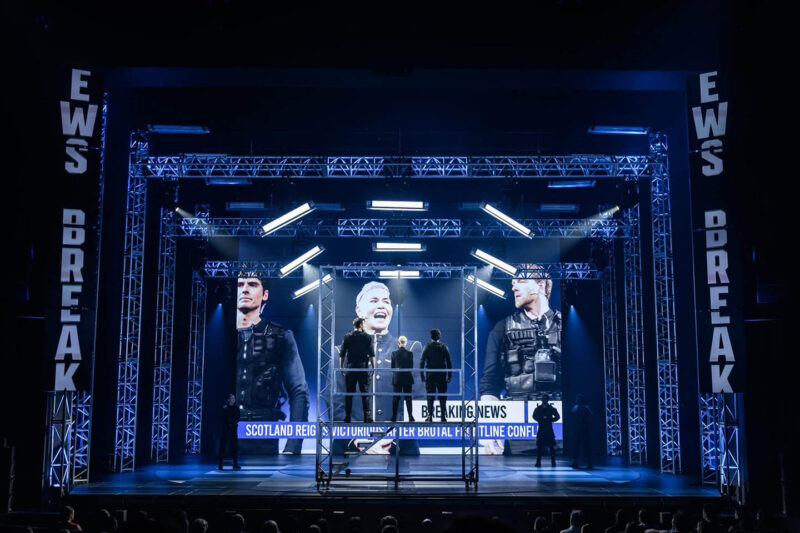
The show has many moving parts, so setting a scene to plot involved ensuring the correct scenery was in place, the triple revolve was set in the right position, the flying cameras were at the correct height (so they weren’t casting shadows!), the appropriate video content was playing, and understanding what sound cues were occurring and whether they required any lighting support. Only once all those elements were in place could Jason begin making informed lighting choices.
“When discussing the show initially with Nick, the director, I wanted us to find a dominant light source for the world of the work,” remarked Jason. “I kept coming back to the banality of interior fluorescent lighting—shadowless, flat and generally unappealing. I also liked the idea that I could adjust the colour temperature of each environment using the troffers as a visible, believable light source.
“I also wanted an element that could introduce a sense of magic into the world. When the witches move into their “Double, Double Toil and Trouble” sequences, the physical movement of these fixtures would become a feature. I suggested to Nick and the set designer, the wonderful Josh McIntosh, that we integrate 20 hanging troffer-style luminaries spread across four flown bars.
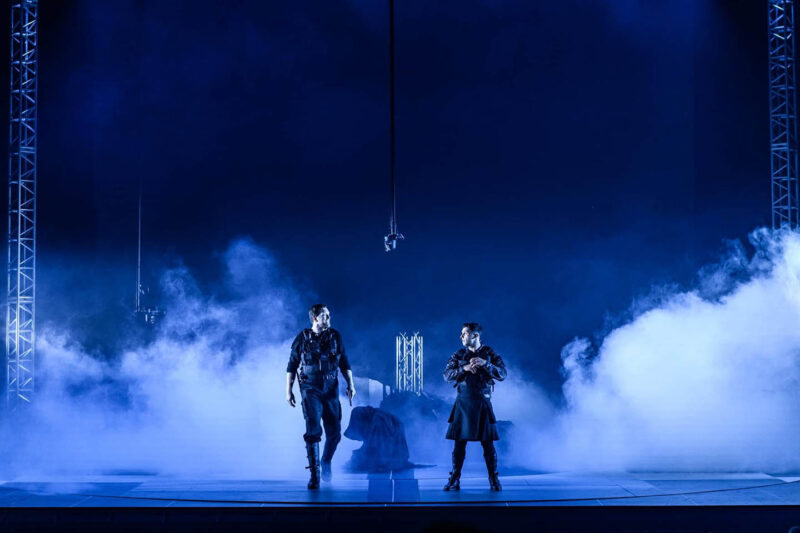
“Initially, I thought we might modify existing troffer fittings, but the kinetic motors had a maximum payload of only 2.4kg. Josh’s solution was to manufacture lightweight aluminium shells, which dramatically reduced the weight while maintaining the look. As it turned out, the kinetic motors had integrated LED tubes, making the fabrication process surprisingly simple and incredibly effective.
“They couldn’t have been more perfect for the world of the show. They create striking transition moments as they fly through the space, form false ceilings for a range of scenes, and ultimately allow the world to literally come crashing down around Macbeth.”
Beyond the troffers, lighting was integrated into several scenic elements. Five light-up Perspex tabletops contained concealed RGBW LED strip and were controlled via RC4 wireless DMX and battery systems, allowing performers to be lit from below in quite an eerie way. There were three large flown windows constructed from frosted ripple Perspex, each fitted with RGBW LED strip along the top edge.
Jason is a big fan of having a stock of Astera wireless fixtures available on productions, saying they’re brilliant for filling gaps or adding light to scenic elements when there isn’t the time or budget to permanently integrate LED strip. On Macbeth, a combination of Astera Titan Tubes and AX3s was used throughout the production to support a range of scenic and practical lighting moments.
A mix of venue stock and hired equipment was used, with Res X coming to the party and supplying most of the additional fixtures.
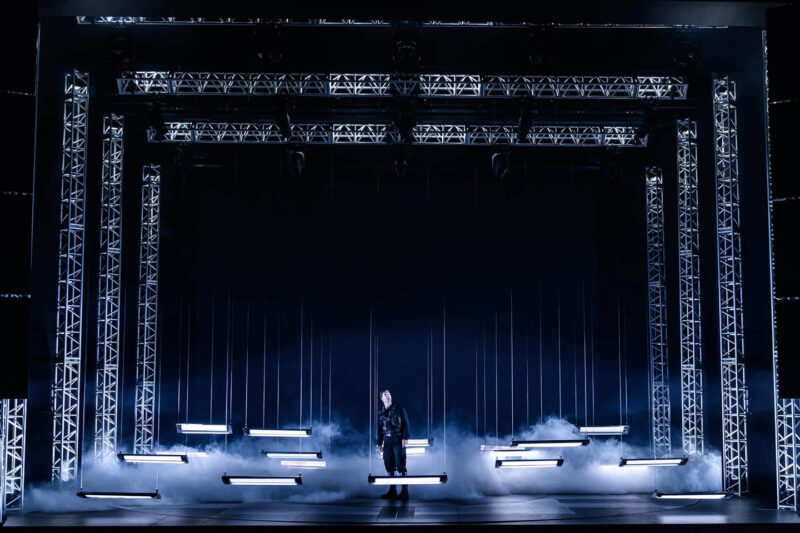
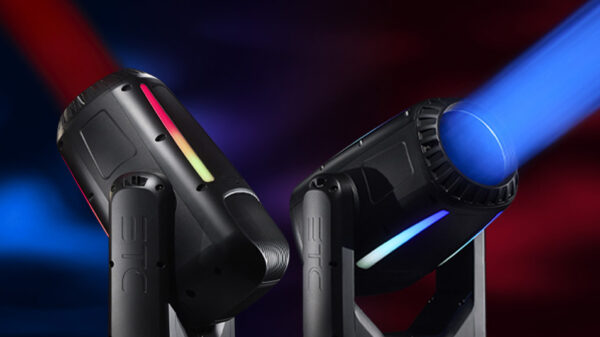
The backbone of the rig was 27 Martin MAC Encore Performance CLDs. Twenty of these did the heavy lifting overhead, mounted on three dominant silver box trusses that could fly in and become part of the world of the play. The remaining seven fixtures were positioned FOH and used for high-side face light and specials.
13 Martin MAC Encore Wash CLDs were located primarily on the side ladders to provide additional side fill and sculpt the performers throughout the show.
Along the front edge of the stage were 20 Chauvet COLORado PXL Bar 8s, which acted as footlights. Jason adds that having a refocusable footlight system was incredibly useful. Overhead, 20 Chauvet COLORado PXL Bar 16s were installed across two bars and used as mid-stage and upstage light curtains.
“On this production, I deliberately moved away from a traditional spot-and-wash moving light rig overhead and instead relied on the PXL Bars whenever colour wash was required,” elaborated Jason. “Curtains of light through haze are incredibly effective at creating depth and making a stage feel infinitely larger against a black backdrop. I strongly believe that, in a world where it’s easy to throw more gear at a problem, setting yourself rules and limitations as a designer often creates a stronger outcome. Limiting myself in this way helped define the show’s visual language and gave the rig a clearer sense of purpose.”
The sidelight system consisted of 54 Prolights EclProfile CT+ fixtures in various lens configurations. The show was predominantly side-lit, so having dance-style booms with upstage and downstage cross-light at both head and shin height was critical. It helped keep the sidelight clean and controlled while reducing the number of shadows cast between performers. According to Jason, the EclProfiles are also remarkably bright and have beautiful colour-mixing capabilities.
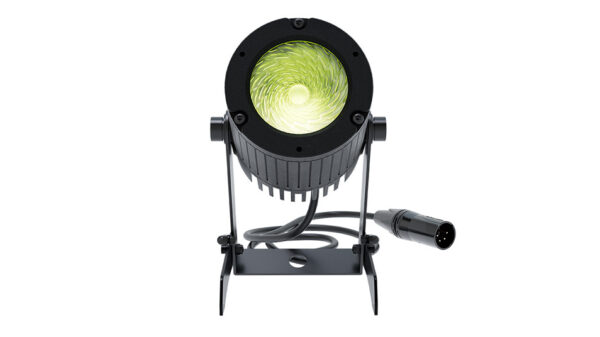
Supplementing the booms were 10 Chauvet Rogue R2 Wash fixtures positioned just above head height, providing additional side fill and texture where required.
To illuminate the flown trusses themselves, 34 ShowPRO Fusion PAR QX12s served as truss warmers.
Atmospherics played a significant role in the production’s look, using two Look Solutions Cobra foggers for fast-dissipating haze, two MDG Atmospheres for continuous haze, and two X-SW1800 low-fog machines to create the show’s heavier atmospheric moments.
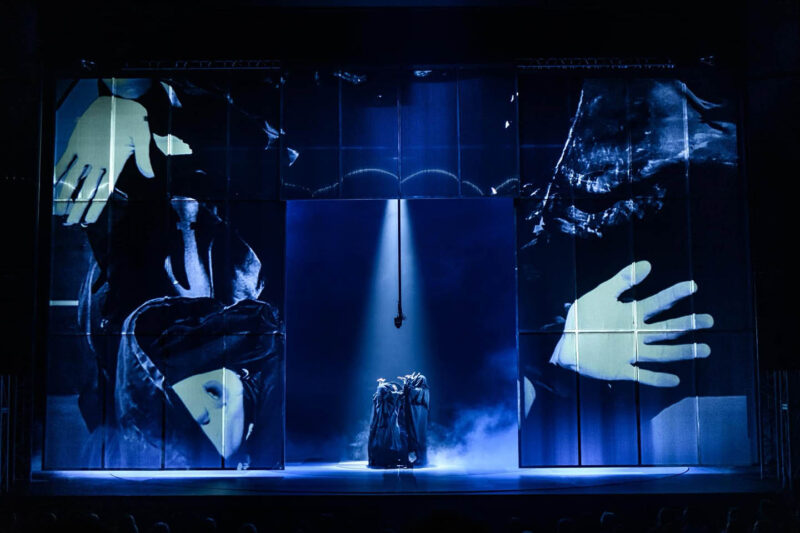
The production featured a significant video component, led by a 12m-wide x 8m-high LED screen upstage. In addition, a 20K Barco projector was used to project onto the downstage windows, a floating TV mounted on a truss stick, and two full-height truss towers positioned on either side of the stage, each carrying four LCD screens.
One of the most exciting elements was the camera system. The production utilised three moving-head cameras, each controlled via one Co-Video Designer Jeremy Gordon’s own adapted (patent-pending) Xbox controllers. These cameras were mounted on 9m dropper bars, allowing them to fly deep into the stage space, getting right into the action while also panning and swivelling to create many unsettling, ghostly perspectives that feel right at home in Macbeth.
There were also several iPhones used throughout the production as additional live cameras, both operated by the cast and mounted on articulated arms during the banquet scene. The integration of live video throughout the production helped reinforce the media-driven world of the play, blurring the line between political event, news coverage and theatrical performance.
“The banquet sequence in particular utilised some clever video trickery involving the guests seated around the table and Banquo’s ghost, but I’ll leave a little of the magic for audiences to discover for themselves,” commented Jason.
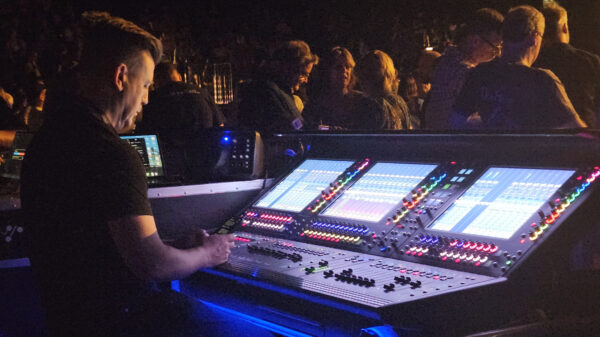
Simon Hardy programmed the production on Jason’s console of choice, the ETC Eos Apex 10.
“Simon and I have worked together for many years, so there’s a strong shorthand between us,” said Jason. “He knows how I typically approach lighting a show from fixture grouping and naming conventions through to the colour palettes and organisational systems I tend to start with. That familiarity allows us to work quickly and focus our attention on the creative side of the process rather than the mechanics of programming.”
All lighting, sound, and video cues are ultimately executed by Stage Manager and Co-Video Designer Jeremy Gordon using QLab. Given the level of integration between departments on this production, having a single playback and cueing system ensured all elements remained tightly synchronised throughout the performance.
Jason says that there is never just one favourite moment in a production, but one that stands out for him is at the top of Act 2, where the witches are performing their spells. The troffers are moving kinetically through the space; the lighting, video, and sound are all working together; and the stage is filled with low fog and atmosphere drifting across the moving revolve.
“It’s one of those moments where all the design departments are contributing equally to the storytelling and creating something that couldn’t exist in any other medium,” he explained. “For me, that’s what the spectacle of live theatre is all about: a room full of people working together to create a moment that feels genuinely magical.”
Photos: Joel Devereux