










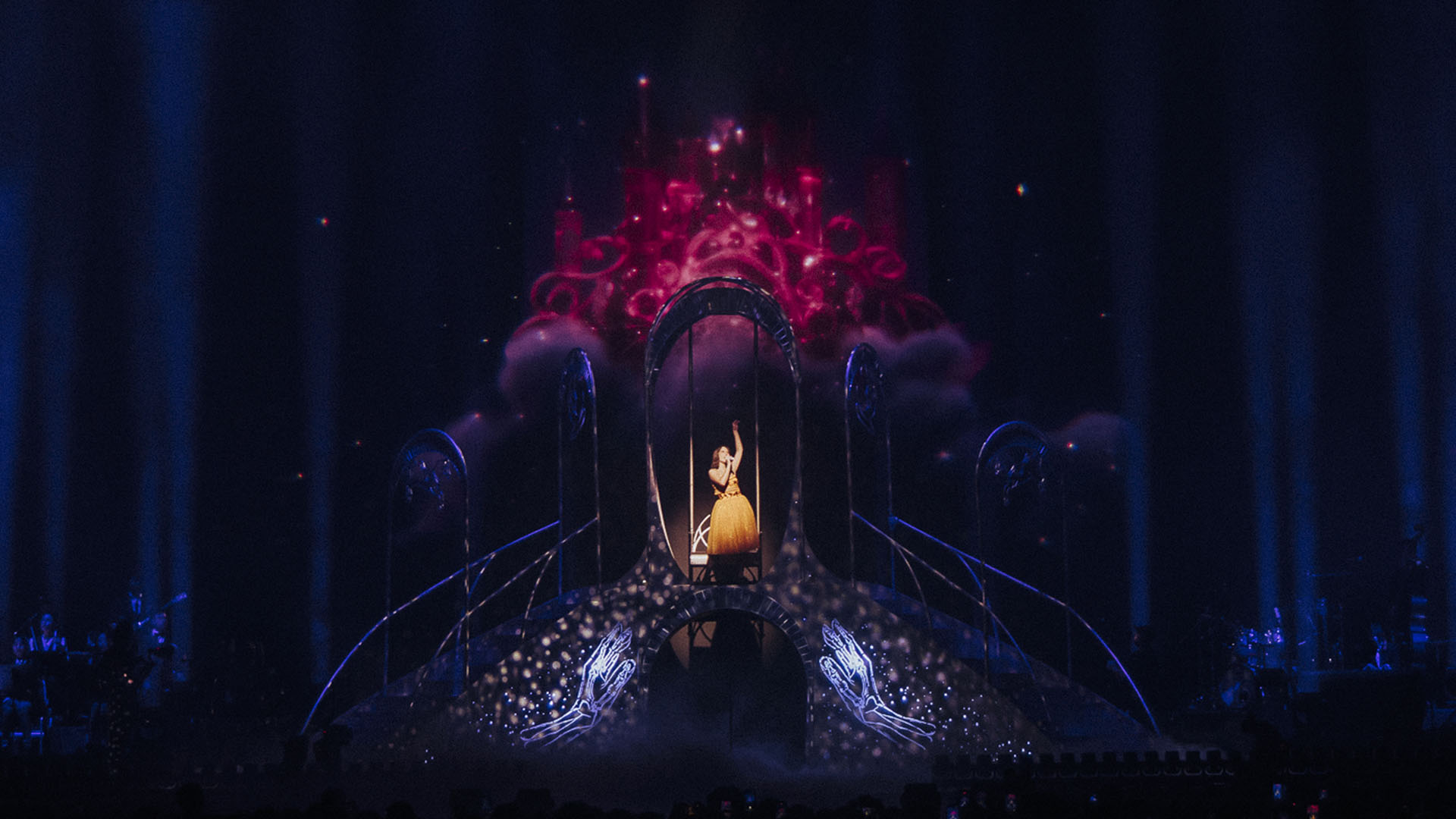
The A Matter of Time Tour was Icelandic musician Laufey’s third world tour, her first arena tour, starting in September 2025 and running for a year. A two-time GRAMMY®-winning artist known for bringing her jazz-influenced style to Gen Z, Laufey is on a meteoric rise, and you’d be hard-pressed to find negative comments about the show.
Her two-hour show unfolds in distinct conceptual acts inspired by golden-age Hollywood, black-and-white cinema, and storybooks. Through timeless orchestrations and a modern lens, it explores unrequited love, wistful longing, and fleeting encounters.
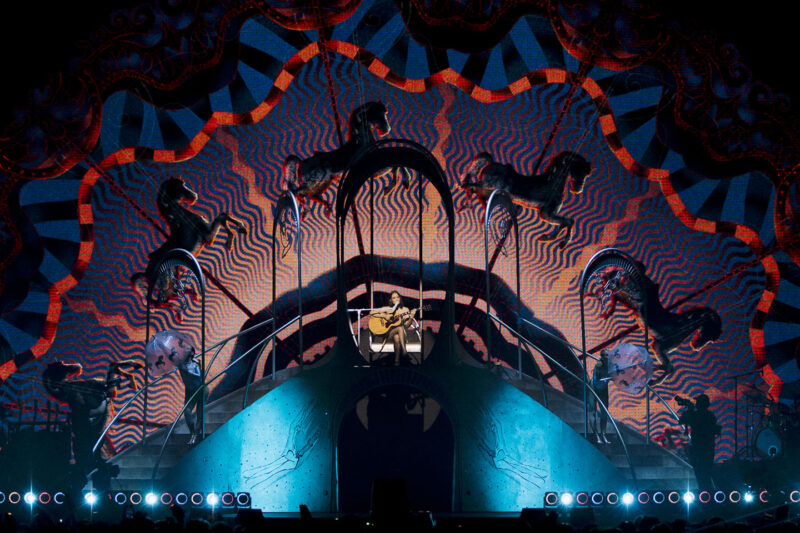
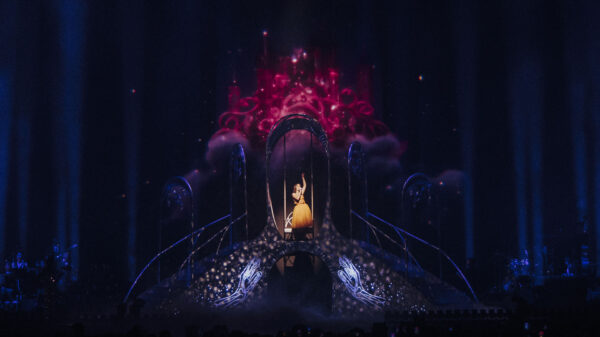
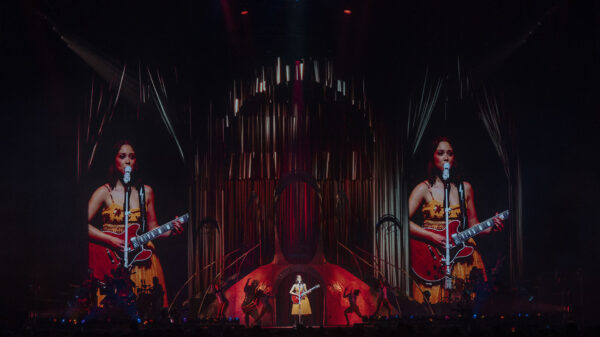
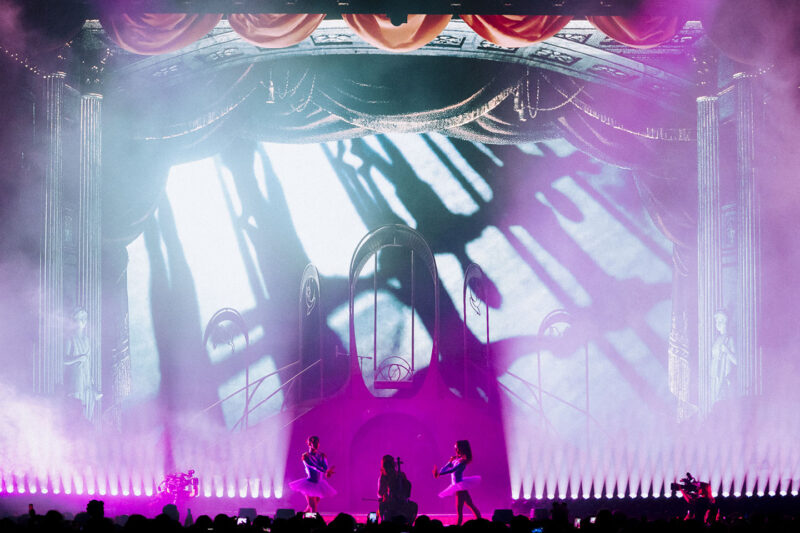
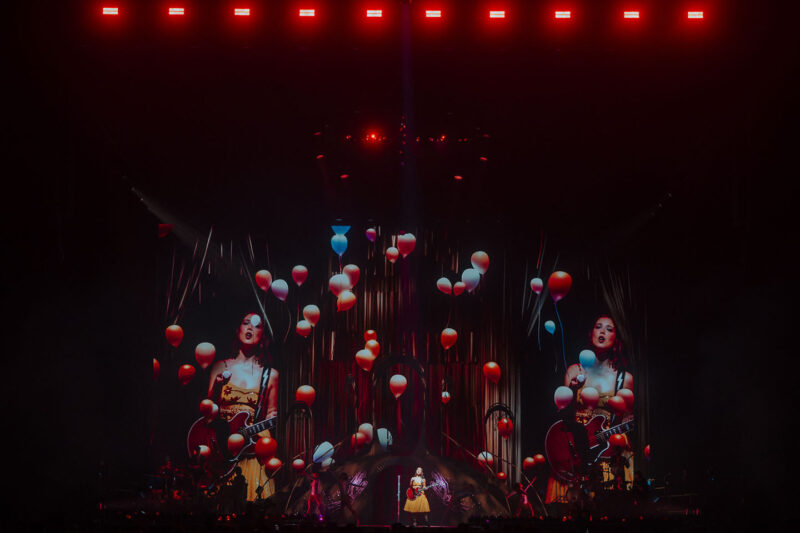
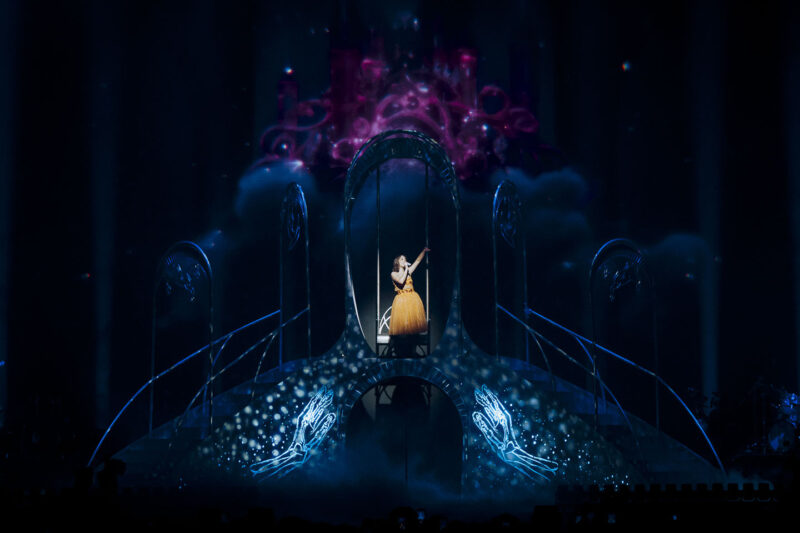
The stage design features sweeping double staircases, a swing, spinning clocks, black cats in wine glasses, carousels, a smaller second stage, Juliet balconies, and twinkling lights – an aesthetic fit for a modern-day Disney princess. The production’s richly imagined look reflects the care invested in developing the tour’s visual world.
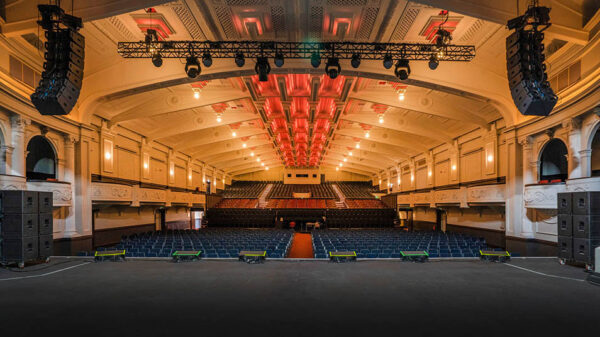
Sydney’s Afterpay Arena isn’t an obvious setting for an intimate jazz performance, yet once Laufey takes to the stage, the cavernous space seems to shrink to a cosy club. That’s not solely the artist’s talent; it’s also the work of a creative team that clearly enjoyed collaborating on this project.
Laufey’s twin sister, Junia Lin, led the team as creative director; entertainment architects STUFISH designed and directed the show; David Finn designed the lighting; and FRAY Studio created the video content.
STUFISH partner and registered architect Ric Lipson said the team greatly enjoyed working with Junia, whose close connection to the artist made the collaboration especially meaningful.
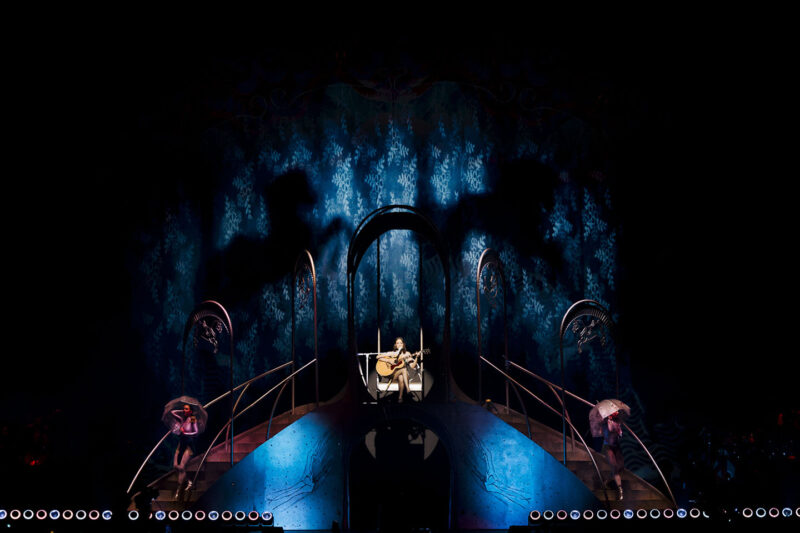
“I wasn’t overly familiar with Laufey’s full catalogue of music, but once we listened to more of it, we were entranced by it because it’s so beautiful,” he said. “Junia explained that the music is a manifestation of a time that they’re trying to reignite, a time of whimsy and magical classicality. She wanted the audience to feel as if they were in an enchanted ballroom.”
When Lipson first met Laufey, she was very keen that he understand she hadn’t just stepped up into arenas, and therefore it shouldn’t be a massive, bombastic show bigger than her.
“It still had to be about her, the intensity of the music and the beauty of it all,” remarked Lipson. “It was important that we found that balance. How do you fill a room without distracting from the artist?”
The main set evokes a castle ballroom with its own distinct sense of time and style. Its multiple levels and transformative design give Laufey varied ways to move through and perform within the space.
Lipson and the team knew they had to incorporate certain themes from the initial creative, such as a staircase, a jazz club, a grand piano, a catwalk, and a stage that could transform into the fairytale fantasy. As the tour and album are called A Matter of Time, the clock was an important motif, with the show featuring many references to clocks, time and calendars. The show’s theatricality begins with a large red curtain.
“The red curtain goes, and never before have we had such a wonderful classical overture prelude to the show,” commented Lipson. “The whole design process was quite individual, as we could bring this whimsy not only into the design of the show, but also into the way that we created the show. It was one of the most exciting experiences we’ve had in a long time.”
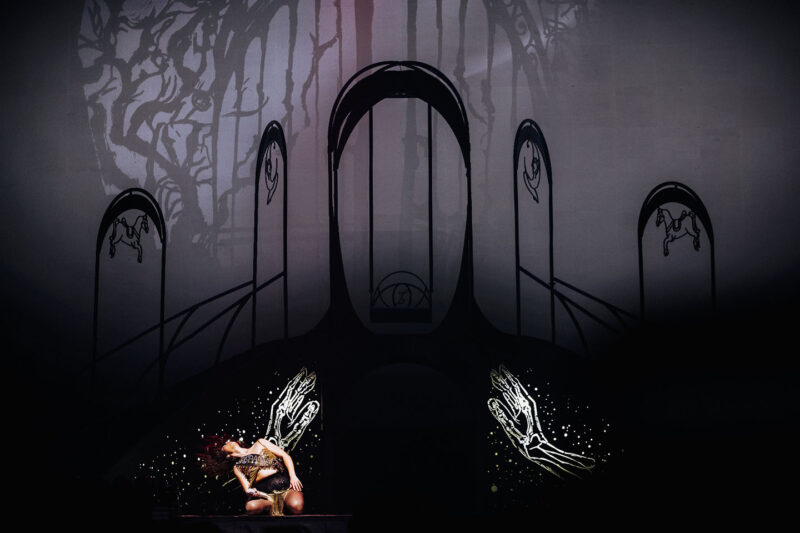
Lipson notes that they didn’t want the video element to be a backdrop to a set, but rather an extension of it.
“That was a challenge, but a challenge that we really enjoyed,” he said. “We wanted to bring a beautiful and delicate sentiment to the design. There’s a saying we use a lot, which is ‘intimacy but on a grand scale’, and I think it’s like: how do you bring an artist that has never performed in an arena before, where her fan base up to that point has seen her in clubs and concert halls and small things, and how do you take that essence, that theatrical essence, into a big arena and not make it feel like it’s getting lost?”
Animation introduced each of the five acts, setting the tone for the music that followed. FRAY Studios blended 2D and 3D animation, then processed the imagery to evoke the recent past, as though each frame were drawn from Laufey’s memories. The result was a cohesive, whimsical fairytale atmosphere with a subtle darkness that reflected the music’s emotional range.
Using Notch and Disguise workflows, Disguise composited live camera feeds directly into the visuals, while projection mapping extended the content beyond the LED wall and onto the physical set.
Incorporating IMAG into the content was an important consideration. Because it was initially uncertain whether dedicated IMAG screens would be available, the system had to support embedding live camera feeds directly within the visual content.
Notch and Designer integrated live camera feeds into the content, using grading and mattes to blend IMAG naturally with the visuals and create a seamless connection between live performance and designed imagery.
Driven by Disguise, projection mapping extended the LED-wall visuals across the physical set, strengthening the connection between digital and physical elements.
Designer’s patching workflows proved essential during production. As several resource-intensive renders required frequent minor revisions, the team could replace only the affected frame ranges rather than re-render entire sequences, saving significant time.
“We used patches particularly often on this show, as we had a few very heavy renders which kept changing very slightly,” says Hanna Schrage, Senior Video Designer at FRAY. “It was fantastic to be able to just render and replace 100 frames versus all 2000.”
The American production was larger than its European and Australian counterparts, though the scaled-down versions preserved the design’s key essence. Elements such as the scroll-shaped B-stage and clock-inspired halo truss were reduced in size, making the show feel even more intimate.
“Interestingly, many people found the smaller production more intimate than the original and preferred the scaled-down version,” Lipson noted. “We knew from day one that the full-scale version was only going to be the show that they could take around the USA because of freight costs. Australia, South America, and Asia often get a reduced set, but reducing it to the level we did for Europe is unusual.”
Lighting
With a long career in ballet and opera lighting, David Finn might seem an unexpected choice for Laufey’s world tour. Yet Laufey is a devoted ballet fan and a regular at London’s Royal Opera House, where she saw Finn’s lighting for Cinderella and loved the design.
“I believe STUFISH was already contracted for the set design. Coincidentally, I had previously worked with STUFISH lighting my only other music act, The Chicks, so we already had a history,” Finn said.
Finn adds that FRAY Studios’ tour visuals became far more central to the production than initially expected.
“Finn Ross at FRAY Studios has an exceptional team of content creators,” Finn said. “It was one of the best creative collaborations I’ve experienced. Everyone – from musical direction and STUFISH to creative director Junia Lin, FRAY Studio, and me – worked together remarkably well. We were a natural fit.”
Finn’s Associate Designer on the show was Alex Goldberg, who was also the programmer. Finn notes that Goldberg was a perfect fit, a great programmer who is also very fast.
Aesthetically, Finn aimed to create a design that simply felt true to the music.
“I wanted the dancers to be integral, the lighting to reflect the music, and every number to feel distinctive and surprising while presenting the set at its best,” he said. “Coming from ballet and opera, I begin with the music. Pop may be less psychological and intellectual, but we still approached the show as we would a script or story, building a clear progression from one moment to the next and giving each piece its own identity.”
Finn admits the tour provider, Solotech, somewhat guided the fixture choice by suggesting the new Vari-lite VL3600, and he was pleasantly surprised.
“The VL3600 was our workhorse fixture in the US,” he said. “In hindsight, I would have used even fewer fixture types. I try to keep the range limited, but unlike opera and ballet – where we avoid effects purely for spectacle – pop shows often need that visual impact. Fortunately, Acme makes impressive, affordable fixtures, and I fell in love with the Tornados!”
Finn cites Sabotage – an almost heavy-metal number that typically closes the show – as one of his favourite looks. He also created subtler, elegant designs for songs such as Bored and Snow White.
“If Laufey asked me to work with her again, I’d say yes in a heartbeat,” he said. “She’s remarkable – authentic, principled, and true to herself, her music, and her fans. I hope she continues to rise because she’s a genuine artist.”
Lighting Director Aaron Sweatt transitioned from tour management to lighting six years ago and hasn’t looked back. His credits include Role Model, Sabrina Carpenter, Lizzy McAlpine, Chance the Rapper, and Mk.gee, among others. Three years ago, he became Laufey’s Lighting Director and has watched her rise from clubs to sold-out arenas.
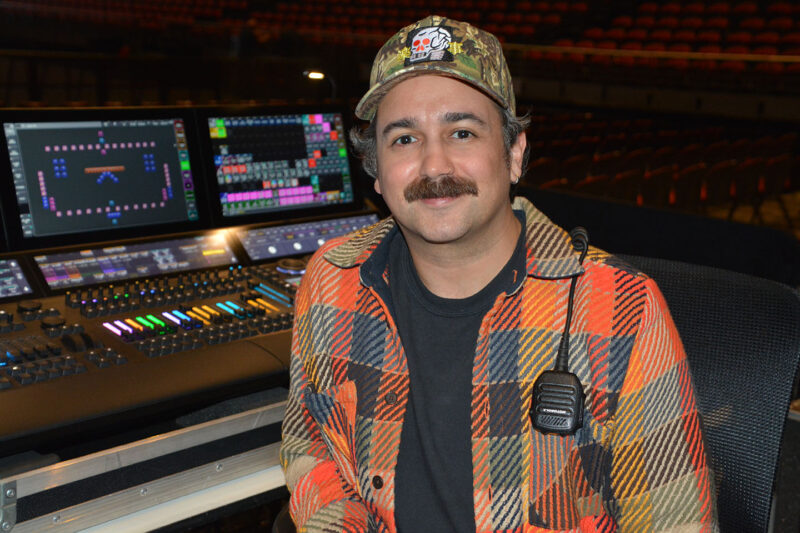
Sweatt clearly enjoys translating David Finn’s design night after night, commenting that he finds his theatrical element beautiful.
“It’s a little bit more work on my end to update things and make sure I get all the specials covered, but I think the end result’s gorgeous,” he said.
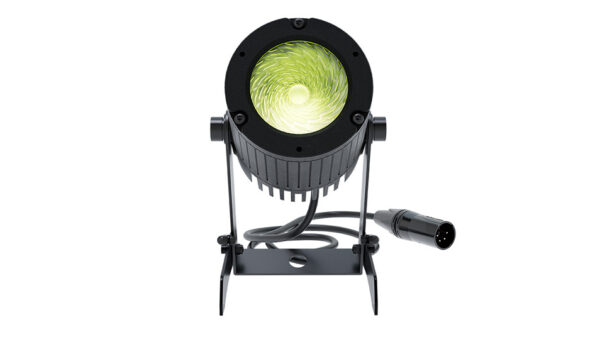
Key to the lighting design are the popular ACME Tornados, with 12 positioned on the downstage edge and eight creating a cross shape within the circular truss dubbed The Halo. The Halo was downsized from 12 spokes to four for the Asia and beyond legs since lighting was being sourced locally in each market. The Halo ring housed 12 Robe MegaPointes, with one more dead centre to the structure, as well as six Martin MAC Aura PXL.
Like the 10 GLP JDC-1s on the front truss, the Tornados are used in full pixel mode, and Sweatt admits to being a big fan of them.
“They’re not ideal at very low output, when you can start to see issues like the red chip coming on,” he said. “But they’re excellent for eye candy: the beams get incredibly tight, and when they line up cleanly, the look is beautifully uniform.”
The main profile fixture in the US and EU was the Vari-Lite VL3600, which was substituted with 44 Ayrton Veloce in this run.
“When substitutions are made, I just need a seriously capable profile that can handle everything we utilised in the VLs,” said Sweatt. “I hadn’t used the Ayrton Veloce before, but it’s been great. The colours are great, it has shutters, great zoom range and a lot of output.”
The Veloce line the downstage and upstage trusses, as well as the sides, creating a large box around the stage. There are also three per side on the downstage edge for shin-buster positions, plus two upstage on the floor: one for her entrance from behind the opening video wall, and another that rolls in to provide floor-level backlight and colour inside the arch.
A further 16 MAC Aura PXL are located on band risers and by the thrust.
In the US, Sweatt had Robe iFORTE® LTX FS Followspots, which Sweatt describes as producing gorgeous pastel colours, especially on Laufey. The Asian run used different fixtures for followspots at every gig, so Sweatt was relieved to have a couple of Ayrton Dominos with the PRG GroundControl Followspot System in Australia.
Adding to the show’s theatricality were four MDG ATMe high-output haze generators, a standard fog machine upstage centre behind the video wall for her entrance and exit, and two Chauvet Cloud 9 low-lying fog machines.
FOH has two MA Lighting MA3 full-size consoles, one as backup, with approximately two-thirds of the show on timecode. Alex Goldberg programmed the show.
Video
Video Director Kenneth LaBarre has had a varied career in the live production world and describes himself as the best failed musician ever.
“I’ve fallen into the right profession because it’s great to be doing this!” he declared. “When streaming took off in the United States in 2005 with the festivals like Lollapalooza, Austin City Limits, and Coachella, I was in on the ground floor of that. I was the lead director of Coachella, Lollapalooza, Austin City Limits, et cetera, working for Live Nation, AEG, and C3 Presents.”
Eventually, LaBarre switched to touring, working for acts such as Jack White, Chappell Roan, LCD Soundsystem.
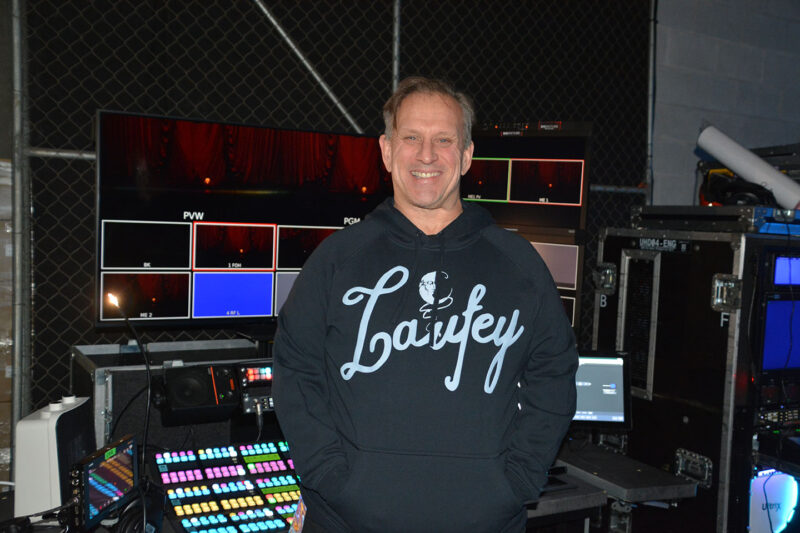
His broadcast background gives him the confidence to step into any environment—whether a truck, control room, or another live production setting—and feel at ease.
“I feel very fortunate to move between both worlds, especially now that artists often perform at festivals that are also live-streamed,” he said. “I don’t need a technical director or assistant director; I can run it myself on a switcher because I’ve worked through every role in the industry and understand what each one requires.”
Laufey’s team needed a video director with experience in both broadcast and cinematic production. LaBarre says many tours are shifting toward a more cinematic look, replacing traditional broadcast and standard video cameras with cinema cameras.
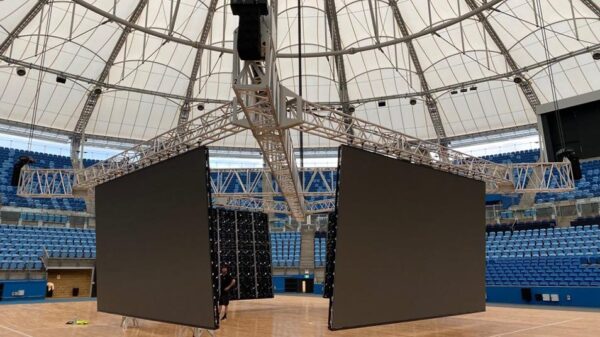
LaBarre says portrait screens are always the biggest challenge in arena shows because they offer limited space to work with.
“I try to balance it out because portrait screens make a cinematic look difficult; they keep everything centred,” he added. “So, I blend in wider shots that aren’t typical of an iMAG show. I think portrait screens have had their day, especially when there are dancers on stage, and you want to show the artist in context with the people around them.”
The Laufey show used three fixed tripod cameras and two gimbal cameras to create a Steadicam-style look similar to shows such as The Voice or Australian Idol.
“On those shows, you often see that iconic Steadicam shot circling the piano as the singer belts the final chorus,” LaBarre continued. “That visual language has carried into this production, so I rely heavily on my two gimbal operators.”
Panasonic broadcast cameras are used for the three fixed positions with DJI RS4 gimbals. Added to that are Sony FX3 cinematic cameras with a small, DSLR-size form factor. Sony G Master 16- 35 millimetre lenses with a variable neutral density on the front are added because the show is lit.
“It’s lit more like a theatre production than a rock show,” LaBarre said. “With light levels and white balance constantly shifting, variable neutral density is essential to stop the camera from blowing out.”
“Everything is 1080p 59.94,” he added. “I don’t use 4K on these shows because it wouldn’t add much. For a stadium-scale act like Taylor Swift, I would use 4K, but with these portrait screens, it doesn’t make a noticeable difference.”
LaBarre runs a Ross Carbonite TouchDrive 3 M/E switcher, which he describes as overkill for this show, but he loves having it. “The Ross Carbonite seems to be the best switcher for these tours, and also the system itself is very user-friendly,” he adds. “I know my way around it as I’ve been using it for over 10 years.”
Photos: Nicole Mago
This article first appeared in the October issue of Lighting & Sound International