











Advanced lighting control technology from Pharos Architectural Controls has been used to bring a large-scale, artist-led façade installation at the New Zealand International Convention Centre (NZICC) in Auckland to life. The project combines architectural lighting, flexible control and contemporary art to create a dynamic and evolving night-time identity for one of the country’s most significant new public buildings.
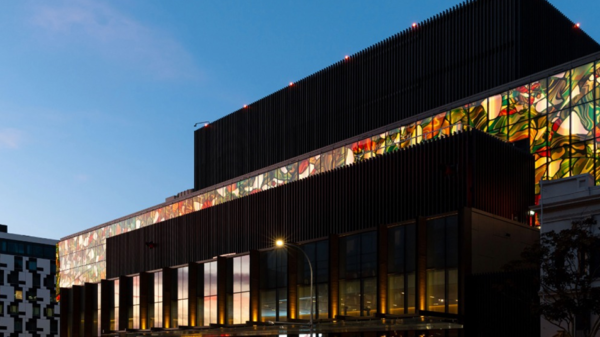
Positioned as the largest multi-purpose convention centre in New Zealand, NZICC occupies a full city block in Auckland’s CBD and has been designed to host international events at scale. Central to the building’s identity is the integration of permanent public artworks, including Iwi Rau (Many Leaves, One Canopy) by New Zealand artist Sara Hughes, a striking glass façade installation spanning multiple elevations of the building.

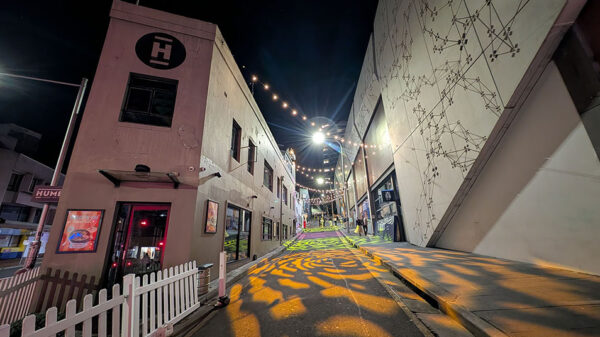
Comprising 475 individually printed glass panels, the artwork uses more than sixty colours and varying transparencies to reflect the shifting light, depth and movement of the New Zealand bush. By day, natural light animates the façade; by night, a carefully programmed lighting scheme transforms the building into a subtle, immersive canvas.
Lighting designer Richard Bracebridge of Light Works developed the lighting concept, working closely with Sara from the early design stages to ensure the illumination responded sensitively to the material qualities of the glass. Early mock-ups and on-site testing informed how light would interact with the ceramic frit surface, ensuring both daytime and night-time experiences were fully considered.
The lighting control system was designed and programmed by Nick Abel, Director at LS Group. It uses five Pharos Designer LPCs – one single-universe controller, two two-universe controllers, and a further two four-universe controllers – distributed throughout the building. Supported by a high-capacity Ethernet backbone and DMX distribution network, the system provides seamless control of thousands of individual lighting points integrated across the façade.
The power and flexibility of the Pharos system allowed each glass panel to be individually addressed, significantly increasing the creative potential of the installation. This level of control made it possible to move beyond uniform colour changes, enabling intricate gradients, layered effects and slow, evolving transitions across the building’s exterior.

The project team developed a two-and-a-half-hour lighting sequence inspired by the rhythms of the natural environment, transitioning from sunset through to sunrise. The programme is divided into a series of evolving scenes, including a simplified “rest” state during late night hours, ensuring the installation remains atmospheric without becoming visually overwhelming.
The result is intentionally subtle and non-repetitive. Rather than a fixed display, the façade continually changes, meaning visitors experience something different depending on the time of night or their movement through the city. Effects are designed to evoke natural phenomena such as shifting cloud cover, dappled light, and the soft luminescence of nocturnal flora and fauna.
The project presented significant challenges over its extended timeline, including a major fire in 2019 that required substantial reconstruction of the building and the complete remanufacture of the artwork. These delays, however, ultimately allowed for the control system to be refined multiple times, resulting in a highly flexible and future-ready solution.
In addition to the façade lighting, the Pharos system integrates with other control platforms across the building, including AV and theatrical systems, ensuring coordinated operation while maintaining clear control boundaries between different user groups.
Discussing the project, Tony Symms, Regional Manager for Asia Pacific at Pharos said, “NZICC is a great example of how advanced control can turn architecture into a living canvas. By giving the team the flexibility to individually address each panel, Pharos helped unlock an artistic and evolving result that responds beautifully to the building’s design and the surrounding environment.”
Artist Sara Hughes said,“I wanted the artwork to be a living canopy breathing life into Auckland’s CBD…Using the Pharos controls gave me the ability to paint with light, each panel could be individually controlled which allowed me to create slow gradients and subtle effects”
Director of LS Group Nick Abel added, “The scale of NZICC required a control system that was both powerful and adaptable. Pharos allowed us to refine the design over time and ultimately deliver a solution where the entire façade could be treated as a dynamic, architectural canvas. The level of control we achieved enabled a far more nuanced and artistic outcome than originally envisaged”.
From a Pharos perspective, the project highlights how advanced lighting control can support large-scale creative collaboration, enabling artists, designers and programmers to deliver complex, site-specific experiences.
The result is a landmark installation that merges art, architecture and technology, creating a distinctive and evolving night-time presence for Auckland’s skyline while celebrating the natural identity of New Zealand.
Project Credits
Project: New Zealand International Convention Centre (NZICC)
Client: SkyCity Entertainment Group / New Zealand Government
Artist: Sara Hughes
Lighting Design: Light Works Ltd
Lighting Control: Pharos Architectural Controls
Lighting Programming & Integration: LS Group
Photography: New Zealand International Convention Centre