















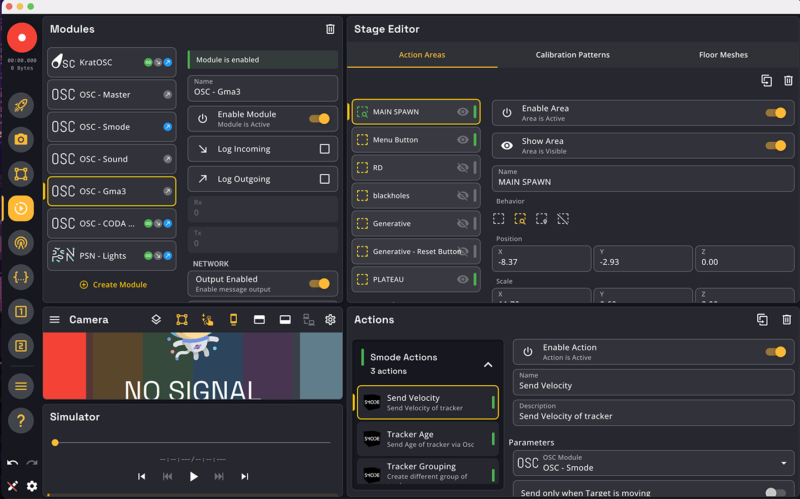
Smode Tech has announced that SMODE will be the first media server platform to natively integrate KratOSC, the open communication protocol developed by Naostage for its Kratos beaconless performer tracking system. The integration enables SMODE users to access a full range of real-time tracking data, including spatial zones, movement speed, and detection age, without manual configuration. This will open up new creative possibilities for immersive installations and live performance environments.
KratOSC is an open protocol built on the widely adopted OSC standard, extended with a data structure designed specifically for the demands of performer and object tracking. It exposes persistent target identifiers, 3D positional data, movement speed, detection age, spatial zone assignments, and grouping logic, enabling receiving systems to respond not just to where a performer is, but to how they are moving and how long they have been present within a defined area.
“We developed KratOSC for one simple reason. We believe the value of a tracking system is measured, above all, by what creatives and integrators can do with it,” says Paul Cales, CEO and founder of Naostage. “An open, documented protocol is a guarantee for our clients and partners that Kratos data can feed into their ecosystem without depending on us, without a proprietary intermediary, and by integrating naturally into existing workflows.”
The integration was developed during a three-day residency held at Naostage’s facilities near Rennes, France, in April. Working side by side, Naostage developer Joshua Kieffer collaborated with Smode Tech developers Théo Arnauld Des Lions and Aurore Bordes, with product specialist and training manager Erwan Tehel and business developer Thibaut Georgelin from Smode Tech also present throughout. The teams worked from a shared roadmap rather than a fixed specification, allowing the technical and product decisions to be resolved in real time and iterated immediately. This pace, both sides note, would not have been achievable working remotely.
“The relationship between software users and their developers is generally limited to automated emails and social media exchanges,” says Tehel. “But we believe it’s important to be present on the ground, particularly in the live performance world. These development days were genuinely defined by a spirit of collective engagement, both in meeting the teams from Naostage and Spectaculaires in person, and in thinking together about the collective interactive experiences that the combination of Naostage and SMODE makes possible.”
The integration gives SMODE three core capabilities. The first is full access to Naostage’s Action Areas – definable zones within the stage or installation space, each carrying a persistent UUID, which allow designers to trigger or modify visual content depending on whether a performer enters, occupies or passes through a given zone. Area logic of this kind was already available within Kratos, but recent additions to KratOSC made it considerably more simple to surface a complete picture of those areas inside a receiving system. SMODE is the first platform to integrate Naostage’s area system in full, giving designers a spatial scripting logic that extends creative control well beyond simple position data.
SMODE also gains access to enriched per-target data from Kratos, including movement speed and detection age, with the latter tracking how long a given individual has been continuously identified by the system. These values allow visual behaviours to respond to the quality and character of a performer’s movement, rather than simply their location in the space.
A new TrackingSystemShapeGenerator element, developed as part of the integration, exploits the KratOSC data structure to generate shapes and geometries in real time, driven directly by tracking output. The element is intended for designers who want to work with tracking as a visual material in its own right, rather than using it solely as a positional control layer.
“Having KratOSC supported natively, rather than through an adaptor or manual configuration, means any SMODE user will be able to connect a Naostage system in a few clicks and immediately draw on the full range of tracking data to drive their content,” says Paul Cales. “Before this integration, a large part of what Kratos could deliver was inaccessible on the creative side. With the native integration, SMODE becomes a complete creative environment fed in real time by Naostage tracking.”
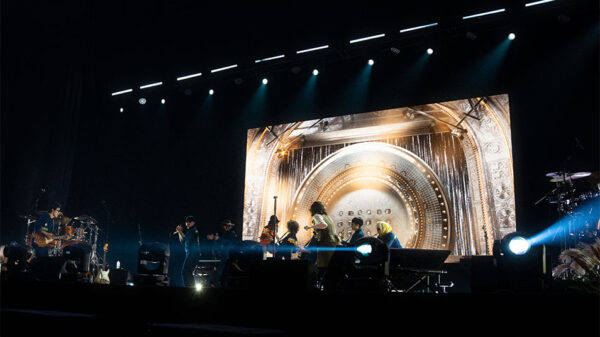
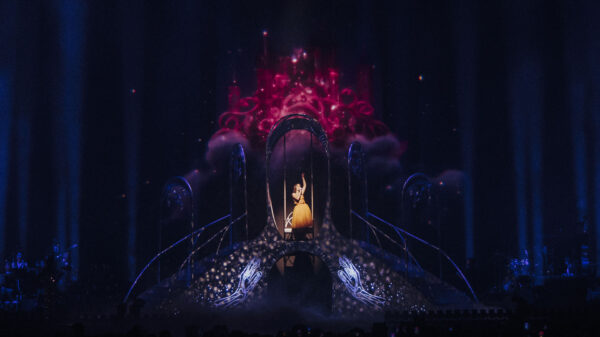
The integration was presented publicly for the first time on 17 April at an Immersive Tech Day hosted by Spectaculaires, a Brittany-based company with over 35 years’ experience in immersive scenography, monumental projection, and large-scale light events. The demonstration was built around the concept of a fest-noz, which is a traditional communal dance gathering in Brittany, a deliberate choice to anchor the technology in a popular cultural context rather than an abstract technical showcase. Performers were tracked in real time by Kratos, with SMODE exploiting the native KratOSC stream to generate visual content responsive to their movements, speeds, and interactions with defined spatial zones.
“The demo was designed to show how tracking data, specifically positions and movement speeds in this case, can drive real-time graphic creation,” says Thibaut Georgelin. “The aim was to demonstrate how these new capabilities open up entirely new directions for scenographic thinking. Seeing the possibilities in person always speaks louder than a spec sheet.”
Reception at the event was positive, with integrators, technical directors, and creatives in attendance moving from the demonstration into concrete discussions about project applications. The SMODE and Naostage combination is seen as well-suited to a range of environments, including permanent immersive installations, live performance or theatrical productions, and popular or community events, where beaconless tracking removes the need for performers or participants to carry any additional equipment.
The native KratOSC integration is coming soon to SMODE. Both teams are completing final testing ahead of release, and a date will be confirmed in due course.
“SMODE is the first media server to integrate KratOSC natively at this level of depth, and we hope that will inspire other players in the industry to make the same journey,” says Paul Cales. “For Naostage, this confirms a direction. KratOSC is not an internal tool. It is a standard we intend to build with the whole ecosystem. We have further residencies and integrations in the pipeline.”