


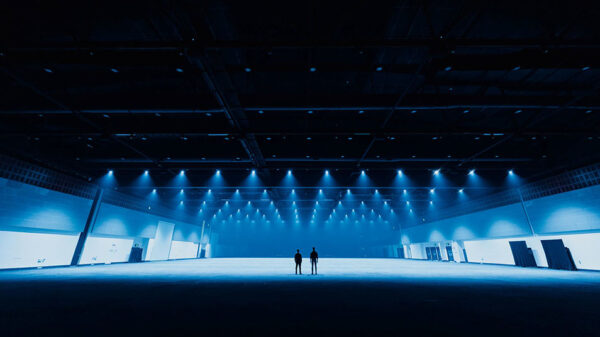
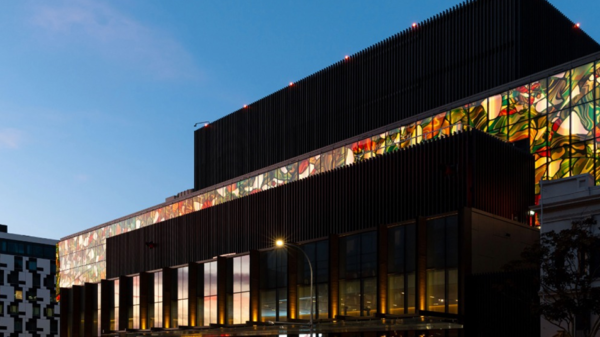


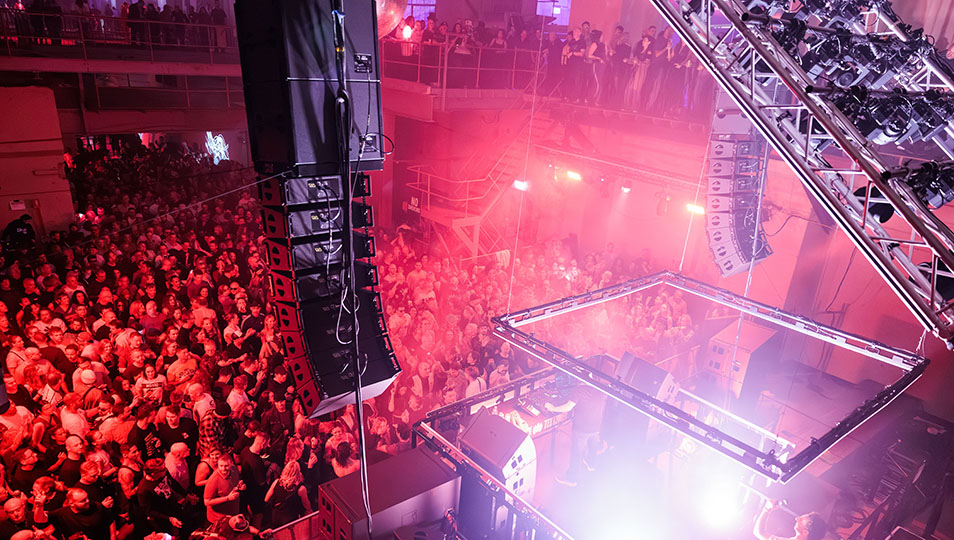
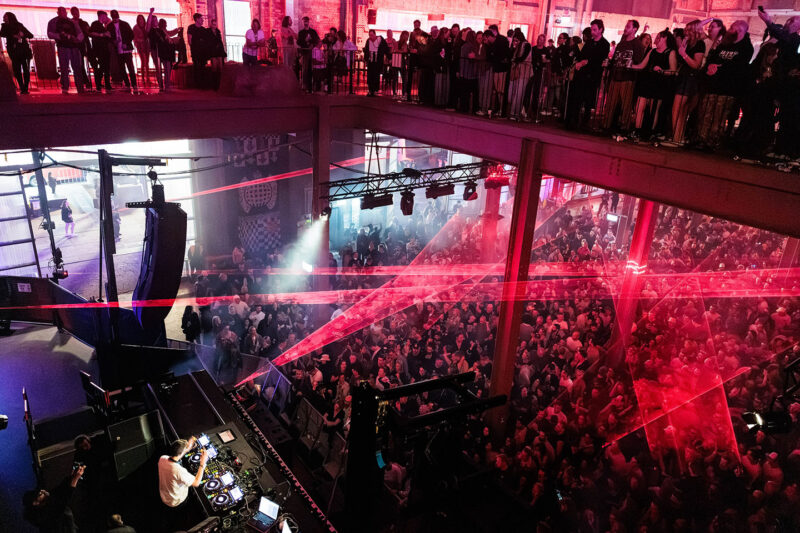
White Bay Power Station opened in 1917, built by the NSW Railway Commissioners to power Sydney’s trams and later its rail network, along with suburban homes and businesses. It ran for close to 70 years, was decommissioned in 1984 and was added to the NSW Heritage Register in 1999. Following remediation and conservation works carried out between 2021 and 2024, the coal-fired plant at Rozelle opened to the public in March 2024 as a cultural, commercial and community precinct. Its halls are large, high-volume industrial spaces with substantial height, hard surfaces, long throws and segregated open voids above the floor, and the site sits alongside the residential streets of Sydney’s inner west.
In July 2026 the power station hosted the Sydney leg of Ministry of Sound Testament, a warehouse-style touring series built around curated sessions celebrating the club culture of the nineties and early 2000s. The 2026 edition ran across 11 nights in seven cities in Australia and New Zealand. Sydney took three sold-out shows over two stages: a nineties session on 18 July with Danny Tenaglia, Darren Emerson, Brandon Block and Altern 8, and two 2000s sessions on 24 and 25 July with Booka Shade, Crookers, Riva Starr and Sinden.
Audio, lighting, video and staging were supplied by Sydney-based VLA Production, primary production supplier to Testament Sydney since the inaugural event in 2021 and a longstanding partner of Ministry of Sound Australia and its booking and talent division, Soapbox Agency.
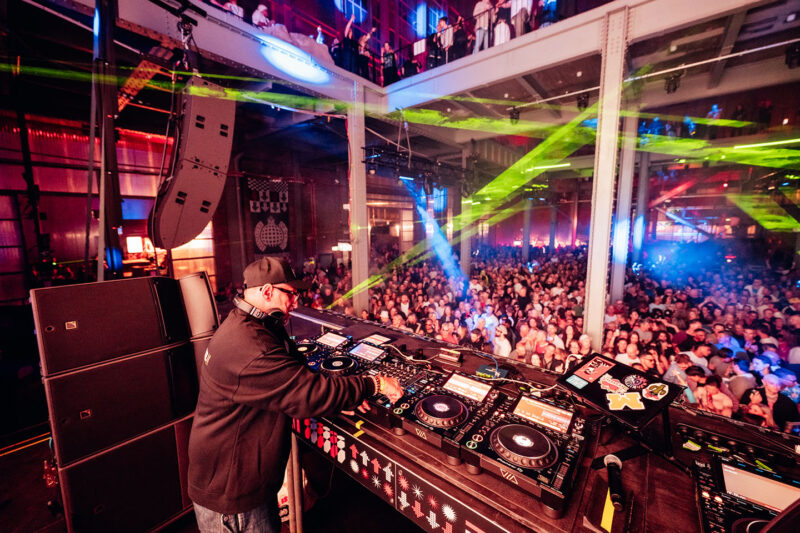
The building carries no in-house technical infrastructure, so every element of the production was brought in and built specifically for the run. For 2026 VLA invested in the L-Acoustics L2 platform, and Testament at White Bay was the company’s first major deployment of the system, supported on site by Group Technologies Australasia, the L-Acoustics distributor for Australia and New Zealand. When VLA took delivery of the system earlier in the year, the L-Acoustics Australian team conducted on-site training at the company’s Sydney headquarters, preparing the crew ahead of the Testament run.
Concrete, Heritage Protection and Neighbouring Homes Set the Brief for L2
“The brief was clear: deliver a system that feels like a world-class festival inside a heritage-listed industrial building, without compromising the building, the neighbours, or the audience experience,” says VLA Production Director Keith Eisenhuth.
The building’s industrial architecture of concrete, steel and vast reflective surfaces generated strong reflections and intelligibility issues that had to be modelled and controlled. Heritage protection limited where the team could rig, run cable and mount equipment, so every position had to be planned with precision. The venue’s position among the residential streets of the inner west made off-site noise management critical, requiring a design that delivered high impact inside the building while tightly controlling spill outside it.
Soundvision Resolves Coverage Before Load-In
VLA had a generous lead time on the project and used it to design, model and refine the system well ahead of the physical build.
Soundvision was used to model the system’s coverage throughout the venue, configure array aiming and angles, and workshop subwoofer configurations for controlling sub frequencies. This offsite modelling gave the team confidence on arrival at the venue that the coverage, SPL distribution and performance of the system would meet the requirements of the event.
“Soundvision was invaluable because it let us solve problems before we ever stepped foot in the venue,” says Keith Eisenhuth. “By the time we arrived on site, we already knew the coverage, SPL distribution and potential trouble spots, which meant faster deployment, cleaner tuning and a system that behaved exactly as expected from the very first show.”
L2 and L2D Cover the Main Dance Floor with Two Enclosures per Side
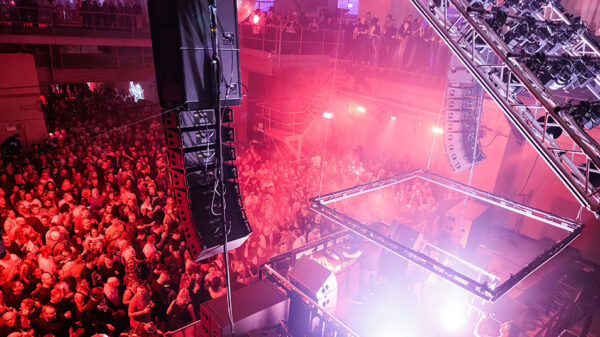
The main dance floor was covered by one L2 and one L2D per side, L2 carrying the long throw down the length of the room and L2D covering the nearer floor. Both enclosures pair Panflex horizontal directivity control with an integrated cardioid pattern, holding energy on the dance floor and off the surrounding structure and the streets beyond it. The flush-fitting four-point captive rigging shared by the two enclosures, and the single connector feeding each one, held attachment points and cable runs to a minimum, which is what the heritage restrictions on the building demanded.
Low frequency came from nine cardioid-configured KS28 arranged in three clusters. Kara II provided in-fill across the front of the room. Delay positions ran two A15 Focus and one A15 Wide per side, while the VIP and upper-level areas were covered at four positions by Syva over Syva Low, each above an SB18 for extended low-frequency support. DJ foldback ran one KS21, one A15 Focus and one A15 Wide per side.
Amplification ran on LA-RAK II and LA-RAK III. System control and tuning were handled by an L-Acoustics P1, with an LC16D forming part of VLA’s primary AES signal path, keeping the architecture fully digital while carrying the channel count and distribution the L2 deployment required.
Kara II and KS28 Run the Second Stage
The second stage ran its own dedicated system. Nine Kara II and two SB18 per side formed the main hangs, with six cardioid-configured KS28 ground-stacked three per side with two X12 handling out-fill. DJ foldback matched the main stage at one KS21, one A15 Focus and one A15 Wide per side. Amplification ran on LA-RAK II, with control again handled by P1.
L2 Sets the Benchmark for VLA’s Future Productions
Feedback across the three nights was consistent. Visiting engineers remarked on how balanced and controlled the room felt even at high SPL, and on how quickly they could get comfortable on the rig. Artists and DJs praised the clarity and impact of the low end, noting that it translated their sets as intended without becoming harsh or fatiguing.
“White Bay Power Station is a uniquely challenging space, and for our first major deployment of the L2 system we wanted to ensure every detail was validated,” says Eisenhuth, crediting both L-Acoustics and Group Technologies Australasia for their support. “Their willingness to come on site, review our design and assist during commissioning made it a great experience.”
“Investing in the L2, and in the broader L-Acoustics ecosystem, has significantly elevated VLA’s capability, giving us the consistency, headroom and flexibility needed for bigger, more complex shows,” concludes Eisenhuth. “The launch of our L2 at Ministry of Sound was an incredible kickoff, a moment that immediately showcased what the system could do.”