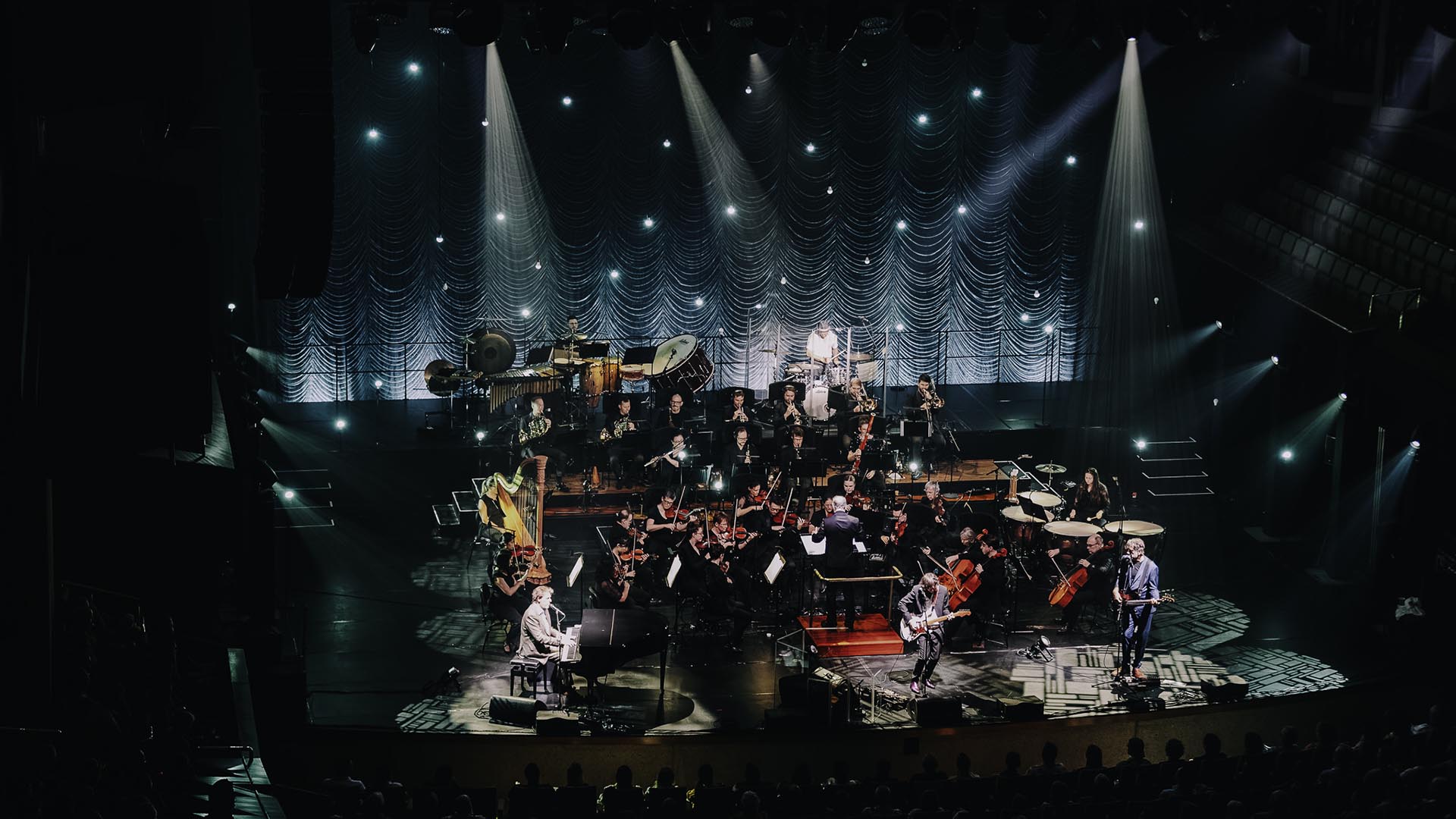
The Whitlams was the first Australian indie band to perform with Australia’s finest orchestras back in 2004, and the show has developed in the ensuing 20-plus years as new albums have been written and released.
The past few months have seen the band share centre stage with Australia’s finest orchestras as they tour the country again, and the tour hasn’t finished yet, with shows in Canberra, Adelaide and Perth coming up.
Production Manager and Monitor Engineer Clayton Davies has worked with the band for several years, although usually as a four-piece rock band. For this tour, he decided that an Allen & Heath dLive console was essential for monitors and the FOH mix.


“We’ve incorporated the ME-1 40 Source Personal Mixer, which just networks straight out of my console, so it’s super streamlined, and it’s a turnkey system for the orchestra members that require personal mixing,” commented Clayton.
Clayton adds that after a couple of tours, FOH Engineer Brendan ‘Bloss’ Keane and he discussed with the band the consistency and time management required for this type of show and hence the need to avoid different consoles at every show.
“Tim’s definitely someone who values time, so once we pitched to him that we can fly this console around with us everywhere, he was sold,” said Clayton. “I use the dLive CTi1500 at monitors, which is what we usually use as a four-piece formation, and then Bloss has a dLive S5000 or S7000 at FOH. I get all the inputs from him via the GigaACE audio networking card. It’s a digital tie-line, so we don’t have to worry about passive splits or anything like that. The orchestra’s engineer gives Bloss the stems from their console, and then Bloss just sends me all the inputs via the GigaACE card. We don’t have to worry about extra patching.”

Having worked with The Whitlams on many orchestral shows already on this tour, Clayton doesn’t find the gig itself too demanding, as he is used to personal differences despite having a different orchestra at every gig.
“I originally started this tour by doing scene changes for every song, as Tim had some requests,” said Clayton. “However, as the tour’s gone on, I’m not using them anymore because there’s only the tiniest little movements that happen. For example, Tim will start the show out front, not behind the piano, and he wants more strings for that, since he has to rely on them to keep time. But then there’ll be another song where he might just need a little bit more brass because they have some stabs that he really needs to get the timing from. Other than that, it’s me literally just waiting for them to tell me what they need more for themselves. It’s all been pretty streamlined and straightforward”.
“I’ve also given them hotshot mics that can talk to my ears directly without having to wave at me and cause a fuss. Which is the way it’s done these days on a lot of professional touring levels. It’s just a little button that lets Tim talk straight to my ears, without stopping the show or making it look unprofessional.”


Using the ME-1 40 Source Personal Mixer within the dLive consoles means Clayton does not have to use an Aviom System and Dante patch every time to make it work for an orchestra.
“This is as simple as running a Cat cable out of my CDM rack and just plugging it into these units, and it automatically labels the channels for you; it already picks up all the inputs out of the frame without me doing anything. All I’ve had to do is assign which input to which key, and it retains its value. So, I haven’t had to reprogram anything at all on the tour. I did it once, and that just stayed there.”
Clayton adds that the real advantage of continuing to use dLive for this tour is that it just makes sense to use these mixers; he doesn’t have to babysit anything, and nothing changes.
“We programmed all the tie-lines and haven’t touched them since the start of the tour. You turn the console on, load your showfile, and it’s done; we don’t even have to talk about the patch. Because these are big days and there’s a lot involved, the last thing we wanted was to waste time on things like that.”

With IEMs, everyone uses 64 Audio earbuds, whilst the packs are hired locally, usually Shure PSM 1000.
A different orchestra engineer is employed in each city, so their choice of mics is always at their choice/discretion. For The Whitlams, Bloss has been touring the same mic kit around since he joined the team. Vocal mics for guitar (Jak Housden) and bass player (Matt Fell) are Sennheiser e945s. Tim’s vocal mic is a DPA d:facto. Guitar mics are a combination of Shure SM27 and Sennheiser e906. There is no bass amp; direct XLR into the SansAmp pedal. Piano is a Yamaha CP88 which is also direct XLR.
Drum mics are In – Shure 91A, Out – Beta 52, Snare top and bottom Shure SM57, Rack and Floor Sennheiser e904, Hi hat and Ride Rode NT5 and overheads Shure SM27.

The lighting design was by Bryce Mace, and they are touring a bunch of Astera NYX Bulbs to add to the venue’s in-house lighting. Will Todd was the lighting director. The show was controlled by a combination of MA3 full-size and light, with a simple overhead wash/spot rig varying between Martin MAC Aura XIP, Mac Ultra, MAC Viper XIP, Ayrton Zonda, Perseo, and Eurus.
Photos: Isis Tortora – @isisxamber.photo