You’ll find Allen & Heath in venues all across the world, their products serving both to push the envelope of sound as well as providing products that’ll outlast many of the local bands whose sound they process.
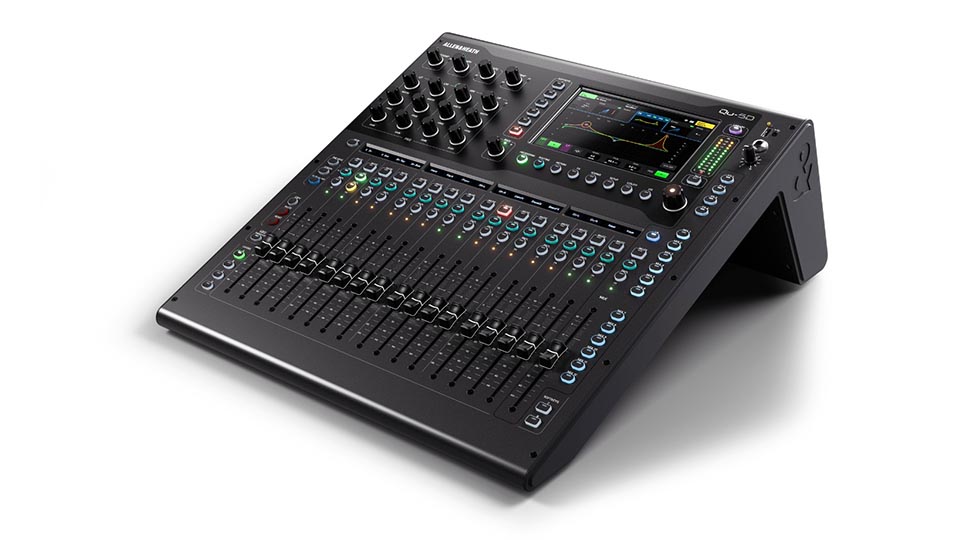
The Qu-5D falls into the former category, the Qu-5 being part of next generation in the new Qu series mixers, while the addition of the ‘D’ in its name communicating that this mixer is equipped for Dante, allowing for expanded connectivity, flexible routing and above all, a future-proof design. It’s important to note that the Qu-5 can’t be equipped with Dante after the fact, and this is the only thing that differentiates the Qu-5 and the Qu-5D, as well as a slight increase in price for the Dante-equipped model we’re reviewing here.
The Qu-5D is the smallest in the range of Qu mixers, at least in footprint. Featuring 17 motorised faders and four layers, the Qu-5D expands quickly from a tidy little mixer into something well and truly capable of mixing larger bands, groups and shows with ease. The 17th fader on the far right of the fader bank is intended for use as a master mix fader, while the remaining 16 faders can be used for separate tracks and signal.
Read the full review on www.mixdownmag.com.au
Allen & Heath has announced the release of dLive firmware V2.1, building on the V2 release with new processing and RackUltra FX as well as expanded wireless integration, group to group routing, and requested workflow features from the user community.
Headlining V2.1 is CompStortion, a DEEP emulation of the hardware compressor. With a range of attack and release times, distortion modes, and Smash and Brit modes, CompStortion is suited for vocals, guitars, drums and mix bus compression.
The RackUltra FX card now offers Rhythm Delay, an advanced in-console delay. A unique pattern-based delay engine provides customizable repeat patterns and musical filtering in unlocking delay possibilities of studio plugins.
V2.1 also expands the power of the Actions system. Engineers can now trigger an action from a scene recall or via a MIDI trigger; recall a bookmark via an action; apply relative changes to send and main levels; recall the channel processing library; and trigger actions on a dynamically selected channel or mix.
dLive’s wireless integration is extended with the addition of support for the Shure SLX-D wireless microphone system. Users of SLX-D systems can monitor transmitter battery level, RF signal strength, and receiver audio signal level in addition to control of receiver mute and gain from the dLive user interface.
In addition, engineers can now utilise group-to-group routing to build complex processing chains and consolidate mix buses; for instance, kick and snare groups into a main drum group, or all groups routed to a main band group.
Additional enhancements in V2.1 include the ability to unmute a member of a Mute Group, a new Gain Link option for the Peak Limiter 76, plus improvements to Scene Safe GUI, log files, and Director metering and UI responsiveness.
“This release includes some real crowd-pleasers,” says Nic Beretta, director of product at Allen & Heath. “CompStortion adds to the DEEP arsenal, Rhythm Delay opens fresh creative rhythmic effects, and Shure SLX-D integration brings more wireless control into the fold.”
dLive V2.1 is available now from the company website.