Yungblud (real name Dominic Richard Harrison) is a popular English singer, songwriter, and actor known for his genre-blending, rebellious rock music that fuses punk, pop, and hip-hop, often tackling themes of youth, social issues, and identity.
Hailing from Doncaster, UK, he gained prominence in the late 2010s with hits and collaborations with artists such as Halsey and Machine Gun Kelly, becoming a voice for a generation through his energetic performances and outspoken personality.
Yungblud’s “IDOLS” World Tour hit Australia last month, and his shows were lauded for their power and emotion. Somehow, he managed the impossible by making an arena show feel intimate and personal.

Yungblud’s FOH Engineer Owen Charles began his career in live sound twenty years ago, working in the smallest venues in London with a couple of speakers on sticks and a Mackie analogue desk.
“I had my own Behringer stereo two-channel compressor I’d bring around to the venues that didn’t have anything,” he said. “And then I just kind of worked my way up from there.My first proper tour was mixing monitors for Macy Grey and also D’Angelo in 2012. After a couple of years I realised I only wanted to do FOH so I quit doing monitors and started working in hip-hop for MF DOOM and Jay Electronica, I then landed the Pendulum gig. Whilst working for Pendulum Owen started mixing for an up-and-coming artist called Yungblud and decided to purchase a Waves LV1, which he says sounds incredible, but he eventually ran out of channels.

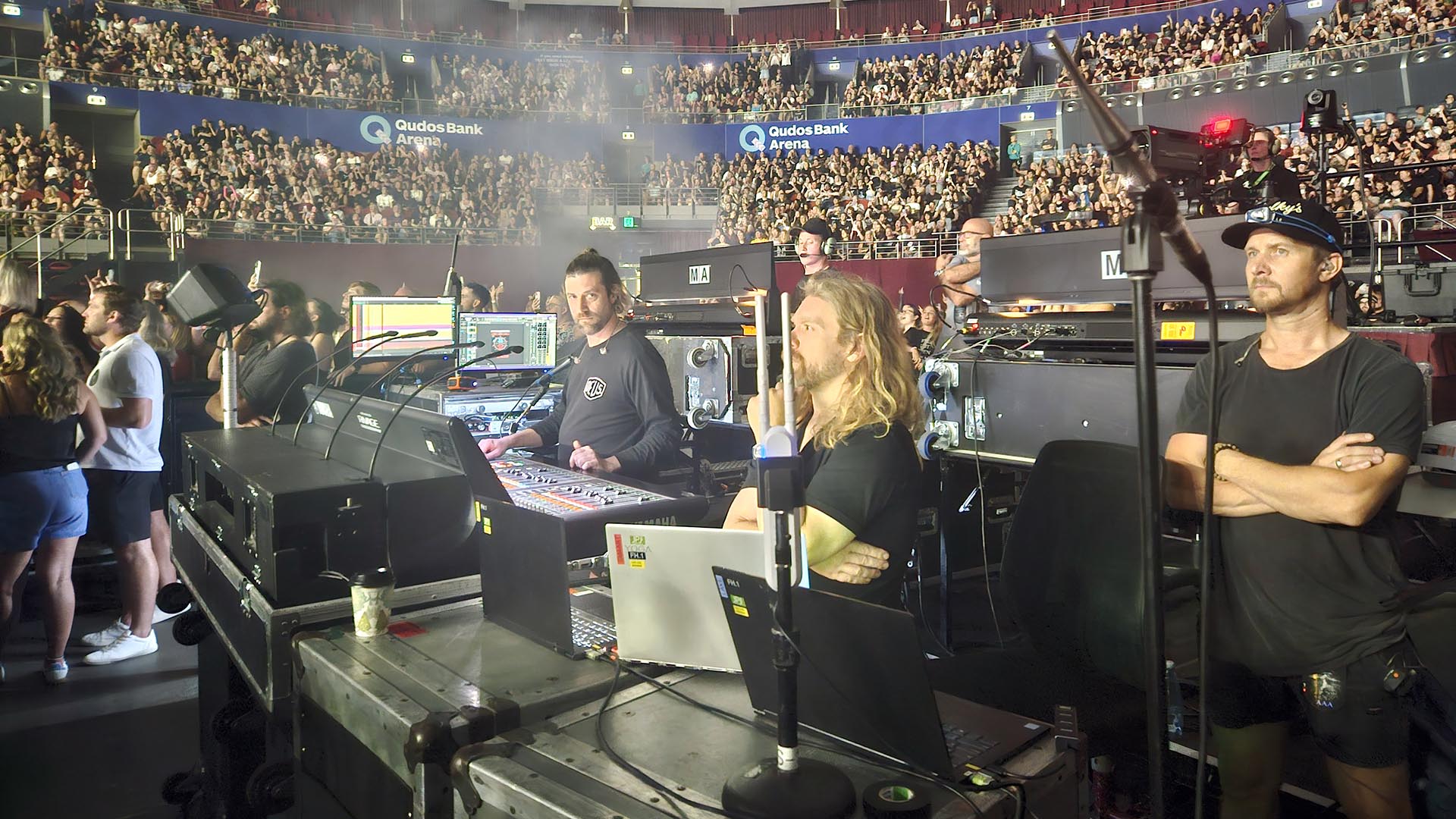
“I’m now on a Yamaha Rivage PM7, sharing gains on stage with Scott Howarth, our monitor engineer, who is on Dlive. I had to switch to the Rivage at the last minute because more channels kept being added and eventually I ran out. The way we setup our system is Scott’s on an Allen & Heath dLive console, and they have the DX remote stage boxes. Wehave one stage right for guitar world, one for drum world, one for playback world, and then we just run Ethernet and power, and that gets rid of a lot of weight. So, when I had to switch desks, rather than change everything, get a split and re-design our whole touring rig only a few weeks before we started rehearsals, I decided to stay on the dLive preamps for now, which is a shame, because obviously the Rivage preamps would be nice.”
Owen explains that he takes timecode from playback that goes direct into the Rivage, then into Reaper, which follows thetimecode. On the Reaper page, he can do fader automation for any channel, any kind of MIDI automation, which is basically what you do on the old SSL or Neve consoles when you’re mixing in the studio.

“It’s literally exactly the same thing,” he remarked. “Obviously, you still have your snapshots for each song as well. And then on top of that, I’ve got Waves integrated with the Yamaha processing. Initially, I tried to keep everything on board the Yamaha and just use the Waves stuff that I really couldn’t live without, but then, as I continued, I’d add more, and I’ve slowly gone back to relying more on Waves. I’ve also got a separate computer running Reaper again, just for recording and virtual playback.”
Outboard-wise, Owen has a Rupert Neve Master Bus Transformer solely for the silk setting, which he finds very useful.
“For example, we were in an arena somewhere in Europe, and I was speaking to my system engineer about how the audio was not in my face enough, and he was thinking about maybe boosting a bit of EQ here and there, and I was like, wait a minute, just increase the red silk!” explained Owen. “Adding those extra harmonics made it perfect, so it’s something I adjust to the room because you’ve got the blue sort of low mid and you’ve got the red sort of sheen.”
Owen also has a Manley Master Buss analogue EQ to add a touch of warmth to theroom.

The Yamaha Rivage PM7 console was chosen primarily for sound and reliability. Owen says that certain technical elements of the desk can be a touch clunky, but it’s a rock solid console and sounds fantastic.
“The Rivage PM7 has great automation capabilities,” he continued. “All the onboard processing is really good. But I think at some point soon, our monitor engineer’s going to have to switch to DiGiCo because he’s run out of busses. Then I might bite the bullet and go to DiGiCo too, so we’re all together. We shall see”
When mixing Yungblud, Owen says his vocal must be in your face the whole time. He’s an incredible vocalist and very unpredictable both dynamically and also performance wise. He has a multitude of mic techniques, depending on the style and genre he’s singing in, which makes for a fantastic technical challenge behind the faders”
“It’s about trying to contain that energy sonically while still representing its message but without taming it or watering it down” Owen added. “On top of that, the whole mix sounds huge because that’s the sound (and performance) they’re producing from the stage. I don’t mean loud, it is a loud show, but it’s not about that, I mean in terms of the performance, it’s huge and honestly unbelievably good (trust me I’ve seen thousands of shows and this one is special). YB and the band together are an immovable force, it’s a pleasure to be behind the desk trying to contain and manage the unfolding chaos.”
Usually, Owen prefers a d&b PA system, but for the Australian tour, he had an L-Acoustics K1 system, which he left in the capable hands of JPJ Audio’s Luis Herd.
“I’m happy with the K1, it’s quite nice because I haven’t toured with K1 for a little while,” said Owen. “It’s quite interesting to just directly compare. Any of the top PAs, if they’re set up correctly, can give you a great show. We’ve got a huge tank of K1, with some K2 at the bottom, some flown subs up top, and K1 sides as well. And then, just ground stack subs. The low mids really do sound so warm compared to other PAs.”
According to Owen, the microphone selection is as standard as you can get. “ It’s a classic package with Shure Beta52a kick out, Shure Beta 91a kick in, Shure Beta 57a snare top, Sennheiser e604 snare bottom and Sennheiser e609 toms.Neumann 184s, the small diaphragm condensers for overheads, hats and rides, for all the metal.

Yungblud has been known to pour water on the drums, destroy the drum kit, throw guitar mics … so it made sense not to go with anything too delicate. Basically we went for high quality choices that are easily available worldwide.” He uses a Shure SM58 vocal mic after they tested a wide range of options.
“We tried everything, and eventually our MD at the time, Vinnie Ferra, was really excited about the sE Electronics V7, so we spent a year or so with him on the V7,” revealed Owen. “I just didn’t get on with it; it broke up in a weird way distortion wise that me and Scott weren’t super happy with. But Dom loved how it looked, so I tried to get him back on the Shure SM58, and he wouldn’t do it. So, out of desperation, I replaced the Shure SM58 grillwith the V7 grill, and it sounded amazing. Now he’s actually on the original SM58 grill. You know you can’t destroy them,and they sound great.”
After the Australian tour with Yungblud and before they start a UK arena tour, Owen has returned to Australia to mix Pendulum, an act he has also worked with for many years.
Performance shots: Glen Pokorny I Qudos Bank Arena