After two years away from the spotlight, global superstar Lewis Capaldi is well and truly back with a new album and tour.
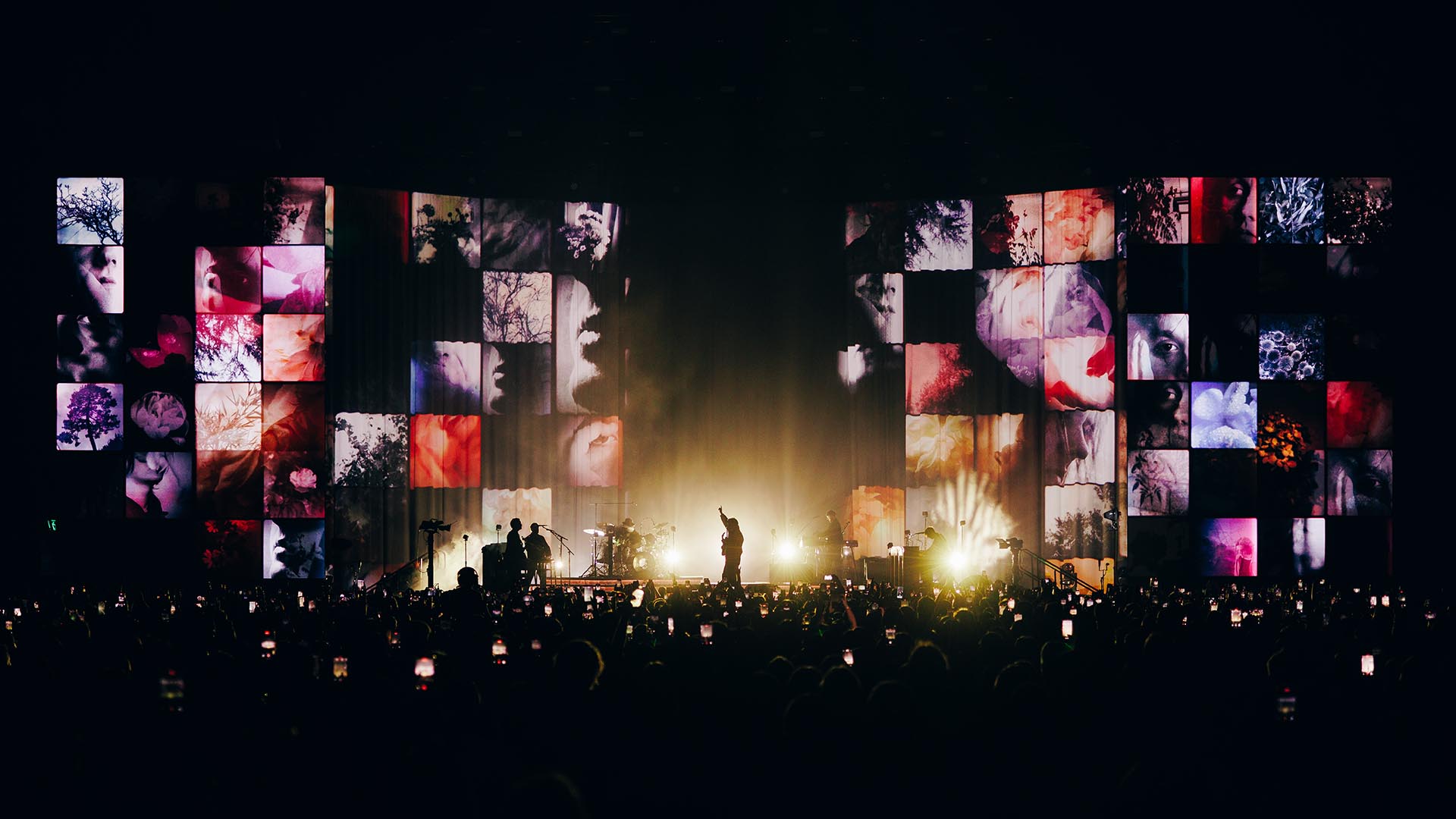
The first iteration of the show design for his Survive Tour premiered in the UK in September, and a couple of months later, it landed in Australia for a string of sold-out shows. Lighting and Production Design is by Cassius Creative, with Beki Mari joining the team as Creative Director. Together, they created a design that ensures Capaldi never feels isolated onstage, with his band wrapped around him rather than behind him.

Beki Mari is known for her work in film direction, creative direction, and design. She is recognised for her unique contemporary style and respected within the global creative community. She was asked to meet management and then pitched some ideas.
“They wanted something that felt honest and intimate, without leaning into obvious tropes or overly polished aesthetics,” explained Mari. “The emphasis was on capturing mood rather than spectacle – something that felt timeless, personal, and reflective of where Lewis was creatively at that point.”
Mari’s first thoughts were about letting small details do the heavy lifting. She was interested in exploring contrast – softness versus grit, clarity versus distortion. It was important that the image not feel overly literal or descriptive but leave space for interpretation.
The LED Absen “window” and the circular staging became the compositional roots, acting as subtle frameworks rather than overt concepts. They helped anchor the design while still allowing it to feel open and intimate.
“The response was very positive,” Mari said. “Lewis connected with the mood and the emotional undercurrent of the ideas, which was the most important thing.”

One of the main challenges was maintaining emotional authenticity while working within practical constraints, such as time and deliverables.
“We overcame this by staying focused on the core feeling we wanted to convey and letting that guide every decision – technically and creatively,” added Mari. “The live cameras were a big part of the overall show design. We brought in ARRI live cameras for the UK leg, which was really exciting, and the circular track gave us incredible dynamic movement. Being able to achieve a cinematic grade in real time helped create a polished music video aesthetic, which I felt really elevated the show.”
Mari states that working with Cassius was very collaborative. They exchanged references, test images, and feedback in real time, which helped keep decisions moving and prevented issues from bottlenecking later in the process.
“Cassius was particularly attentive to detail and clear about their perspective, which pushed the work to be more considered,” she commented. “The communication was direct, making it easier to address challenges without stalling the work or losing momentum. Ultimately, we were all really happy with the result.”
Mari is particularly proud of the window effect in The Day That I Die – how immense yet intimate it feels. She adds that the song is so personal, she wanted it to feel like Lewis was sitting alone in a grand hall.
“The lighting and composition really brought that vision to life, and I felt the song visually looked stunning,” she said. “I’m also really proud of the intro sequence. That piece was actually a combination of hundreds of images — part photos of Lewis, part Polaroids I took over the summer with my SX70, capturing flora and fauna. Catherine Woodhouse, my long-time collaborator and the content creator on the video team, meticulously assembled everything into the final sequence. The way all those elements came together felt magical, and it’s a piece that really rewards close inspection.
“Likewise, Almost, which takes on the same filmic hues and incorporates Polaroids inside the windows of the “apartment” block, felt particularly special and worthy of mention.”

Production
Capaldi has a lot of crew who have been with the camp for many years. There’s also a disproportionate number of Scottish accents backstage with Production Manager, Nick Lawrie, insisting that you definitely don’t need to be Scottish to work with Capaldi … but it doesn’t hurt!
The show’s architecture is the same in Australia, but it missed a few design elements, such as a large Austrian drape at the top of the show and some moving pantographs for lights at the back of the stage. The audience lighting was handled differently, and Pixmob wristbands were not used.
“We brought as much as we could over, but it’s not always practical to take everything everywhere,” remarked Lawrie. “But in terms of the main form, we have this huge curved upstage drape, which acts as a canvas. It can be beautiful when it’s just lit, but we also use it as a projection surface. The curtain opens and closes on a tab track system, and behind it is a Roe Vanish LED screen. So, you have all these different surfaces, and they can be lit in various ways. which is obviously a huge palette for content.”
Lawrie notes that he always has the audio crew ‘shove the PA as high as humanly possible’ to get it out of the way of the iMAG screens.

It was decided early in the design process that large iMAG screens were essential, so everyone could see Capaldi when he was performing. Capaldi is a very emotive performer, and many intimate moments needed to be translated into an arena.
“In the UK, we had a conversation with ARRI, who are traditionally a broadcast or movie camera manufacturer, and have some incredible kit,” added Lawrie. “So we brought ARRI cameras out for the tour to try them out, and they were great, and our Video Director was delighted.”
Lawrie says his main challenge in Australia is figuring out which parts of the show are non-negotiable and must be there for the show’s language to look consistent, so that the audience gets the show Capaldi wants to display.
“And then there’s the freight aspect,” he added. “No one comes here and does two weeks of pre -production. We go into the first venue and have a production day. Obviously, we’ve done the show before, so we know the pitfalls. In the UK, we were touring a custom stage to fit the show’s architecture. Whereas over here, we’ve gone local, with a kind of weird geometry, and we’ve rented a couple of bits that we integrate each day.”
In addition to the track for the ARRI cameras, the custom curved top set riser with LED trim was shipped. The server controls for video and projection, audio control, a lot of backline gear and the large drape were also shipped.
Video
Video Director Ed Coleman is the new guy on tour, having joined the camp at the start of this tour. Coleman must ensure that Beki Mari and Cassius Creative’s vision for the show is met, delivering intimate shots without camera operators on the stage. It’s the common conundrum of achieving an intimate show in an arena.

“The way the stage is laid out is interesting because everyone’s facing in towards Capaldi, so he’s not isolated, and I came up with the idea of using a custom-made curved track system around the stage, which provides 270° of camera access, enabling a variety of shots,” said Coleman.
Luna Remote Systems’ remote dollies are used to transport cameras. There is only one camera at the front of the house, and hence only one actual operator at a camera. Everything else is remotely controlled at the back of the house.
“Sometimes iMAG can just be functional iMAG, just coverage, which isn’t necessarily artistic, but what I always aim to do is artistic and immersive,” explained Coleman. “With this stage design and the track on the downstage edge, you get really immersed in Capaldi’s world.”
In the UK, Coleman used the ARRI Live cameras for the first time on a UK tour, but in Australia, they were replaced by Panasonic UDC4000 cameras, which he says are not quite as cinematic.
“It’s a lot more functional down here with the Panasonics,” he commented. “We were using a lot more of the shallow depth of field pulling focus through things on stage, while also using the vastly superior latitude of the ARRI cameras to create beautiful reverses with minimal audience lighting.
“It was the brief from Beki Mari to make it feel like a music video as opposed to iMAG. Having the luxury of the movement of the Luna dollies when it’s all in sync is just really, really lovely.”
Blackmagic Micro Studios G2 cameras are also placed on top of the dollies for wider shots.

“For example, there’s a guitar solo so we can have a whole body of Andy Black playing guitar, but we’ve also got a close-up at the same time so we can cut between them,” commented Coleman. “They integrate perfectly into the system, which has been a powerful thing, because they’re cinematic and my engineer Sam Siegel gets them to match the other cameras, opening up a lot more scope.”
Coleman ran a Ross Ultrix Carbonite production switcher, adding that he’s not doing much complicated keying on this show. In the UK, he had three channels of video cutting at points because they also did live streams, as well as the iMAG, out of the same setup. In Australia, it’s just two MEs with the upstage, independent screen for projection, and the two iMAGs are on one channel, so he is only cutting two video channels.
FRAY Studio created the video content for the show using Unreal Engine in combination with real-time VFX from Notch and rendered content.
Ed White programmed all the video content designed by Beki Mari using four disguise gx 2c media servers.
“It’s a relatively simple show in terms of the servers that we need,” he elaborated. “We’ve got quite a few outputs. We’re driving two Panasonic PT-RQ50K 4K projectors with separate feeds and then a 4K canvas for LED. It’s a timecode show, and almost all of the cameras are treated with Notch.”

Apart from a few moments between songs, it’s time-coded throughout, with disguise running from code and doing what it needs to. ?? states that his job is more of a technical one on this show rather than controlling the creatives.
“It’s just looking after the equipment and making sure that everything is lined up and calibrated beforehand with the projection,” he added. “At a couple of the venues, we’ve had issues with air conditioning systems because we’ve got an upstage curtain that needs to be projected on and lit from lights underneath as well. So that’s a challenge to work around air conditioning systems and gusts of wind that can blow things. It’s more of a lighting problem than a projection one, but it’s a constant battle, and we’re finding ways to move things around slightly to minimise it.”
Lighting
The lighting design was handled by Cassius Creative with Paul McAdams out on the road as Lighting Director.
McAdams notes that, unlike some shows these days, the lighting is not there solely to support the video elements.
“It’s definitely got its own thing,” he revealed. “It’s very classical, stylish, and almost theatrical. It’s not a big broad pop spectacle; it’s very much the music and drawing your attention into the set and the band, which is why there are a lot of side spots. These are very precise at hitting the band.
“The show features many ballads and slower songs, so a lot of the programming is subtle. It’s not just on, off, quick move on. Every cue is very thought out from one to the next. It’s precise, very soft, and very subtle, so you must be sure it’s blending correctly.”

Whilst McAdams deploys haze, it’s a struggle to implement due to the projection across the drapes. He says he must be wary that it’s not overpowering. Then there’s the eternal issue of the air conditioning in Australian venues, with the crew battling the drapes being blown around.
For the Australia run, the lighting setup was standard with three overhead trusses of Ayrton Veloce, their central primary spot profile fixture. More Veloce are located on four sets of Torm ladders for the primary side key light for Lewis and the band.
Out front were two Ayrton Domino LT spot profiles as main key fixtures on Lewis for the cameras. Eighteen Ayrton Rivales are flown with a further 23 on the floor. They provide eye-candy effects, beams, aerials, and animations.
“The Rivales are great, but this is my first time using Veloces,” remarked McAdams. The benefit is that they use the same engine as Rivale, which saved me a lot of hours on the initial build day and the programming. They come from the same range of Ayrton fixtures, so colours, etc., are the same, making updating presets and colour matching very easy.”
Eighteen Ayrton Domino spots are located behind the Vanish LED wall, and in front of it is a white translucent curtain with fans blowing to create movement. The effect is mesmerising, like light coming through the window.
Rather than traditional crowd blinders, 36 Martin MAC Viper XIP line the stage edge, also providing backwash on the stage when required. GLP JDC-1s supply standard strobe effects but only in white.
The massive, curved drape at the back is uplit by a bunch of Chroma Q Color Force 72, which McAdams describes as very punchy and bright.
McAdams was running an MA Lighting grandMA3 in MA2 mode, saying there are features of MA3 he doesn’t like, particularly the Phasers.
“In terms of programming a 20-song show and trying to do it quickly and comfortably, I still think the MA2 effects engine is better,” he said.
This article first appeared in the February issue of Lighting & Sound International
Show Photos: Christian Tierney