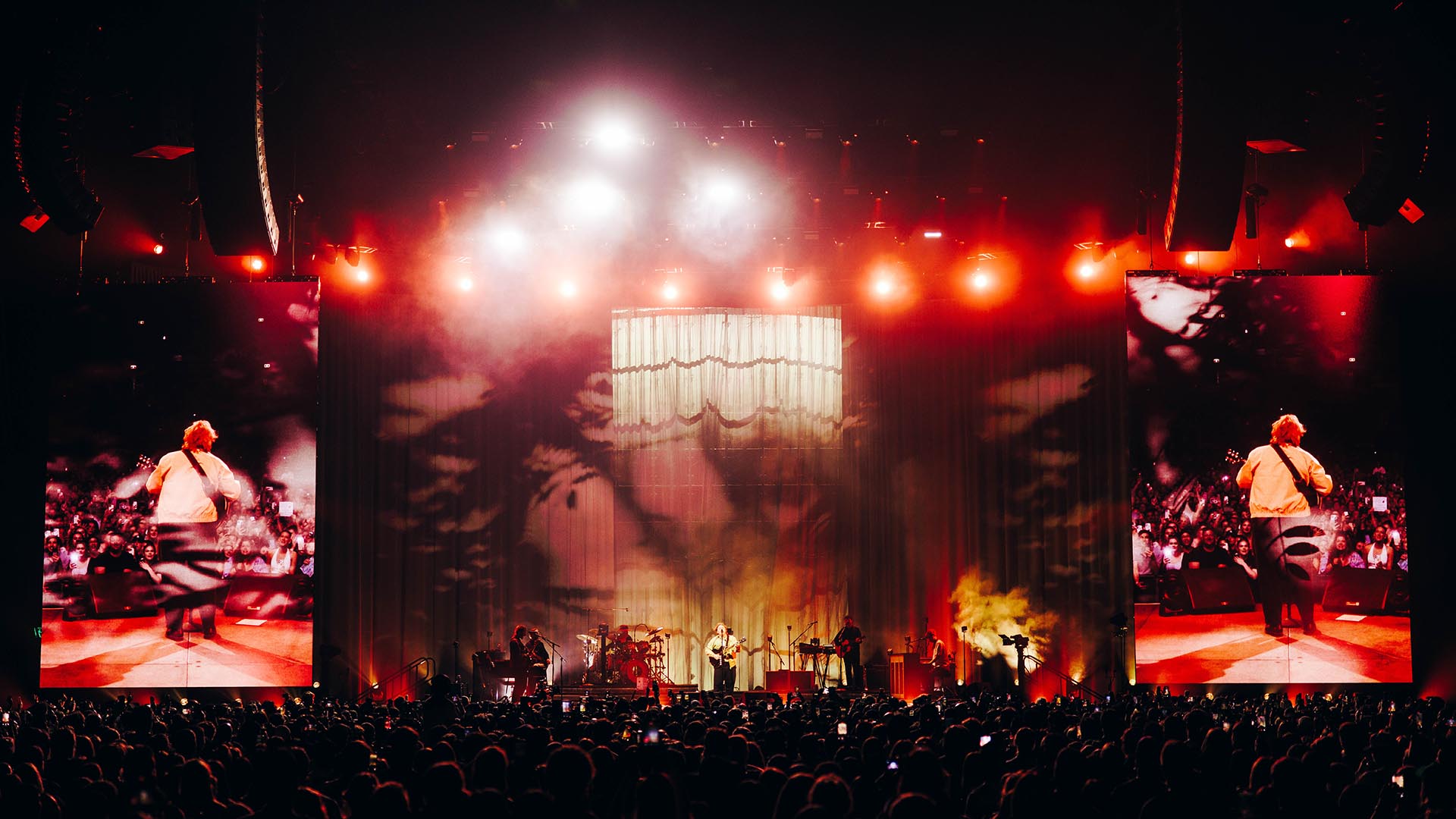
After two years away from the spotlight, global superstar Lewis Capaldi is well and truly back with a new album and tour. The first iteration of the show design for his Survive Tour premiered in the UK in September, and a couple of months later, it landed in Australia for a string of sold-out shows.
FOH Engineer Andrew Bush, who joined the Lewis Capaldi camp back in 2018, has also recently worked with James Arthur and You Me At Six.

It’s no surprise that mixing Lewis Capaldi is all about his vocals, but his personality also needs to come through.
“Obviously, his vocal needs to be at the forefront of the mix, and it needs to be intelligible at all times,” remarked Bush. “The quiet or whispered sections need to be heard, but also the louder sections need to be kept in check. Lewis, Aiden, the Musical Director, and the band have worked really hard to put together a stylistically wide-ranging show, with the set featuring everything from piano ballads to alternative and indie arrangements and upbeat pop songs – it’s an interesting and fun show to mix.”
For Bush, the key is getting the right balance between making the band as powerful and impactful as possible, whilst still keeping Capaldi in the pocket at the front of the mix for the whole night.
There are six onstage: Aiden Halliday, the MD, who plays keys and guitar; Freddy Sheed plays drums; Aidan Beattie plays bass and keys; Ciaran McEneny plays guitar and keys; Andy Black plays electric guitar and lap steel; and Capaldi, who also plays electric and acoustic guitar.
Since August 2025, Bush has mixed on a Yamaha PM5, having previously used Allen & Heath whilst touring with Capaldi.

“With Lewis returning last summer after a two-year break, it seemed like an ideal opportunity to try something different,” explained Bush. “I was always keen to use the RY16-ML-SILK ‘Rupert Neve’ input cards on this gig, along with the onboard effects, particularly the Bricasti reverbs and Eventide harmonisers. The increased channel count available on the Rivage platform was also a consideration, as it allows us to expand easily at any point.
“I like how straightforward the layout is, how easy it is to get around, and that every parameter of a selected channel is visible on one page. I am also a huge fan of the SILK processing on all the analogue input channels because I can really change the tonality of a source effectively without using any EQ. It’s something I miss when I use other platforms.”
Bush uses a wide selection of the console’s on-board plugins, including all his reverbs, which are mostly the Bricasti emulations and a couple of Yamaha SPX units. He adds an outboard rack housing a Fourier Audio transform.engine, a Rupert Neve Master Buss Processor and Rupert Neve Master Buss Transformer. Added to that is a Sonic Farm Creamliner stereo line signal conditioner, a Mäag Audio EQ4, an API 2500+ and a couple of Rupert Neve Tape Emulation Units.
“I use the Fourier unit as I used to use the UAD Live Rack platform,” elaborated Bush. “I used UAD for years but gravitated over to the transform.engine when UAD stopped supporting the Live Rack. On that, I have the main processing for Lewis’s vocal. I use Soothe Live to tame the resonances and sibilance in his voice, and I follow that with UAD 1176 and LA-2A compressors to even the dynamics out.
“Otherwise, I use the Fourier unit for compression and saturation on drum groups, and a bit more Soothe Live on electric and acoustic guitars where necessary.”

In terms of analogue outboard, the API and Rupert Neve tape saturation units live on the Drum Master, whilst the Master Buss Transformer sits on the Music Buss, with Bush noting that it holds the band in place nicely and adds some gentle EQ and colour. The Mäag EQ, Creamliner and Master Bus Processor are in a chain on the Mix Buss to add some EQ, depth, texture and a little bit of limiting if needed.
To capture Lewis’ huge dynamic range, a Shure KSM11 capsule on a Shure Axient ADX2FD handheld is deployed, and Bush remarks that it seems to handle anything thrown at it.
“I find it suits his voice well and the high gain before feedback is very useful, especially when mixing the quieter songs in big noisy rooms,” he added. “We’ve been using that quite happily for several years now.”
The drum kit is mostly DPA, except for the kick, which has an Audix D6 piggybacking on a Beta91. A DPA2012 lives on Snare Top, whilst a trio of DPA4018c takes care of ride, hats and snare bottom. Toms take DPA 4099 Extreme SPL, and a DPA 4011ER stereo set is used as the main overhead pair.
Bush says he enjoyed Qudos Bank Arena, saying that for such a large room, it’s not too ‘boomy’ and is fairly controlled. “I think it sounds quite direct. Thankfully, for the size of the room, it’s been quite forgiving.”
Bush’s preferred PA is a d&b SL Series with local audio provider JPJ Audio supplying for the Australian tour. With a d&b GSL system on the mains and KSL on the sides, they have aimed to replicate their FE Live UK touring package as much as possible.
Monitors
Monitor Engineer Chris Smart also used a Yamaha PM5 console, again switching mainly for a higher channel count.
“What I like about Yamaha consoles is that they are all very similar to operate,” remarked Smart. “If you’ve used one, you can use them all, which is good. It has some cool elements, such as the Bricasti built in, and others, like all the Neve stuff in there.

Smart uses Bricasti reverbs, the Master Bus Processor on the outputs, the SILK processing on quite a lot of channels and the Primary Source Enhancer.
“Running monitors for Lewis Capaldi is relatively straightforward,” said Smart. “They’re all easy-going guys, and super friendly. They know what they want, and they’re good at telling you.
“I think the most challenging part was probably getting it all going in rehearsals, starting from scratch, making all the files. Then I couldn’t do the UK tour, so I handed it over to someone else. The first gig in New Zealand was my first gig back.”
Onstage, there are a pair of d&b M4 monitors for Lewis, centred on the stage, and then there’s one at Aidan’s piano because there’s a song where Lewis plays the piano.

All IEMs are Shure Axient with Ultimate moulds, having used the PSM1000s before. Smart particularly likes the ShowLink remote control technology that allows him to make live, real-time adjustments.
“Being able to see the level that people are listening at is really useful because it means that I can set my pack to the same level, and then I know exactly what they’re hearing if I need to make changes or whatever,” he commented. “You don’t have to sync all the packs every day, which is nice. The ShowLink pushes the new frequencies to them, which is cool, and saves a bit of time. Also, if you need to change the frequency or anything like that, you don’t have to change the pack; you can do it in the software, and it’ll handle it for you.”
This article first appeared in the February issue of Lighting & Sound International
Show Photos: Christian Tierney