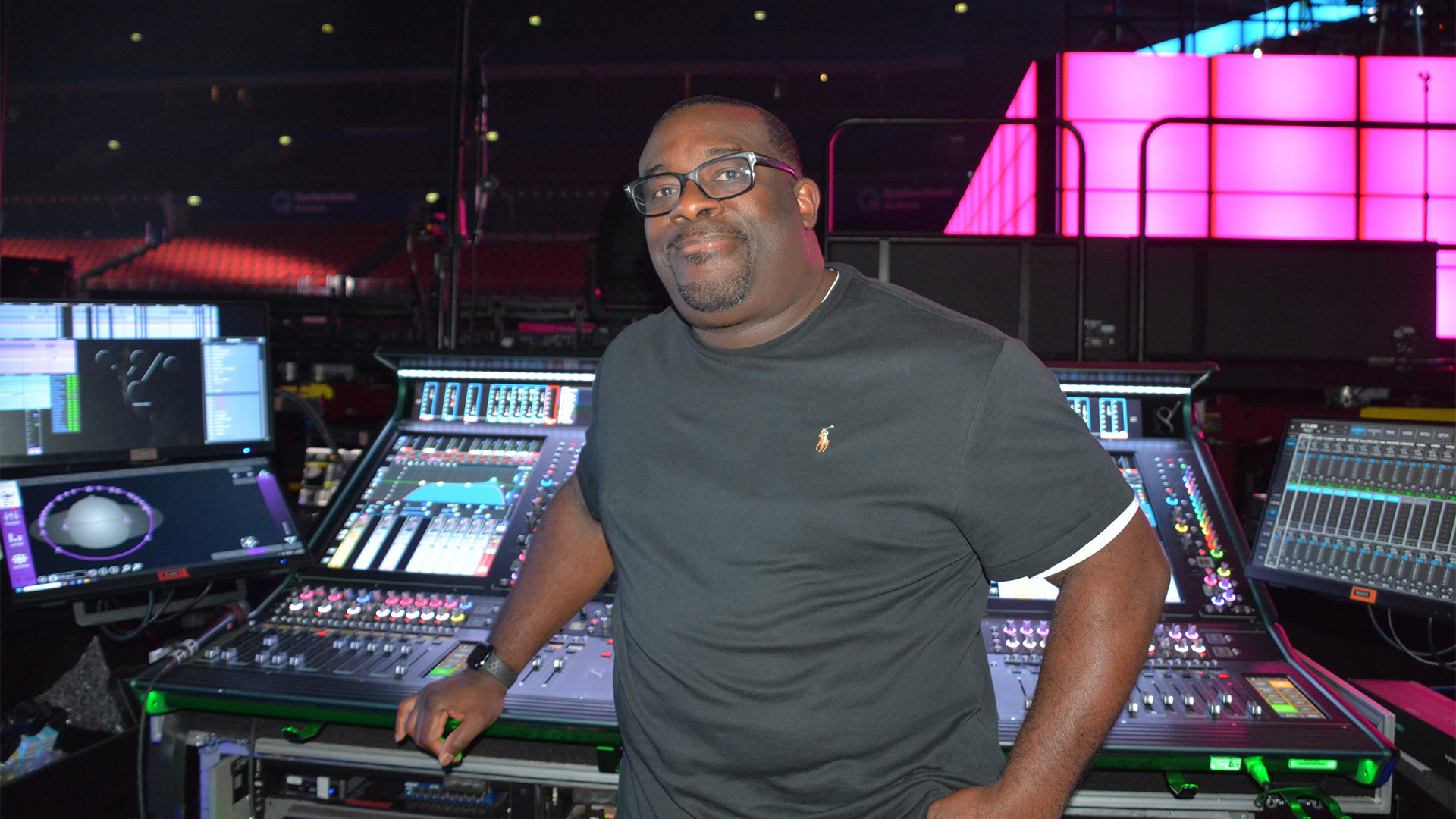
Kyle Hamilton has become one of the most sought-after FOH engineers in live music, having mixed for artists such as Kendrick Lamar, Janet Jackson, Rihanna, Pharrell Williams, Lalah Hathaway, Lionel Richie, and many more over his 32-year career.
“I’ve been blessed with being able to be in the music industry this long,” he opens. “I’ve had the opportunity to work with diverse artists like the Isley Brothers, Stevie Wonder, Prince, and now Doja Cat.”
While this marks Hamilton’s first official tour with Doja Cat, their working relationship dates back to 2021. What sets her apart, he explains, is the way she fully embodies each song she performs.
“The main difference working with Doja Cat is that she goes into character for whatever record she’s doing,” he explains. “Since they’re all different, they’re all versions of herself in that character. It’s like mixing several different personalities on stage.”
Despite the scale of the production and the energy of the crowd, Doja Cat remains deeply immersed in her own performance. “She’s just a character; she’s in her own space, even with 20,000 people screaming and singing,” says Hamilton. “It actually makes my job almost effortless because she leaves it all on the stage every night. She’s a true artist and extremely hands-on with pretty much every aspect of the show, from audio to video to pyro to lighting.”
That level of performance means adaptability is essential at FOH. With Doja Cat’s range of personas comes a variety of vocal dynamics and sometimes microphones throughout the show.

“She may give me an aggressive vocal one song, and the next song it may be more pulled back,” Hamilton notes. “It doesn’t make it tricky, but it does mean I have to pay attention to where she is on stage. All her records are very detail-oriented, and since she becomes a different character in each one, you have to stay on your toes and really pay attention to her.”
At the Sydney show, the production utilised an L-Acoustics K1/K2 PA system, a choice Hamilton was more than happy with.
“Doja’s music is low-end heavy but very musical at the same time,” he explains. “The K1 and K2 give you all the low end you need and then some, while still delivering the mid range so you can hearall the musical parts that make these songs special. At FOH, you’re going tofeel it; not just hear it.”
Despite the impact, the show is carefully controlled. “It’s not a loud show,” Hamilton adds. “We cruise around 98dB, and my peak may be 102dB. The audience, though, has peaked at 113dB, and they sing every song, word for word.”
Control comes via a DiGiCo Quantum 852 console, paired with an Avalon 737 for Doja Cat’s vocal chain and select reverbs through UAD Live. Hamilton also multi-tracks the show through a DAD AX64 interface, keeping processing minimal. “I don’t use a lot, I use pretty much everything on the desk,” he explains. “You’ve got a half-a-million dollar console; you want to use all of it. Otherwise, what’s the point? This band is incredibly solid – their programming, their sonic signature, everything is meticulous. It’s not my job to change their timbre. They’ve already built their palette. I’m just an extension of them. I repackage what they present.”

Vocally, Hamilton makes only subtle adjustments to help Doja Cat sit perfectly in the mix. “I cut a few select frequencies so her vocal cuts through the mix, but her tone is natural and crystal clear,” he says. “She really does sound like her record. That’s how she performs. The vocal chain is used sparingly, except when we’re doing parts that are heavy on Auto-Tune as an effect, just like on the record.”
Doja Cat uses a Shure Nexadyne capsule paired with Shure Axient wireless for her microphone. While her microphones are custom-built, they all utilise the same Nexadyne package.
The band consists of drums, key bass, keys, guitar, three horn players, and two background vocalists. On drums, Shure Nexadyne microphones are used across all toms and snares, with a Beta 91A and Nexadyne Dynamic Kick Drum Microphone on kick. Overheads are KSM 32s, with KSM 137s handling hi-hats and snare bottoms. The horn section uses DPA 4099 microphones, with remaining inputs coming from DIs or playback.
“There are more aggressive songs,” Hamilton concludes, “but overall, the sonic signature of the show is supposed to be big, not loud. It sounds massive, but it’s comfortable. It’s a pleasant feel. Nothing is overbearing.”
Monitors
Monitor engineer and account executive Jeremy Peters, of Clair Global subsidiary Sound Image, mixes on a DiGiCo Quantum 852, praising the company’s standards and support as unmatched.
“DiGiCo’s customer service is second-to-none,” he says. “Kyle and I are constantly in contact with them – not because something’s broken, but because we’re always sharing information back and forth.”
A long-time DiGiCo user, Peters was an early adopter of the Quantum 852, taking the console out before its official release.
“We knew it was coming and had to have it in our arsenal,” he explains. “This was before the Super Bowl, so we were really on the front line. We took it into rehearsals ahead of Doja’s Coachella performances and worked through things every day, ironing out bugs for the entire audio industry. At this point, there’s nothing anyone – or any situation – can throw at me that this desk can’t handle.”
For Ma Vie, the Quantum 852 handled 197 channels, with roughly 150 in use, including 32 channels of tracks via Dante through the Orange Box.

A key component of Peters’ workflow is KLANG immersive in-ear mixing, using Dual KLANG:konductor processors.
“I don’t like being limited in any way,” he reveals. “I never want to tell an artist no or hit a brick wall and think, ‘that’s it – I can’t do anything else’. The band loves it because it adds a new spatial element to the mix. I can place elements in space and run lower overall IEM levels. They feel great, play a great show, and protect their hearing.”
Peters also uses Waves effects, describing them as a flexible, consistent tool across all his clients. “My set-up and muscle memory never change,” he explains. “Things physically live in the same place, and I approach every showthe same way. What changes is scale. Maybe I need six ear mixes instead of 18. Maybe I need two microphones – or 50. But the placement, patching, and workflow stay the same.” A newer addition to his set-up is a 5.1 microphone used to capture crowd response for Doja Cat’s IEM mix.
Doja Cat’s wireless set-up is built around Shure Axient Digital and Shure ADPSM systems, paired with FiR Audio in-ear monitors.
“All her microphones are run in frequency-diversity mode and feature talk switches,” Peters adds. “She has a wide range of custom-wired and RF microphones – Chrome, Zebra, Leopard, and many more designs – but they’re all retrofitted with talk switches. If she needs to speak to us, she hits the switch, the mic mutes to FOH, and she talks directly into the ears.”
Because the entire system is networked via access points, Peters can communicate directly with the packs, change frequencies, monitor battery status, and send or receive settings in real-time.
“Almost everything – mics, ears, horn mics, and backline wireless – is running in frequency-diversity mode,” he said. “The software lets me see exactly what’s happening at all times.”
To ensure total reliability, Doja Cat’s microphone operates on two channels simultaneously, eliminating the risk of dropouts.
According to Peters, the result of his toolbox is an audience and performance mix that sounds like a finished record or a concert capture for broadcast – and that’s precisely what Doja Cat hears in her IEMs.
Show photos: Greg Noire
This article first appeared in the January issue of Lighting & Sound International