Written by Alastair Swanson
Opening
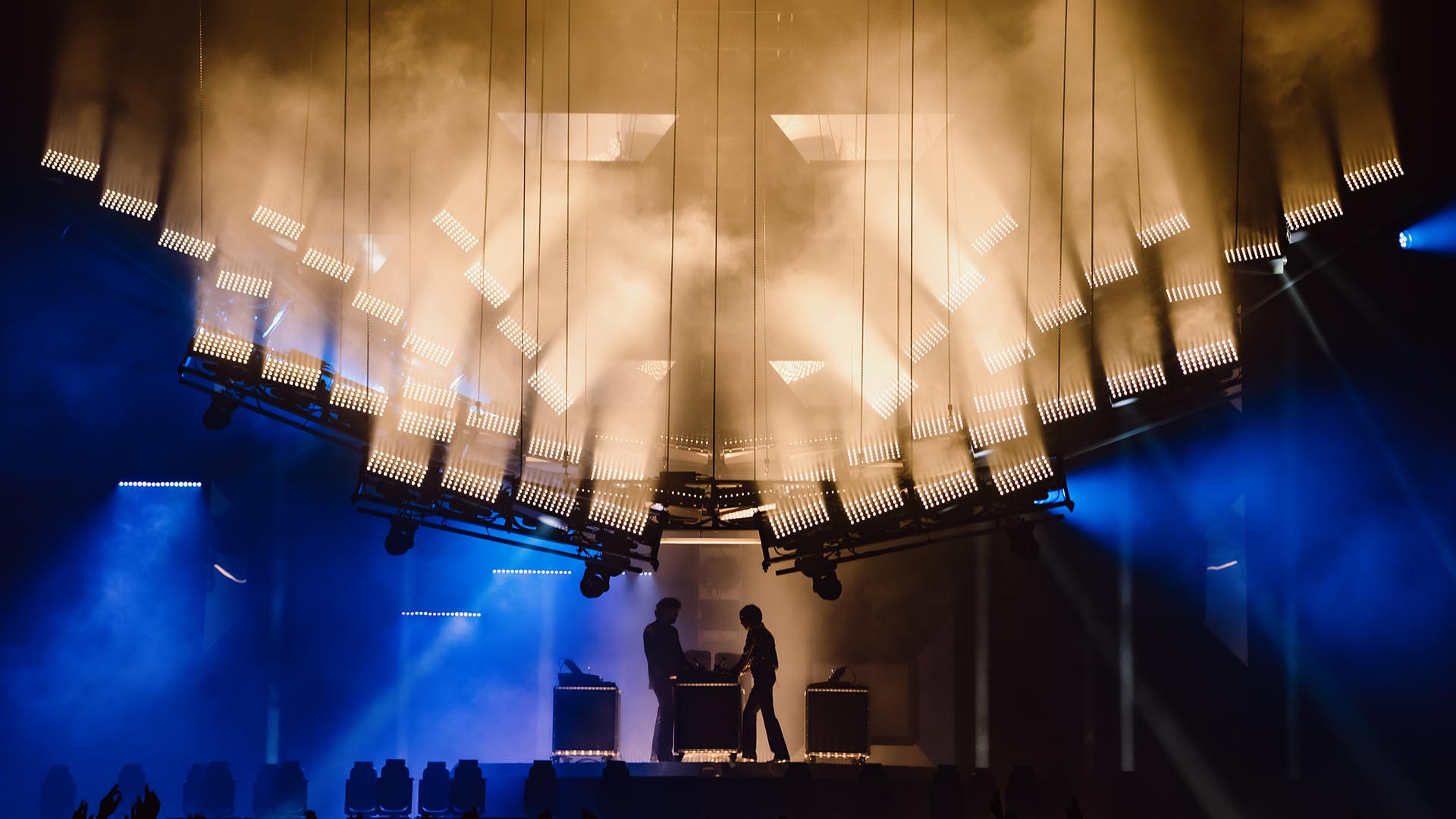
Walking into Qudos Bank Arena for Justice’s Hyperdrama tour, you’re immediately hit with the raw power of what custom fabrication can achieve. This isn’t just another arena show – it’s a masterclass in how purpose-built lighting transforms a production into something unmistakable.
Justice’s visual identity has been iconic since 2007: stark white light, graphic precision, and an intensity that’s uniquely theirs. But what most people don’t see is the custom fabrication philosophy that makes it work. I sat down with Lewis (Lerisson Vincent), Justice’s lighting designer since 2007, to talk about the production and the Mitobs a custom three-sided moving heads built from recycled VL2500 bases and why his team doesn’t require timecode on a 100+ shows tour.
This is a production where LED screens refuse to show traditional video. Where moving lights get completely reimagined into something new. Where the entire lighting rig is operated live, every night, without a single timecode cue.

Lewis: The Collaboration Begins
Lewis’s journey with Xavier de Rosnay and Gaspard Augé started by chance. “I met Justice during a show in a small venue, La Cigale. It was their first live concert, and I was working there as the venue’s operator,” Lewis explains. “They liked how committed I was and the relationship we built. Since we were about the same age, they asked me if I wanted to keep working with them and see where it could lead.”
That relationship became the foundation of everything including Justice’s distinctive visual signature. “We’ve been going with white since the first run,” Lewis explains. “We went with a white colour pallet from the very first round because that’s what the group wanted, so I followed that.”
This wasn’t just about aesthetics it was a creative constraint that would define Justice’s lighting identity for nearly two decades. “We agreed that we could use all the different shades of white,” Lewis says. The only exception? One track. “For ‘Stress,’ which has always been intense since the beginning – we thought that, since it was very powerful, red would be a good colour to highlight that piece.”
It’s this kind of restraint, this commitment to a singular lighting palette, that allows the custom elements to have maximum impact. When everything operates within strict parameters, the custom fabrication doesn’t fight for attention, it defines the show.

The Mitobs: From Concept to Moving Head
Justice’s visual language has always included special set, from their giant LED cross to triangular set pieces called Toblerones three-sided fixtures 1.8m long with 4 mounted in a frame that became a signature element of their productions. By the time the 2017 Woman Worldwide tour came around, the Toblerones had evolved into sophisticated units with LED, video, and mirror faces working together to create Justice’s distinctive look.
But it was for Hyperdrama that Lewis had an idea that would transform the concept entirely.
“I thought it was a shame that moving heads were sitting unused in rental warehouses,” Lewis explains. What if they could take the proven three-sided Toblerone concept and mount it on moving head bases and add pan as well? It was part artistic vision, part environmental conscience, why not give discarded gear a second life as something completely new?
Lewis brought the concept to Sébastien Sacco, his longtime collaborator and Groupe B Live project manager who had the mechanical expertise to turn the vision into reality. “Sébastien has been with us on tour since 2012. Technically, he’s operating at an engineering level – he’s extremely good with mechanics, electronics, and development, and he’s passionate about it.”
The challenge was clear: could they take Lewis’s three-sided concept and mount it on recycled VL2500 moving head bases? “Working with Sébastien, we developed a prototype, he built a prototype based on my initial concept using a VL2500 base. Since it worked well, we decided to present it to Xavier and Gaspard, who liked the result and approved using them on the tour.”

With B-Live’s fabrication resources behind them, Lewis and Sébastien brought the Mitob to life: a three-sided moving head with warm white high brightness LED pixels on one face, a video screen on another, and a mirror on the third. By mounting this configuration on a motorized base and yoke, they created something that’s never existed before a fixture that combines video, light, and reflection with full movement capability.
It’s not trying to be a traditional moving light. “When used in this configuration they have an impact that is versatile,” Lewis explains. “Creatively we don’t have any challenge with this project because we make the project for the show. Because it’s a 3-sided moving head and it’s our design we know it has what some people might say it has limitations such as not having any zoom or not having any colours and the video is just a small screen however we designed these for our strengths on the show.”
The Mitobs were purpose-built for what Justice needed, not what the rental market demanded. That’s the power of custom fabrication, the freedom to design for artistic vision rather than broad applicability.
The technical challenges? They exist, but they’re manageable. “Because the units are built from recycled parts, they can be a little temperamental but Sébastien knows them extremely well as he built them but when you’re touring a rig even with moving lights that are hire stock you see about the same amount of issues. So for us it’s normal to have an issue out of 10 or 15 shows but it’s not caused us any real problems.”
Sébastien tours with the production, ensuring the custom units run smoothly. It’s the kind of commitment that only makes sense when the gear is so unique.
Design Philosophy: Real Over Virtual
Lewis’s approach to designing the show is as dedicated as the gear he builds.
“I use WYSIWYG as I’ve been using it for a long time and I like it but that’s just for the plot” Lewis says. For the actual programming and design testing? “We’ve tested Depence for doing visualisation for the show but we’ve found we get better results by testing the rig in a space. 3D visualisation just isn’t the same as being there and seeing if something aligns.”
This is especially critical for a show built around reflections. “We also work a lot with reflections, one of the sides of the Mitobs is a mirror as well as the back wall having a lot of mirrors so being able to see how light behaves in the rig is really critical.”

Even more radical: the entire show is busked. No timecode. “The entire show is busked, we don’t use any timecode at all. Because we know the music and we all work together as a team and we’ve been doing this for a while we can work in sync.”
Lewis’s automation operator Adriane runs the Mégaoctet servo system mostly from memory after 100+ shows. “At the beginning of rehearsals I tell my team you have to listen to the music and know the music well.”
The design process itself takes 4-6 months of collaboration between Lewis, Xavier, and Gaspard, followed by another month of technical review with tour manager Manu, then 6 months of manufacturing. It’s a year-long conversation that results in something that can’t be replicated in a visualizer.
“Xavier and Gaspard will come and look at what we’ve been able to create with the rig and see how they feel about the looks and versatility and I’ve found with them and other artists that seeing something in person has far more impact than on a visualiser, at least in my experience.”
The Sydney Show: Adapting Without Compromising
Bringing the Hyperdrama production to Australia meant compromises, but not on vision. “We have changed the whole kit, it’s not the same on Europe and the US,” Lewis explains.
In Europe, the floor package uses Starway Baracca fixtures with laser sources. US regulations force a swap to Robe Megapointes. For Sydney? “We couldn’t get megapoints for the show.” The solution involved bringing three trusses of core equipment—including the Mitobs and automation—while sourcing JDC2 strobes, wash units, and beam lights locally.
“The wash units are only for the audience, it’s not a really good step for the show and we have the beam and the beam is different because they don’t have the number we needed.”
But the core vision the Mitobs, the mirrors, the white light philosophy travels intact. It’s a reminder that custom fabrication isn’t just about what you build, it’s about building the things that can’t be compromised.

Closing
What makes the Justice production work isn’t just the custom gear – it’s the design team that understands how to use it. Lewis credits his production team who’ve been with him for years: “They understand the way I work and that I can come up with a vision in my mind and communicate that easily with them. From there they take the parts that they’re good with and understand well such as kinetic systems or video and they work out the possibilities of the design with the elements they understand.”
It’s a reminder that custom lighting isn’t just technical, it’s relational. It requires teams who’ve worked together long enough to communicate in shorthand, to trust each other’s instincts, to build something that doesn’t exist yet.
“The fact that we work so well as one unit is really rewarding and makes everything happen so easily.”
An amazing show like this wouldn’t happen without everyone.
Production: CORIDA
Management: ÉTENDARD MANAGEMENT
Photos: Ashley Mar
Gear List
Flown local hire:
18 x JDC1
10 x Martin MAC Aura XIP
21 x Chauvet Colour Strike M
30 x Ayrton Rivale Profile
42 x Martin Sceptron 10 1000
28 x Chauvet Rogue Outcast 2x Wash
Toured:
34 x Tetra 2X
12 x Prolights EclPanel TWCXL (48 Pixel Mode)
56 x MiiTob
16 x Elidy-Big
Floor package local hire:
10 x GLP JDC1
40 x Ayrton Rivale Profile
Alastair operates Light Innovations Pty Ltd, a Perth-based lighting design and installation company specialising in custom fabrication, custom LED systems, and innovative lighting solutions for events, venues, and permanent installations. With a background in engineering and custom electronics design, he builds bespoke lighting solutions from the ground up, from prototype development and 3D printing to full-scale fabrication and technical integration.