Doja Cat’s Ma Vie World Tour kicked off in New Zealand before arriving in Australia for the artist’s first-ever arena run across the country. When she burst onto the stage at Sydney’s Qudos Bank Arena, she did so in full theatrical mode – big blonde hair, a leopard-print bodysuit and purple leggings setting the tone for the retro-themed staging.
Backed by colourful blocks of light and a live jazz band, the show unfolded as a glossy, ‘80s-inspired pop-rock spectacle.
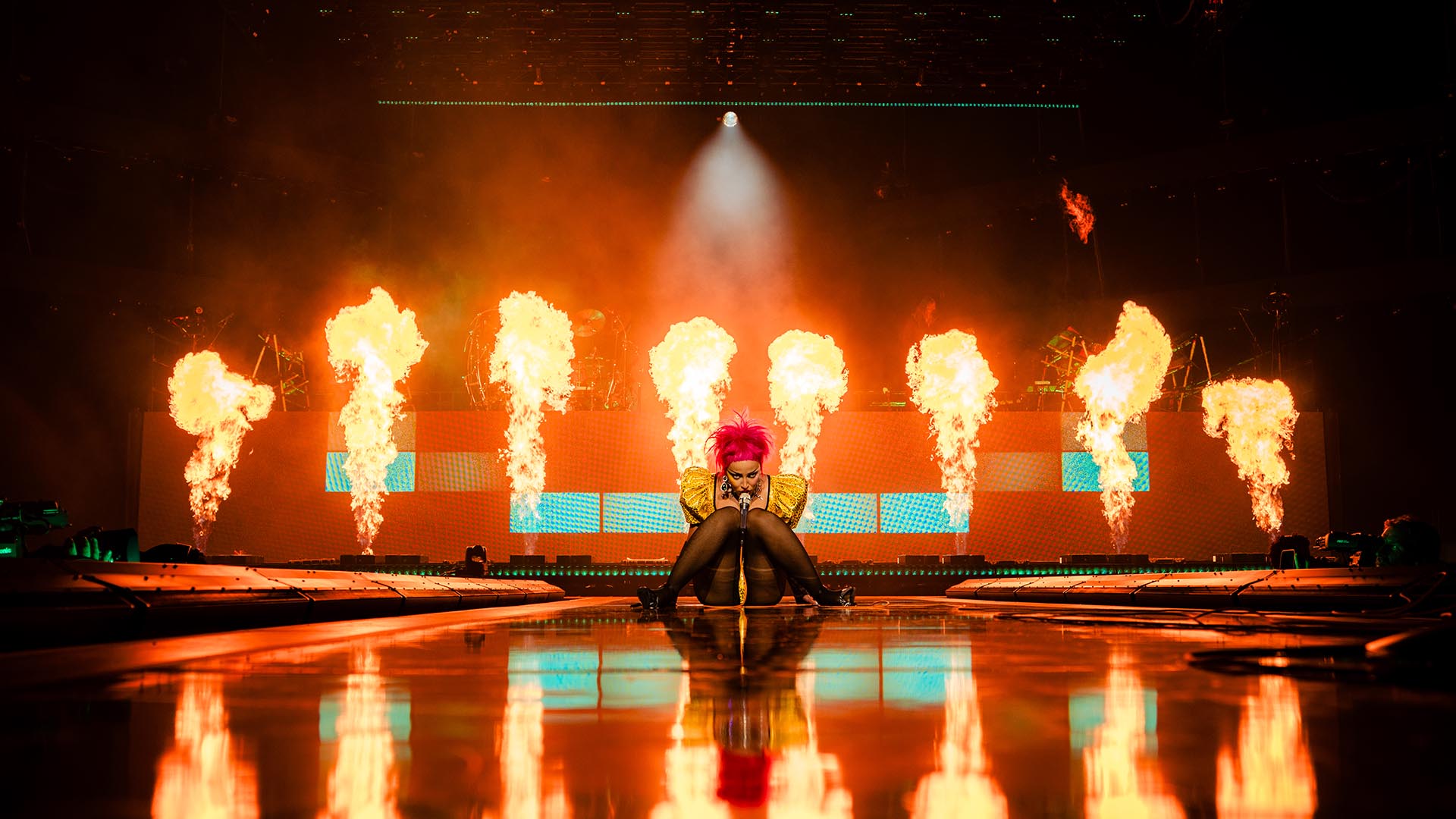
The drama didn’t stop with the aesthetics. Flaming pyrotechnics, bursts of fireworks and even Doja Cat casually eating a fan’s poster mid-set underscored her commitment to spectacle. With her genre-hopping sound and slick performance style, Doja Cat proved she’s a force to be reckoned with; not just headlining arenas but commanding them.
VISUAL DESIGN
The tour’s visual direction is spearheaded by Silent House’s Parker Genoway, who acts as creative producer alongside his roles as lighting and production designer, with Tyler Santangelo overseeing lighting programming. Genoway’s relationship with Doja Cat began in 2021 during the Planet Her album campaign and has since evolved through multiple tours and two high-profile Coachella performances. He credits creative director Brett Alan Nelson with bringing him on board to help translate Doja’s bold creative instincts into a large-scale arena production.
For Doja’s first tour across Asia, Australia and New Zealand, the team set out to create a show that introduced her latest material while ensuring a balance of established hits for markets where many fans would be experiencing her live for the first time.

“Given the constraints of fly dates, the production was intentionally streamlined, with all larger elements sourced locally,” explains Genoway. “Even so, Doja needs nothing beyond her extraordinary talent and undeniable charisma to deliver a truly epic performance.”
That approach required a stage design flexible enough to be executed seamlessly across a wide range of territories, while still delivering a custom, elevated look befitting an artist of her calibre.
Elements such as flame effects and pyrotechnics posed challenges, as different regions require different products and legal standards. However, thanks to meticulous advance work by special effects designer Nick Arnold and his team, the execution has been nothing but safe and successful throughout the tour.
The standout element of the show is the light cubes inspired by a Gary Numan show from the ‘80s, as Genoway explains: “His use of bold primary colours and simple geometry proved incredibly influential and helped keep us within a clear, focused design framework. Rather than building complex 3D environments or heavily animated content, we committed to a single Notch block throughout the performance, developed by Blink in collaboration with Michael ‘Hank’ Hankowsky.
“Hank crafted stunning visual sequences alongside Tyler Santangelo, who developed the lighting, and together this dream duo created something truly special from an intentionally minimal structural set. Instead of traditional light boxes, as Gary Numan might have used, I opted to reference the look using locally sourced video tiles.” Genoway’s approach to the lighting design for Ma Vie was intentionally straightforward: expansive grids of large, washy fixtures that could be easily swapped out for comparable gear across different markets. Meanwhile, Santangelo led the lighting advance, meticulously reviewing each available fixture to ensure compatibility with the programming that had been developed in Los Angeles.
“While certain elements were highly specific – such as ground-controlled followspots – others remained flexible thanks to a deliberately minimal programming style, free of gobos and unnecessary complexity,” Genoway adds. “The vibrant, colour-saturated aesthetic was driven by a fully LED rig and a consistent fixture palette, designed to complement the clean, structural video language of the show.”
LIGHTING
Lighting director Chris Da Silva says he enjoys the flexibility of the tour’s lighting rig, noting that it’s rare to see a show that is primarily wash-heavy, with Martin MAC Auras serving as the central focal point.

The original lighting design called for 144 MAC Auras split between the overhead pod and the ribbon trusses. For the Australian leg, some fixture substitutions have been necessary: MAC Aura XIPs take on the Aura roles across the pod, while MAC Ones are used on the ribbon trusses. Profile fixtures include Elation’s Proteus Maximus, with 34 Elation DTW Blinder 700s on the downstage truss providing audience lighting. GLP JDC Burst 1s are positioned on the stage floor, while Chauvet Professional COLORado PXL Bar 16s line the downstage edge, thrust, and backlight the band.
Da Silva shares that his main challenge on the tour is maintaining consistency while working with a wide range of lighting inventories, as the production is not travelling with its own lighting package. “No matter which different fixtures we have available in every country, my priority is to deliver the designed show as best as possible,” he explains.
The show also utilises five Robe iForte LTX FS RoboSpots – two flown above the FOH position, two mounted on the downstage truss, and one rear spot upstage.
“RoboSpots are pretty much the go-to for touring key light,” says Da Silva. “Having colour, intensity, and shutter control from the desk really allows the spot operators to fully focus on following the artist. This is especially critical when travelling to countries where I need a translator to communicate with spot ops; it helps keep spot calls short and simple.”

According to Da Silva, lighting plays a significant role in shaping the show’s narrative, guiding the audience through different musical eras – from the ‘80s-inspired aesthetic of Doja Cat’s latest album, to her biggest hits. “The lighting is driving a lot of the storytelling,” he says. “I also love that the video content on this show moves away from traditional background imagery. Our programmers, Tyler (lighting) and Hank (visuals), were very intentional about having both elements playing together or deliberately contrasting to accent the musicality of the show.”
Two MA Lighting grandMA3 full-size consoles provide control for the tour. “MA3 is not only more powerful for programming, but it makes my job easier delivering the show every night,” Da Silva adds.
Chameleon Touring Systems supplied lighting equipment and crew throughout the Eastern Australian run.
VIDEO
Not only does this show have a flavour unique to Doja Cat and her own unconventional approach, but it also challenges the idea of a typical touring video rig.
“Many of the visual elements are reminiscent of shows from the past, evoking a tasty vintage video seasoning that complements the rhythm of the lighting rig,” shares Rebecca Gerhard, video operator and Disguise engineer on the tour. Gerhard is kept busy maintaining the system that interconnects the cameras and the screens on the road, in addition to making live adjustments from FOH during the show each night.

“I make sure that the show looks as close to the original vision as possible every night, despite how different the room may be,” she says. “Unlike your typical Disguise-driven show, this video content is actually mostly generated and completely driven from the console itself. It’s the brainchild of Michael ‘Hank’ Hankowsky and Parker Genoway. Notch blocks built by Blink drive the rest of the video creative. For example, if you look at the timeline in [Disguise] Designer, you can see the whole show runs in one track. But if you go to the console side of things, there are separate cues for every instrument, every little boop and bop. This musicality is where the magic really happens.”
Rather than having pre-animated content that was rendered and then uploaded to the servers, Gerhard has intangible ‘lighting fixtures’. These fixtures generate DMX information, which is programmed and timecoded in the console via Sockpuppet.
Essentially, she explains, timecode hits the desk, the desk fires sequences and cues in grandMA3, and Disguise feeds the screens. “The visual elements of the content dance in tandem with the lighting rig, so it only makes sense to treat the video as another fixture. This paradigm has changed my perspective on what’s possible when video and lighting intentionally paint one cohesive picture.”
As with her fellow creatives, Gerhard’s biggest challenge each night is ensuring everything in the show is consistent. From IMAG to colour balancing, the sweet spot is in the details. Fortunately, Hankowsky has built the show to give her all the tools to do so, and Fuse Technical Group has provided top-of-the-line infrastructure to support the creative.
“From load-in to load-out, I am thrilled to be a part of building this brilliant marriage of modern tech and classic aesthetics,” she concludes. “The Ma Vie tour is a treat, both from the eyes of an artist and the mind of an engineer.”

SPECIAL FX
The show features flame effects, pyrotechnics, and confetti, and the special effects team consists of Raefn Webber, the tour’s special effects crew chief, and Connor Jordan, another operator. Both work for Strictly FX with a local Australian company, Show FX, providing crew for the tour and delivering and setting up the pyro, as well as the equipment used in Australia.
Most flames and pyrotechnics are combined and directed at the show’s central section.

“There are about four or five songs close together in which the flames and the pyrotechnics are used to complement each other,” says Webber. “Then obviously we’ve got a big hit of confetti right at the end, which is always a crowd-pleaser.”
Ultratec Special Effects is the main manufacturer of the pyro for the show, utilising over 400 pieces, which is a significant amount for an arena stage. “We’re looking at 50 pieces per board across eight boards,” explains Webber. “It’s busy and keeps us on our toes during the show, but it’s a really, really good look.”
A grandMA3 light controls the flames and confetti, and the show is completely timecoded, so Webber and Jordan can focus on safety and ensuring the show runs smoothly.
“For pyrotechnic control here in Australia, we’ve been using an excellent system called FireOne. We use it a lot in the US and in Europe, and we’re pleased with it. It’s really solid, and it also runs on timecode, which gives us a lot more time to spot and address safety issues if any arise. It also makes sure the show is the same every time and everything fires at the correct timings with other departments.”
Show photos: Greg Noire
This article first appeared in the January issue of Lighting & Sound International