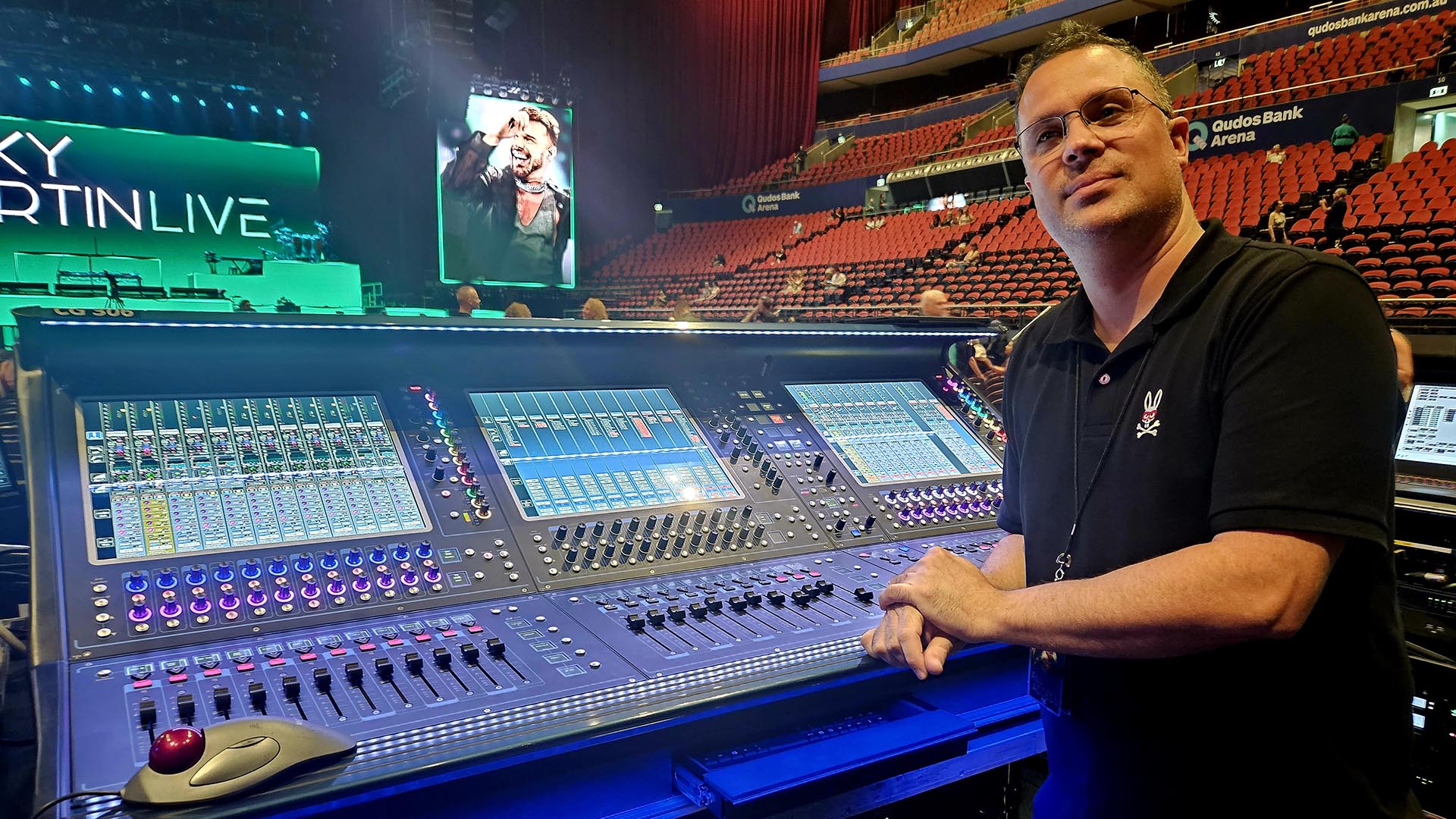
More than just a concert, Ricky Martin Live 2025 was a celebration of his enduring legacy, proving once again why he remains one of the most electrifying performers in the world.
Jorge Frontera (pictured above), Clair Puerto Rico employee and Ricky Martin’s FOH engineer for several years, was utilising his preferred L-Acoustics PA, comprising K1 and K2 with KS28 subs. The main hangs were 12 x K1 with 4 x K2 downfield. On the K2 for downfield, he used the pan flex at 90 as Ricky does more than half of the show out on a runway.
The side hang was 16 x K2 per side, and for the 270 hangs, there were 12 x K2. Added to that, there were 24x KS28 subs on the ground and 6 x K1 subs per side flown. Front fills were all KARA.
“What I like most about the L-Acoustics PA is the tone, and that I can get what I want really fast,” elaborated Jorge. “Also, the pan flex that I mentioned, for me, it’s a really good PA.

For control, Jorge used a DiGiCo Quantum 338 with two 32-bit SD Racks, which he has been using for four years.
“I really like the Quantum processors, I like the Spice Rack and what I really like ultimately is the DiGiCo Quantum Mustard Source Expander, which is really good to clean the noise and background stuff. I also have Shapshots running by a timecode so I don’t have to click next.”
Outboard-wise, he’s using Waves Soundgrid plug-ins with two Extreme Servers in the system. A Rupert Neve Master Buss, Lexicon PCM 91 digital reverberator, Shelford Channel and 5045 Primary Source Enhancer for Ricky’s vocals are also used.
“From the console I am using just the regular reverbs for background vocals, for drums, for guitars, brass, and percussion,” explained Jorge. “On Waves, I’m just using a reverb and a delay for Ricky.”
Jorge adds that Ricky sometimes sings really low, then goes from 10 to 100 in no time. Consequently, Jorge uses a C6 multiband compressor at the end of the vocal chain to control the dynamics.

Ricky uses a Sennheiser SKM 6000 microphone with an MM435 capsule, which provides greater noise control. Almost all of the wireless is connected to the SD racks by AES.
“We are sharing racks, so we don’t have any splitters right now,” said Jorge. “And that’s something that is really good for us because the setup is really fast.”
Jorge states that his biggest challenge is usually the truss placement, as it can be quite low in places.
Eduardo Martinez has been Ricky’s RF Tech for the past five years, and he says the RF spectrum in Australia is great, especially compared to Puerto Rico, his home country.

“We can only use 470 to 608 megahertz in the US, but here the range is 520 to 698, so we have more space to work, and it has been very clean in all four cities, actually,” he said.
While Ricky uses Sennheiser Digital 6000 for his microphone with an MM435 capsule, everything else is on Shure Axient Digital.
“Basically, all the brass, guitars and background vocals are using Shure Axient for their wireless microphones,” commented Eduardo. “On in-ear monitors, we had been using Shure PSM1000 for a few years, but we have tried out the new ADPSM on a few shows, and we are sticking to it for now. We mostly run 24 channels of wireless microphones and 16 in-ear mixes, and we also have three musicians and a playback engineer who are on P9HW, so that’s why we can get by with only 16 mixes.”
All the packs with the new Axient Digital and ADPSM systems are connected to the software via ShowLink, so Eduardo can control all the body packs from his computer, monitor the RF on each body pack, and even the battery levels.


“If they have their headphones connected to the in-ear bodypacks, I can see all of that from my computer with this new system, and also on the bodypacks transmitters, I can control everything on the microphone from my computer and change any gain or frequency if I need to live at the moment.”
Eduardo is using the Owon HSA spectrum analyser because it’s quicker and way more precise, so he can easily fine-tune everything.
“Apart from my personal gear and the custom colour handheld mics for Ricky, JPJ Audio supplied us with everything, and it’s been really great working with them; they definitely did make our work easier on this tour,” he commented.
Adolfo Velez was running monitors, covering for Ricky’s usual monitor engineer, César Benítez Seilhamer. He has worked in the Ricky camp for three years, and when he is not doing monitors, he helps with staging and pre-production.

Everybody is on ears with Klang immersive audio in everybody’s mixes. Adolfo says that Klang gives you unlimited dynamic range.
“If you have only left and right, you only have two sources where you can keep adding things to the mix, and at some point, you’re going to reach that threshold where there’s not much you can add before clipping,” he said. “But now, instead of panning left and right, you pan at 360 degrees. You’re not adding a constant level at any given frequency on the left and right, so you have a broader range, everything can be at a lower volume, and you are still going to be able to hear it because it’s not saturated.
“I have a little bit of Waves, but not too much, it’s just to help clean some of the dynamics with the PSE. Now with the Mustard in the new Quantum update, you almost don’t need it in monitors.”
The camp has used DiGiCo Quantum 5 consoles for quite some time, choosing them for their channel processing and mixing.
“We have 48 stereo mixes across the board, ” said Adolfo. “The drummer has his own Klang controller with six or eight mixes that are stemmed together, and then he mixes that. So we’re taking advantage of the Konductor in this matter, where I can create eight or 10 different spatial mixes for him to play alongside. Then he’s able to cater to his mix, but it’s all immersive. Effects, returns, it’s a lot going on. It’s over 120 input channels across two SZ racks, plus playback, and you need the faders and processing. Another thing is that the Quantum 5 has five banks, five layers in each bank, so it gives you another set of instruments in the same bank that you can mix, and you don’t need to change.”

Adolfo remarks that his main challenge is dealing with a bleeding noise in the arena. For example, when Ricky is singing ballads, he needs to open up the microphone dynamics more because he sings at a lower volume, which bleeds into everyone else’s mix.
“Other than that, it is a great show as everybody’s very chill, the musical director runs everybody very well, and it’s a well-oiled machine at this point,” he added. “I just come here to do what’s already been done and take care of every little musician detail that they will request. It’s kind of straightforward at this point.
Microphones include Earthworks on drums and percussion, DM20s on the toms, DM6 on the kick out, and, of course, always a Shure Beta91 on kick in. Neumann KM 184s on overheads, AKG 451s on the hi-hat, and DPA 2011s on the snare.