Who are you?
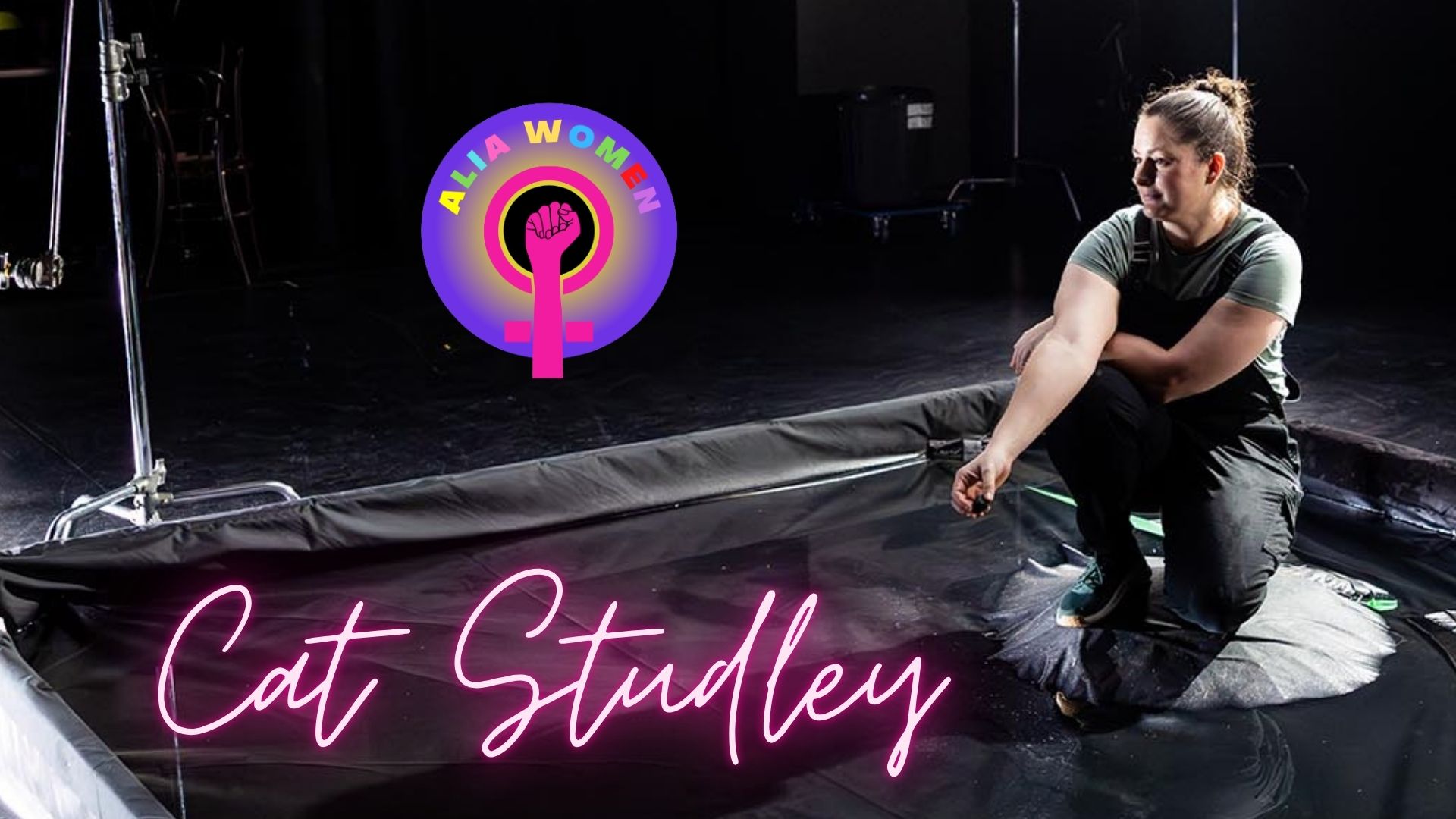
My name is Cat Studley, and I am currently the Production Manager for Bangarra Dance Theatre, based in Sydney. I moved to Sydney about 13 years ago, from a small country town on the Northwest Coast of Tasmania and have been working in the industry for around 10 years.
Describe the work you do
As Production Manager, I wear a few different hats, depending on what we’re doing and where we are.
During pre-production, my job is to help the creatives go from vision to reality. I work closely with our creatives and heads of departments to ensure everything is tracking as it should. I manage the budgets, the schedules, and the set builds. I work closely with our set and props builders to ensure we uphold our values, particularly around Care for Country.

Whilst touring, I oversee the bump-ins and bump-outs, collaborating with our teams to ensure everything runs on time. I collaborate with our tech teams to take notes and implement actions, and also identify potential issues before they become problems.
We often have other things in the works, such as corporate performances, photoshoots or even just future shows and tours. I work on all of these (creating plans, schedules, tech specs, logistics, truck packs, etc).
On top of all that, I also serve as the backup during shows in case any of my team members are unable to perform. Recently, I ran the backstage wardrobe plot for a couple of shows, as our Head of Wardrobe was unwell. It’s definitely not a slow or boring job!
But at the core of my job is to honour the integrity of the story and the quality of the creative elements of the shows. To honour the traditional practices that we’ve been gifted and ensure that every venue and every performance maintains that same level of excellence and care.
What led you to your current work?
I grew up doing a mix of dancing, acting and running around on the farm. When I left high school, I wanted to be an actor, and therefore I completed a Bachelor of Contemporary Arts at UTAS. In my first year, I realised that everyone else was much better at acting, so I shifted to backstage work. I moved to Sydney to complete a Bachelor of Dramatic Arts (Production) at NIDA. After NIDA, I bounced around various companies before landing at Darlinghurst Theatre Company as Production Manager, where I stayed for around two years.

When the role came up at Bangarra, I knew that I had to apply. It was 2018, and I had recently been to the Drama Theatre at the Sydney Opera House and watched Dark Emu and knew that I wanted to be involved in a company that created such vibrant work onstage. I was enthralled by the idea that performance holds more significance than what we see on stage.
After a gruelling interview with Stephen Page, I walked away thinking I didn’t get the role, but was very pleasantly surprised when I received the phone call to ask when I could start. It’s been 7 years, and I still love all that I get to be a part of with Bangarra.
What are you working on now or about to start work on?
Bangarra is currently on our National Tour, with Illume. We’re currently in Brisbane at QPAC, before heading to Darwin and Melbourne.
Illume has been a really amazing project to work on. I was lucky enough to sit in on creative meetings from the start, where they come up with these unbelievably wild ideas. Then I got to work through how we make them become a reality onstage. It has been one of the most collaborative works, with each creative, crew member and dancer having a seat at the table. I think you can really see this in the end result, with each layer in each department really helping to bring the story to the front.
What are the good things about your job?
There are so many good things about my job. In my 7 years with Bangarra, I’ve helped to create and tour over 20 productions. I’ve been lucky enough to go to every state within Australia, as well as overseas to India, Japan, Canada, America and New Zealand.
But really, the best parts of my job are the smaller things; working with emerging creatives on their works, mentoring our production trainees, doing the corporate events, the photo shoots, filming of short films, etc. The chaos and creativity of these events are beyond what we do on a day-to-day level, and they really mean we can push the boundaries.
What are the worst things about your job?
Regional touring is particularly gruelling. Bangarra is very ambitious with its regional touring, with shows that most venues consider to be too big for their stages.

In regional venues, you’re also often working with a limited crew. Normally, there is a selection of very good crew members who are across all departments. However, this often means they’re trying to fix something for Sound when Lighting really needs them to fix something else, making it a juggle to get all the jobs done. Within the Bangarra team, we often work across different departments to get everything done. I’ve had our Head of Wardrobe up ladders focusing lights, or all of the Stage Management team rolling up the dance floor – and I couldn’t be more thankful that we’re a team of people who “just get in and get it done”.
We also work on a schedule of:
Day 1: bump in
Day 2: bump in/ show/ bump out
Day 3: travel to next venue
Day 4: bump in
Day 5: bump in/ show/ bump out
Day 6: travel to next venue
Day 7: day off
Rinse and repeat for around 3-4 weeks (depending entirely on which state we are in). These are 14 – 16-hour days, plus often driving on the travel day, so you can imagine it’s physically and mentally tiring.
What, so far, has been your career highlight?
Bangarra has a process called the Cultural Life Cycle of a work. This ensures that we work with the communities that the stories come from, to uphold the integrity of their values and stories. The last step in the Cycle is to return the work to Country.
On a Return to Country, we spend the week in the Community, teaching workshops, learning cultural practices, and at the end of the week we put on a free performance for the community, often on a basketball court or in a school hall, where we also host a community BBQ and often have local students perform before the performance.
We strip the performance right back to its bare basics, just a backdrop, some lights on the ground and some speakers on stands. But to watch the children in the front rows, (or running around backstage), is one of the most magically moments of my life.
What is the most blatant example of sexism you have encountered at work?
When I was talking to my team about this question, they reminded me of some really strong contenders. From standing in a group of men in venues who directed questions to other men on my team, when it was obviously a question only I could answer (thankfully, the men in my team didn’t stand for it). To go to specialty stores for specific items/ tools and getting told I should “check with my husband if he has one in his toolbox at home and he can help me do the thing I needed to do”. Or watching a table full of male creatives ignore the requests and suggestions of a female director.

But I thought I’d tell you about the time, in a “mainstage” venue, that we had multiple male mechanists treat our female Head Mech with disdain. We were a full female/ non-binary touring crew. Across bump in and tech, there were numerous micro-aggressions, frequent back chat, and many grumbling in corners. This culminated in one of the mechanists being taken off the show, following a particularly aggressive and physical act backstage (they threw a ladder in front of our then ASM, Head Mech and myself, which was placed in front of a fire door by one of their team, but we got blamed for it) and then yelled at our Head Mech when they were trying to check in at the end of the day. Despite this person being taken off the show, the remaining mechs were hostile for days (including their male Head of Department saying, “there are two sides to every story, I don’t believe he would have done that”, despite multiple witnesses).
I’m happy to say that since then, we’ve seen a distinct change in culture in that venue, but it took multiple years of complaints to get there.
What advice would you give any woman considering a career in the entertainment industry?
In the last couple of years, Bangarra has been touring with a full female/ non-binary crew, and the number of people who are shocked that we’re better at it than most fully male teams is frankly disheartening.
It’s hard; it’s physically and mentally gruelling. You will have to miss family events, regular commitments, and choose between your family (or even a dog) and pursuing your career.
Then at the end of the day, people are going to constantly question you and be surprised at how good you are at your job.
Just the other day, I had a venue crew member compliment me on how good I was at my job (and how nice it was not to have someone yelling at them all the time).
By constantly surprising them that you are damn good at your job, that you can be strong and yet be gracious and kind while doing it, you beat them at their own game.
What is your career goal?
My current career goal is to transition out of touring as much as I am currently. I’ve loved being able to see Australia and the world, but I’m getting to a point where I’d like to have a more stable home life and to get a dog.